Antique Staffordshire Red Transferware Teacup & Shaped Saucer c. 1890–1910
Viridian Eclection


The Piece A richly detailed red transferware teacup and shaped saucer, likely Staffordshire, England, c. 1890–1910. The set features a romantic riverscape scene—figures in a boat, turreted architec...
The Piece
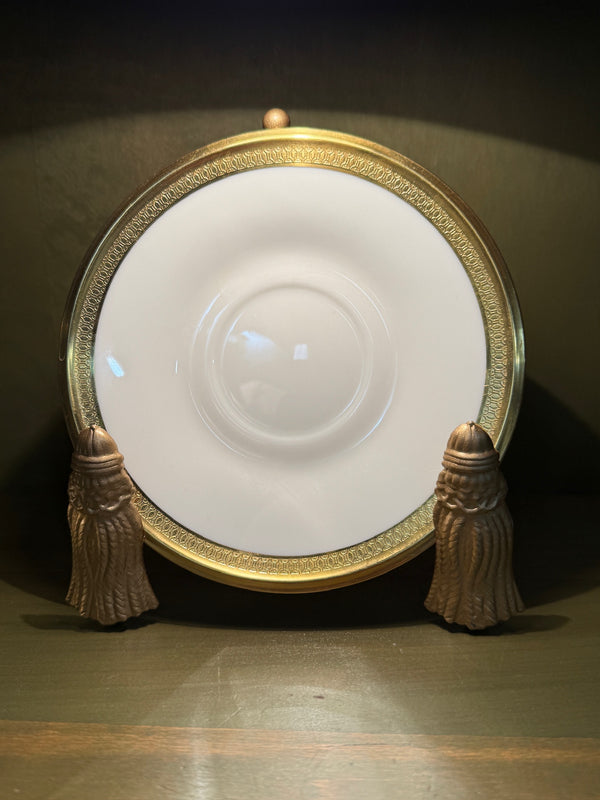
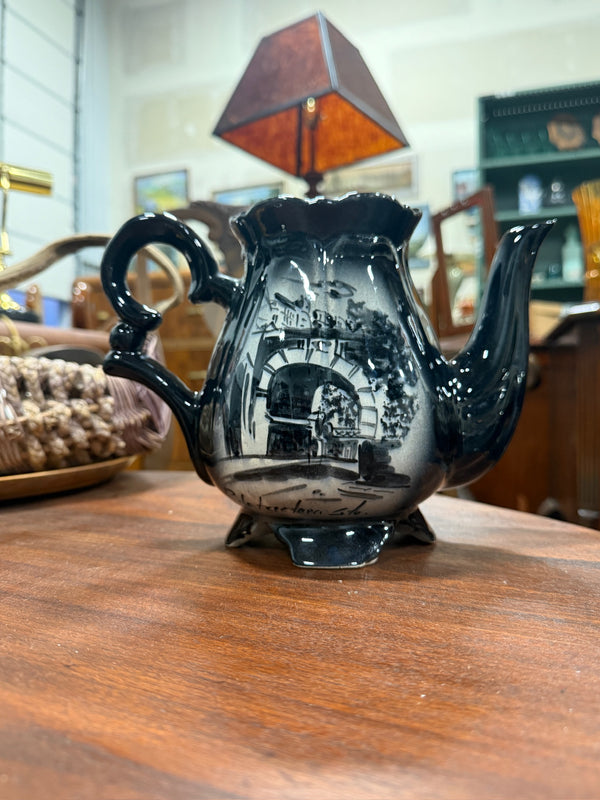
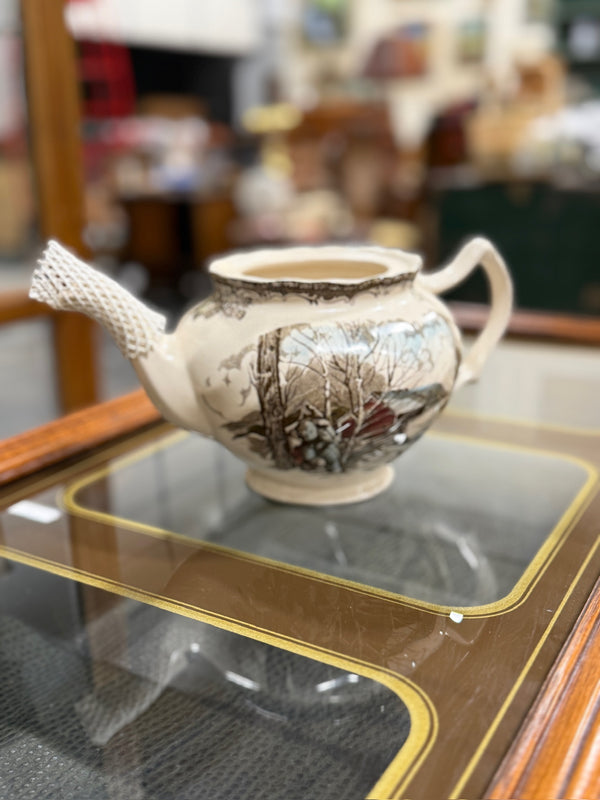
A richly detailed red transferware teacup and shaped saucer, likely Staffordshire, England, c. 1890–1910. The set features a romantic riverscape scene—figures in a boat, turreted architecture, distant towers, and ornamental gardens—rendered in deep iron-red against a warm ivory ground.
The asymmetrical, shaped saucer adds sculptural presence beyond the standard round form, creating movement and visual drama even at rest. Both cup and saucer bear a heraldic crest stamp to the underside: two rampant lions flanking a shield beneath a crown—an export-era quality emblem used by English potteries of the late Victorian and Edwardian period.
Decorative, historic, and unmistakably graphic.
Design & Construction
→ Form & Style:
Late Victorian to Edwardian transferware with romantic architectural fantasy motif. The composition reflects the 19th-century fascination with picturesque European landscapes—turrets, river travel, pastoral figures—presented within ornate scrolling borders.
The shaped saucer silhouette enhances the theatrical presentation, a refinement often seen in later 19th-century tableware.
→ Material:
Glazed earthenware / ironstone body with iron-oxide red transfer decoration. High-gloss glaze over ivory-toned ceramic. Crisp engraved detail indicates late-period transfer printing rather than early Victorian softness.
→ Markings:
Heraldic lion crest stamp to underside of both cup and saucer. Crest-only mark suggests Staffordshire export production, c. 1890–1910, likely manufactured for foreign markets without printed maker text.
History & Provenance
Red transferware gained popularity in England during the mid–late 19th century as an alternative to blue-and-white wares. Staffordshire potteries perfected the copperplate transfer technique, allowing detailed scenic engravings to be reproduced affordably for domestic and export markets.
Heraldic crest backstamps—often featuring lions and crowns—were frequently used by English manufacturers as decorative branding marks for export lines. These emblems signaled perceived quality without referencing official Royal Arms.
The shaped saucer and heavier ironstone body point toward late Victorian to early Edwardian production, when tableware became increasingly ornate in silhouette while retaining practical durability.
This example embodies that transitional refinement—romantic imagery paired with confident construction.
Condition
Very good antique condition.
Transfer imagery remains crisp with strong red saturation. No major cracks, hairlines, or structural repairs observed. Minor glaze irregularities and light age-related wear consistent with late 19th-century production. Small production imperfection visible on underside, typical of the era.
Structurally sound and display-ready.
Product Details
| Attribute | Description |
|---|---|
| Origin | Staffordshire, England (attributed) |
| Date | c. 1890–1910 |
| Material | Glazed earthenware / ironstone |
| Technique | Red transferware |
| Motif | Romantic riverscape with architectural vignette |
| Markings | Heraldic lion crest (two lions, crown, shield) |
| Form | Teacup with shaped saucer |
| Condition | Very good antique condition |
Why It Belongs in Your Home
This is functional history.
The deep iron-red palette pairs beautifully with dark woods, brass accents, layered textiles, and moody interiors. Display it on open shelving, integrate it into a collected china wall, or use it as a striking accent on a bar cart or console.
Small in scale, but visually commanding.
It carries over a century of domestic ritual—and still holds its presence effortlessly.
Every piece is packed with professional-grade materials: multiple foam layers, double-boxing, directional and fragile handling labels. For large furniture we use custom timber crating. We photograph packing before dispatch and can provide images on request.
White-glove delivery is complimentary within 100 miles of Reno, NV. National shipping quotes provided at checkout. All shipments are photographed and documented. Damage claims must be filed with the carrier; we provide all documentation needed to support your claim.
Local pickup is available at Viridian HQ (Reno, NV) with 2–4 days notice. Contact us to arrange. Private viewings also available.
All antique and vintage items are sold as described and all sales are final. Each listing includes detailed condition notes and photographs so you can make a fully informed decision. We encourage buyers to ask questions — about condition, dimensions, finish, provenance — before purchasing.
Antiques are irreplaceable and one-of-a-kind. Carrier handling is outside our control once a piece has left our facility, and major carriers including FedEx do not insure antiques. We do everything within our power to ensure safe transit, but cannot accept liability for carrier damage. If damage occurs in transit, we will provide full documentation to support your carrier claim.
Have a question? — we're happy to provide additional photos, condition detail, or discuss the piece directly.