18th–19th Century Brass Candle Snuffer Head c.1750–1850 — Oldest Viridian Inventory Piece
Viridian Eclection


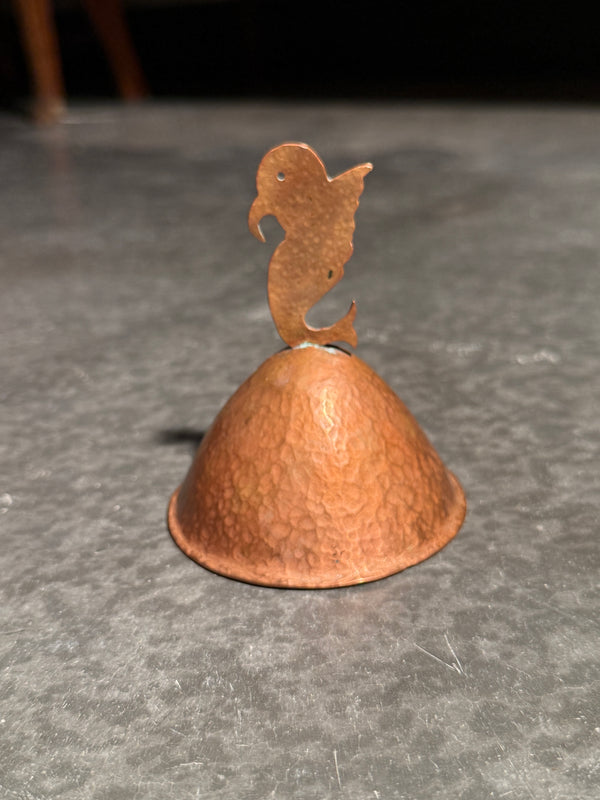
The Piece Early Brass Candle Snuffer (Snuffer Head Only)Unknown makerHand-raised brass with soldered ring handleDomestic fire-control toolc. 1750–1850 Oldest object to date to enter Viridian Eclect...
The Piece
Early Brass Candle Snuffer (Snuffer Head Only)
Unknown maker
Hand-raised brass with soldered ring handle
Domestic fire-control tool
c. 1750–1850
Oldest object to date to enter Viridian Eclection inventory
Primary Description
An early brass candle snuffer head, hand-formed and fitted with a forged ring handle, originally part of a longer handled tool used to extinguish open flames safely. This example represents the earliest object to date to enter Viridian Eclection inventory, predating electrification and reflecting a period when fire management shaped daily domestic life.
Constructed from hand-raised brass, the snuffer shows visible tool marks, uneven interior surfaces, and heat-related oxidation consistent with pre-industrial manufacture. The irregular ring handle is soldered at the crown and retains file marks from hand finishing. Surface patina, interior verdigris, and discoloration reflect prolonged exposure to flame rather than later decorative aging.
Design & Construction
Formed from a single sheet of brass shaped by hand, the snuffer head shows no casting seams or machine uniformity. The interior bears hammer marks and heat-darkened oxidation at the apex. The ring handle was forged and attached by solder, with slight asymmetry typical of early domestic metalwork.
The absence of ornament underscores its utilitarian purpose: extinguishing candles efficiently while minimizing smoke and scattered wax.
History & Context
Before gas and electric lighting, candle snuffers were essential household tools. Long-handled snuffers were commonly used in homes, libraries, and religious spaces to extinguish flames safely without disturbing the wick or spreading embers.
By the mid-19th century, lighting technology and manufacturing methods shifted toward more standardized and decorative forms. Earlier hand-raised examples such as this were gradually replaced, discarded, or separated from their original handles, making surviving snuffer heads important material records of early domestic life.
Age
Estimated date: c. 1750–1850
Based on hand-raised brass construction, forged and soldered ring handle, lack of machine tooling, and utilitarian form consistent with late 18th to early 19th-century domestic lighting accessories.
Condition
Good antique condition.
Surface patina, oxidation, and interior discoloration present throughout, consistent with age and use. No cracks or structural damage observed. Ring handle intact.
Why It Belongs In Your Home
This piece anchors the historical range of the Viridian Eclection collection. As the oldest object to date in inventory, it represents a direct connection to pre-industrial domestic life, where fire was both essential and dangerous. Its sculptural simplicity and material honesty make it equally compelling as a historical artifact and a display object.
Sources & References
→ Victoria and Albert Museum, collections and research on candle snuffers and domestic lighting tools
→ Winterthur Museum, studies on pre-industrial household metalwork
→ Auction and dealer catalog references for 18th–19th century brass lighting accessories
Every piece is packed with professional-grade materials: multiple foam layers, double-boxing, directional and fragile handling labels. For large furniture we use custom timber crating. We photograph packing before dispatch and can provide images on request.
White-glove delivery is complimentary within 100 miles of Reno, NV. National shipping quotes provided at checkout. All shipments are photographed and documented. Damage claims must be filed with the carrier; we provide all documentation needed to support your claim.
Local pickup is available at Viridian HQ (Reno, NV) with 2–4 days notice. Contact us to arrange. Private viewings also available.
All antique and vintage items are sold as described and all sales are final. Each listing includes detailed condition notes and photographs so you can make a fully informed decision. We encourage buyers to ask questions — about condition, dimensions, finish, provenance — before purchasing.
Antiques are irreplaceable and one-of-a-kind. Carrier handling is outside our control once a piece has left our facility, and major carriers including FedEx do not insure antiques. We do everything within our power to ensure safe transit, but cannot accept liability for carrier damage. If damage occurs in transit, we will provide full documentation to support your carrier claim.
Have a question? — we're happy to provide additional photos, condition detail, or discuss the piece directly.