The Piece
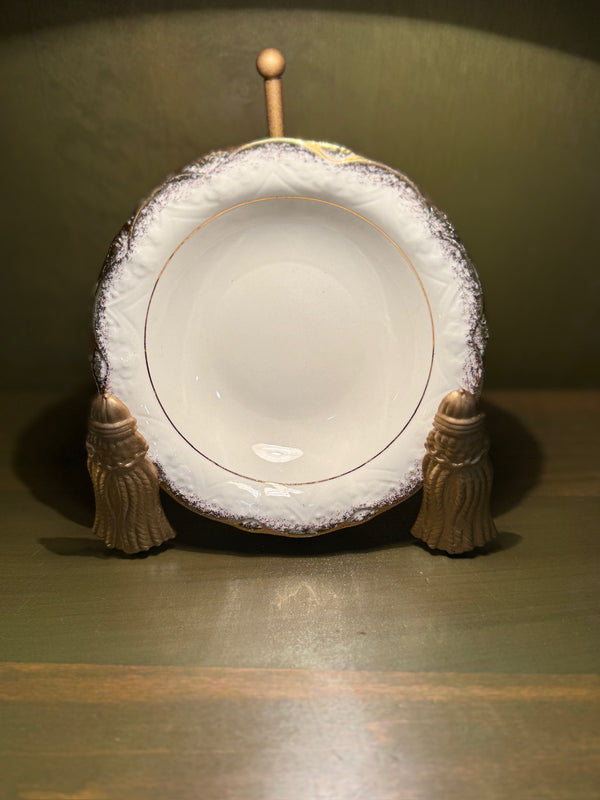
A pair of antique white porcelain teacup saucers, quietly elegant and unmistakably architectural, shaped by light, repetition, and daily ritual. Their surfaces ripple outward in soft radial fluting, creating a subtle play of shadow and sheen that feels almost sculptural in its restraint.
The design is classical without being precious — a Neoclassical sunburst rendered in porcelain rather than stone. The beaded cup wells anchor the composition, forming a delicate inner ring that once cradled a teacup and now reads as a thoughtful, intentional detail. Together, the pair feels balanced and intentional, their simplicity revealing itself slowly rather than all at once.
These are not decorative objects pretending to be antiques. They are antiques — functional, quiet, and shaped by decades of ordinary beauty.
Design & Construction
→ Form & Style
Antique porcelain teacup saucers featuring:
-
Radial fluted sunburst molding extending from center to rim
-
Beaded inner cup wells with classical symmetry
-
Slightly upturned rims for cup stability
-
Clean white glaze with soft tonal warmth
The pattern reflects late-19th-century Neoclassical revival aesthetics, where restraint, proportion, and repetition replaced heavy ornament. The result is refined but approachable — decorative without excess.
→ Materials
-
Glazed porcelain
-
White-bodied ceramic with smooth, even finish
-
Subtle glaze variation consistent with age and use
-
Non-transferware, relying entirely on molded form for decoration
The porcelain is thin yet resilient, designed for daily handling rather than display alone.
→ Technique
-
Molded porcelain construction
-
Relief fluting pressed into form prior to firing
-
Beaded cup wells integrated into the mold rather than applied
-
Fully glazed and kiln-fired for durability
History & Provenance
Likely produced between 1890 and 1915, these saucers belong to the late Victorian and early Edwardian era, a time when European porcelain factories produced vast quantities of white service ware for domestic use, hotels, and export markets.
Unmarked examples like these were intentionally anonymous — made to serve rather than to advertise their origin. Similar pieces were produced across France, Germany, and England, particularly in regions supplying refined but affordable tableware to middle-class households.
Their survival today speaks to both material quality and continued relevance: forms so well balanced they never truly fell out of favor.
Condition
Good antique condition overall, with honest, age-appropriate wear.
-
No chips or repairs observed
-
Glaze intact with minor surface wear consistent with age
-
Structurally sound and visually cohesive as a pair
The crack is old, clean, and stable, and has been factored into presentation and pricing. These are now best suited for decorative or light styling use rather than functional table service.
Product Details
Item: Pair of Antique White Porcelain Teacup Saucers
Date: c.1890–1915
Origin: Europe (likely France, Germany, or England)
Material: Glazed porcelain
Technique: Molded, kiln-fired
Condition: Good antique condition; one saucer with stable hairline crack
Style: Neoclassical / Late Victorian / Early Edwardian
Why It Belongs in Your Home
Because not everything needs to shout to be meaningful.
These saucers are about proportion, repetition, and quiet beauty — the kind of objects interior designers reach for when they want texture without noise. They layer effortlessly into a space: under a candle, holding jewelry, styled on a shelf, or leaned against a wall as part of a composed vignette.
They’re ideal if you value pieces that:
-
Carry history without spectacle
-
Add depth through form rather than color
-
Show age honestly instead of hiding it
-
Feel intentional, not ornamental
Together, they offer more than symmetry. They offer time — visible, tactile, and still useful in new ways.