Late Victorian Turned Brass Inkwell Base (c. 1870–1910)
Viridian Eclection


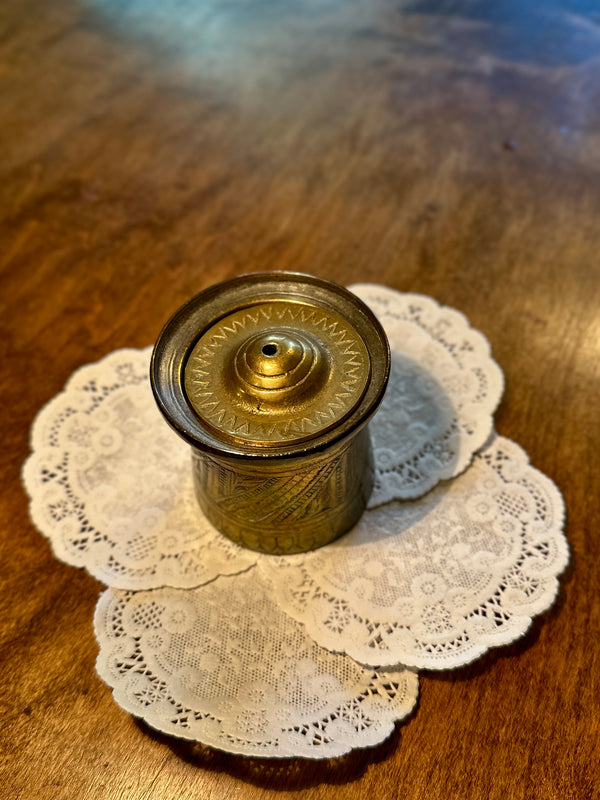
The Piece A late 19th-century turned brass vessel, likely originally part of a Victorian desk inkwell or writing stand. The form is architectural and restrained: a flared cup rising from a stepped ...
The Piece
A late 19th-century turned brass vessel, likely originally part of a Victorian desk inkwell or writing stand.
The form is architectural and restrained: a flared cup rising from a stepped pedestal base. The proportions are balanced rather than ornate, emphasizing structure over decoration.
Inside, visible lathe-turning rings mark its production method — typical of workshop brass from the late Victorian period. The central interior disc suggests it once housed a removable liner, likely glass or ceramic, for ink or wax.
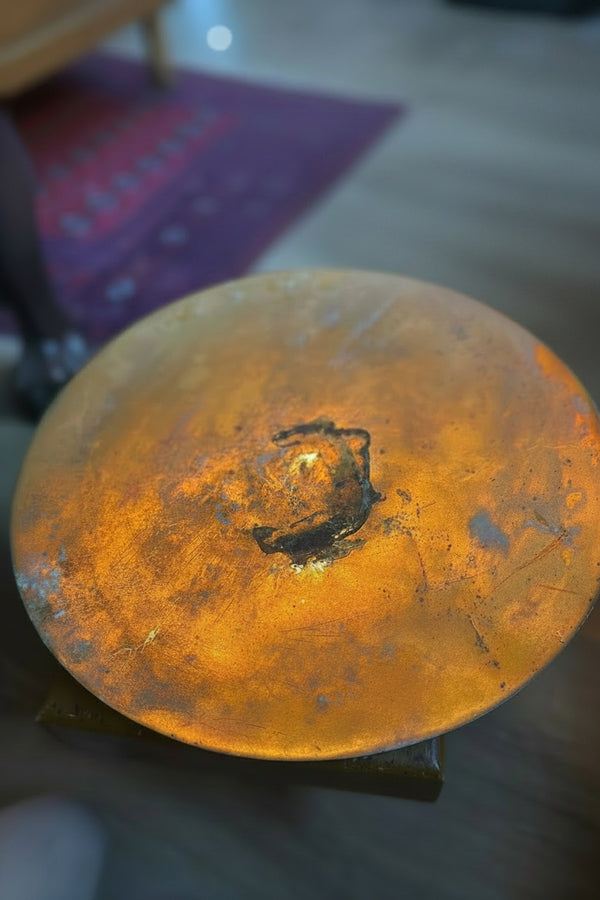
The brass has developed a deep, layered patina that reads authentic rather than decorative aging.
About the Maker / Origin
Unmarked.
Turned brass desk components of this type were widely produced in England and the United States between 1870 and 1910. The stepped pedestal form and lathe-finished interior are consistent with late Victorian workshop production rather than later mid-century decorative brass.
Without a maker’s stamp, attribution remains general, but the construction and wear support a late 19th to early 20th century date.
Historical Context
During the Victorian era, writing desks were formal objects. Inkstands often included multiple brass components mounted on wood or stone bases. These pieces were functional but carried a certain gravitas — weight, solidity, permanence.
Turned brass elements like this were common in:
-
Inkstands
-
Wax seal holders
-
Small ecclesiastical vessels
-
Desk accessories
The emphasis was on durability and proportion, not excess ornament.
Design & Craftsmanship
→ Solid brass construction
→ Lathe-turned interior with visible concentric rings
→ Stepped pedestal base
→ Smooth exterior profile
→ Aged patina consistent with over a century of handling
This is not cast decorative brass. It is machined stock, shaped with intention and finished by hand.
Condition
Honest antique condition.
→ Deep natural patina
→ Interior wear consistent with use
→ No visible structural splits
→ No modern polishing
Surface irregularities are consistent with age and functional history.
Product Details
Material: Solid brass
Era: c. 1870–1910
Form: Likely inkwell base / desk accessory
Height: (insert measurement)
Base Diameter: (insert measurement)
Cup Diameter: (insert measurement)
Why It Belongs in Your Home
This is the kind of object that adds gravity without clutter.
Placed on a desk, it instantly introduces weight and history. Used as a small catchall, it holds keys or coins without looking like a tray from a catalog. On a shelf, it anchors lighter ceramics or books with its darker patina.
It works particularly well in:
-
Studies or libraries
-
Moody interiors with wood and leather
-
Layered desk styling
-
Traditional or collected spaces
Its value is not in decoration. It’s in presen
Every piece is packed with professional-grade materials: multiple foam layers, double-boxing, directional and fragile handling labels. For large furniture we use custom timber crating. We photograph packing before dispatch and can provide images on request.
White-glove delivery is complimentary within 100 miles of Reno, NV. National shipping quotes provided at checkout. All shipments are photographed and documented. Damage claims must be filed with the carrier; we provide all documentation needed to support your claim.
Local pickup is available at Viridian HQ (Reno, NV) with 2–4 days notice. Contact us to arrange. Private viewings also available.
All antique and vintage items are sold as described and all sales are final. Each listing includes detailed condition notes and photographs so you can make a fully informed decision. We encourage buyers to ask questions — about condition, dimensions, finish, provenance — before purchasing.
Antiques are irreplaceable and one-of-a-kind. Carrier handling is outside our control once a piece has left our facility, and major carriers including FedEx do not insure antiques. We do everything within our power to ensure safe transit, but cannot accept liability for carrier damage. If damage occurs in transit, we will provide full documentation to support your carrier claim.
Have a question? — we're happy to provide additional photos, condition detail, or discuss the piece directly.