Egidio Casagrande
Sculptor and Metalworker · Borgo Valsugana, Trentino · Copper and Brass, 1930s to 1986
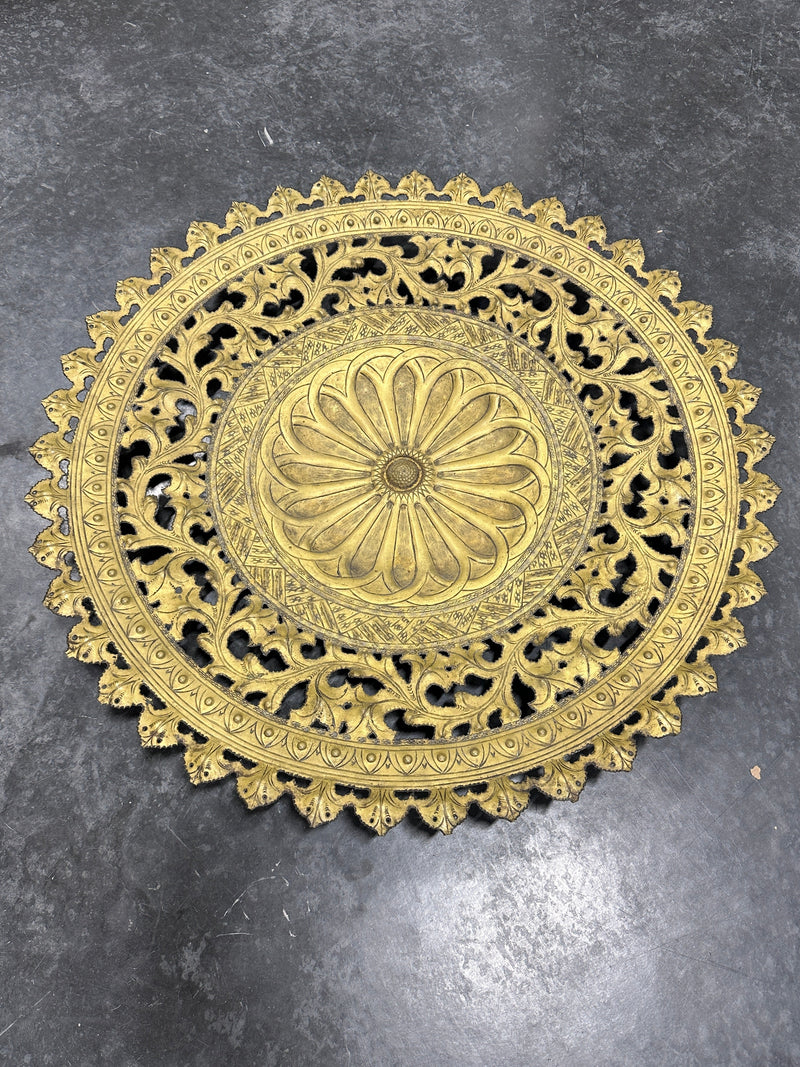
Egidio Casagrande was a sculptor and metalworker from Borgo Valsugana, a small town on the river Brenta in the Trentino, in the far north of Italy. From a workshop on the town's via Roma he and his craftsmen hammered, chased and pierced copper and brass into vases, planters, ewers, clocks, mirrors, crucifixes and great decorative wall plates, and at its height in the later 1950s the business employed some one hundred and twenty people and shipped its work all over the world. His pieces are stamped E. Casagrande Italy Borgo Valsugana, and they are now among the most sought after mid-century Italian metalwork on the decorative arts market. Our piece is one of his monumental wall medallions, a pierced brass sun more than three feet across, stamped with the workshop mark and the number 2.
An Apprentice in the Valsugana
Dealer biographies, repeated across the major Italian and American galleries that handle his work, give his birth as 28 August 1911 in Borgo Valsugana, and say that at thirteen he was apprenticed to the workshop of Luigi Taddei, which made objects in iron and copper. The Valsugana had a long tradition of working metal by hand, and a boy learning to raise a vessel from a flat sheet with a hammer was learning a trade that went back centuries. Casagrande was never formally trained as a sculptor. Everything he made came out of that workshop training and his own eye.
The Factory on Via Roma
At the end of the 1930s a copperworking factory opened on via Roma in Borgo, and it grew into the business that carried his name. The range was enormous. Former workers remember decorative plates and pictures in copper showing rural scenes, views of Borgo, animals and religious subjects; amphorae, vases and planters; clocks, weathervanes, mirrors and jewellery; and sacred art, crucifixes and altars. Each piece was stamped with the workshop name, and many with a production or model number as well.
The boom years were 1955 to 1960. One of the workshop's master chasers, Bruno Sordo, recalled that the business then employed about one hundred and twenty people and that he alone trained twenty-seven cesellatori, the chasers who work the fine detail into the metal with punches. Containers of finished pieces left Borgo for markets around the world, which is how so much Casagrande brass came to rest in American homes.
The Madonna of the Peaks
The most extraordinary thing to come out of the workshop was not a vase. In October 1955 the newly formed Alpini group of Casatenovo, in Lombardy, agreed to help a priest, don Luigi Re of the Casa Alpina at Motta, keep a vow he had made to the Virgin: to raise a monument on a mountain summit. The priest imagined a copper figure three or four metres tall that the Alpini could carry up the mountain. The commission went to Egidio Casagrande, and he built something on another scale altogether: a statue of the Madonna in copper over a steel frame, fourteen metres high, finished in about ten months.
In 1956 the statue left Borgo by road. It stopped at Pergine Valsugana, then stood for about two weeks at the craft fair in Rovereto, and on 2 September it reached Casatenovo to wait for its final site. The original summit, Pizzo Stella, was ruled out by army engineers as unsafe, and the statue was raised instead at Motta, above Madesimo, where it was inaugurated on 15 October 1957 as Our Lady, Protector of Europe. It still stands there.
The statue made Casagrande briefly famous in America. On 12 February 1958 an Associated Press story datelined Sondrio ran in newspapers from Massachusetts to Michigan and Louisiana: a four-ton, 48-foot statue of Our Lady, Protector of Europe now stood on a concrete pedestal on a 6,012-foot Alpine summit, raised by an energetic 65-year-old priest, Don Luigi Re, who had collected $48,000 for it, with cableways built to carry earth, concrete and iron to the top and Alpine troops lending a hand. The wire story credited the work to amateur sculptor Egidio Casagrande of nearby Borgo Valsugana, whose business, it explained, was the hand manufacture of copper vases. The same vases, in their thousands, were already crossing the Atlantic.
The Fountain at the Gate of Borgo
Egidio Casagrande died in Borgo Valsugana on 11 June 1962, at fifty, according to the same dealer biographies. The workshop went on without him. In the 1970s it completed a public fountain he had begun, the Fontana Evita, crowned by an angel on a shell, and for more than thirty years it stood at the main entrance to the town as Borgo's symbol and the workshop's emblem. It was taken down in 2002; in 2022 the provincial government of Trentino approved funds to restore it and put it back.
The End of a Trade
The factory closed in 1986. By the early 2000s hand working of copper and brass had all but vanished from the Valsugana, undone by falling demand and by cheap industrially stamped metal. In the summer of 2018 five of the workshop's former apprentices, Marino Cipriani, Bruno Sordo, Giuseppe Camossa, Bruno Dalvai and Egidio's son Ezio Casagrande, mounted an exhibition of the workshop's pieces and those of other local metalworkers in the Spazio Klien on the ground floor of Borgo's town hall.
Why Casagrande Matters
Casagrande stands where Italian craft met mid-century modern design. His forms are often strikingly modern, plain hammered vessels with a sculptural profile, while his decorative plates and medallions draw on Renaissance, Gothic and Moorish ornament worked entirely by hand. Collectors value the pieces for exactly that combination: the visible hammer marks and hand-cut openings of a village workshop, at a scale and confidence that reads as architecture. A large pierced medallion like ours is the workshop at its most ambitious.
A Life in the Record
Born in Borgo Valsugana, Trentino, according to dealer biographies.
Apprenticed at thirteen to the iron and copper workshop of Luigi Taddei.
Copperworking factory opens on via Roma, Borgo Valsugana; pieces stamped E. Casagrande Italy Borgo Valsugana.
Peak years: about 120 workers, 27 chasers trained by Bruno Sordo alone, containers shipped worldwide.
Builds a 14 metre copper Madonna in ten months; inaugurated at Motta di Madesimo on 15 October 1957 as Our Lady, Protector of Europe.
Dies in Borgo Valsugana.
Workshop completes his Fontana Evita at the town entrance; the factory closes in 1986.
Former apprentices, with his son Ezio, exhibit the workshop's pieces at the Spazio Klien, Borgo town hall.
Most Casagrande brass on the market is a vessel. This is the workshop showing off: a pierced sun three feet across, every opening cut and every ridge chased by hand in Borgo Valsugana, and a near twin carries the same model number, 2. Hung on a wall with light behind it, it throws its own pattern.Viridian Eclection, Reno
Inquire About Available Works
Works by Egidio Casagrande come to the Eclection one at a time. If you own a stamped Casagrande piece, particularly a large wall medallion or a piece with a model number, we would like to see the mark and hear what you know of its history.