Einar Petersen
Muralist and Landscape Painter · Copenhagen to Hollywood · The American West
Einar Cortsen Petersen lived for one hundred and one years and painted for most of them. Born in Copenhagen on October 17, 1885, trained as a decorative painter in the great art cities of Europe, and settled in Los Angeles during the First World War, he became one of the most sought-after mural painters on the West Coast in the 1910s and 1920s. His walls told the story of the American West to hotel guests, bank customers and cafeteria diners from Omaha to Manila. When the buildings changed hands, most of those walls were painted over or torn down, and his name slipped from view. What remains, and what collectors can still hold, are the easel paintings: harbours, farm valleys, canyons and desert country, painted by a man who had spent his life looking at the land on a grand scale.
A Copenhagen Apprenticeship
Petersen served an apprenticeship in his native Copenhagen around 1900. On a scholarship from the Danish government he then spent several years studying art in Paris, Rome and Munich, supporting himself as a working decorator. The Pacific Coast Architecture Database notes that he may also have attended the Kunstakademie in Düsseldorf. This was a practical, architectural education as much as a fine art one: the training of a painter who expected to work on plaster, at scale, alongside architects and builders. A signed and dated village view from 1909, sold in Geneva in 2019, survives from these European years.
Across America
Petersen emigrated to the United States in 1912. Before reaching California he worked in Nebraska, Oregon and Washington, and his mural commissions eventually spread across Omaha, Spokane, San Francisco, Los Angeles, Honolulu and Manila, more than twenty in all. An oil titled Hangman's Creek, signed and dated 1914, belongs to these Pacific Northwest years. Sources differ slightly on his arrival in Los Angeles: a 1976 newspaper profile placed him in Hollywood from 1915, the year of his first Los Angeles commission, while biographical summaries give 1916 as the year he settled there.
The Walls of Los Angeles
His Los Angeles debut was a set of six panels, each nineteen by nine feet, for the lobby of the Rosslyn Hotel at Fifth and Main streets, tracing the history of the city from the Spanish era onward. The Los Angeles Times praised them in October 1915. More commissions followed: pioneer murals for the Hunter-Dulin Building in San Francisco, which opened in 1926; Pilgrim scenes for the Mayflower Hotel on South Grand Avenue; an Aladdin and His Lamp cycle for the Spring Street Guaranty Building and Loan Association in 1928; a forest mural for Clifton's Brookdale Cafeteria on Broadway; a garden scene for the Pacific Seas cafeteria; and Spanish themes for the Guaranty Building in Glendale in 1930. Further commissions are recorded for the University Club and Roos Brothers in Los Angeles, the First National Bank in El Paso, Texas, and Honolulu's City Hall. The historian Mary Mallory has described him as one of the greatest muralists in Los Angeles and California during the 1920s.
Hollywood Home and Studio
Petersen was a member of the California Art Club and of the Painters and Sculptors of Los Angeles. In 1927 he built a Spanish Renaissance house at 2706 Beachwood Drive in Hollywoodland, and the artists' studios at 4350–4352½ Beverly Boulevard associated with him were designated a Los Angeles Historic-Cultural Monument, No. 552, in 1991. Late in 1929 an exhibition of the sketches he had made on several of the Hawaiian Islands was shown at the Architects Building in Los Angeles, prompting the architect William Lee Woollett to publish an appreciation of them in Architect and Engineer in January 1930.
The Easel Painter of the West
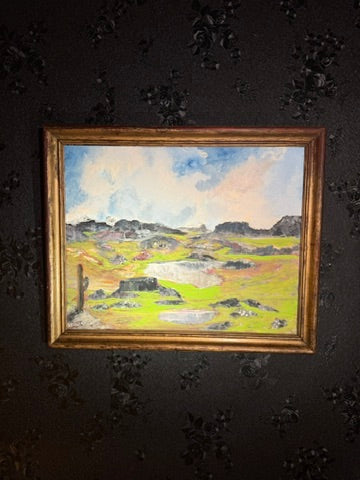
Alongside the murals, Petersen produced a steady body of easel paintings, and these are the works that appear at auction today. The recorded titles map a life lived across California and the wider West: a small tonalist study inscribed A Colored Residence Pasadena Cal from the 1910s; Dry Dock of 1939 and Fishing Boats, Los Angeles Harbor of 1940; Cotton Wood Trees in the Desert, Snow Creek Canyon of 1942; and Harvest Time, San Luis Obispo of 1948. He is also recorded as active in Morro Bay before 1934. Several of these canvases are signed on the front and titled or dated on the reverse, a habit worth remembering when reading the inscription Black Rock Ranch on the back of one of our paintings.
A Century of Painting
By 1976 a newspaper profile could describe him as a courtly ninety-one-year-old native of Denmark living in Hollywood, and could note that many of the buildings he had decorated were already gone or renamed. Honolulu marked his hundredth birthday, October 17, 1985, with an Einar Petersen Day. He died in Los Angeles on December 6, 1986. In 2013 one of the Rosslyn Hotel panels, removed in the hotel's 1980s renovation, surfaced for sale online, a reminder of how much of his public work had been lost.
Why Einar Petersen Matters
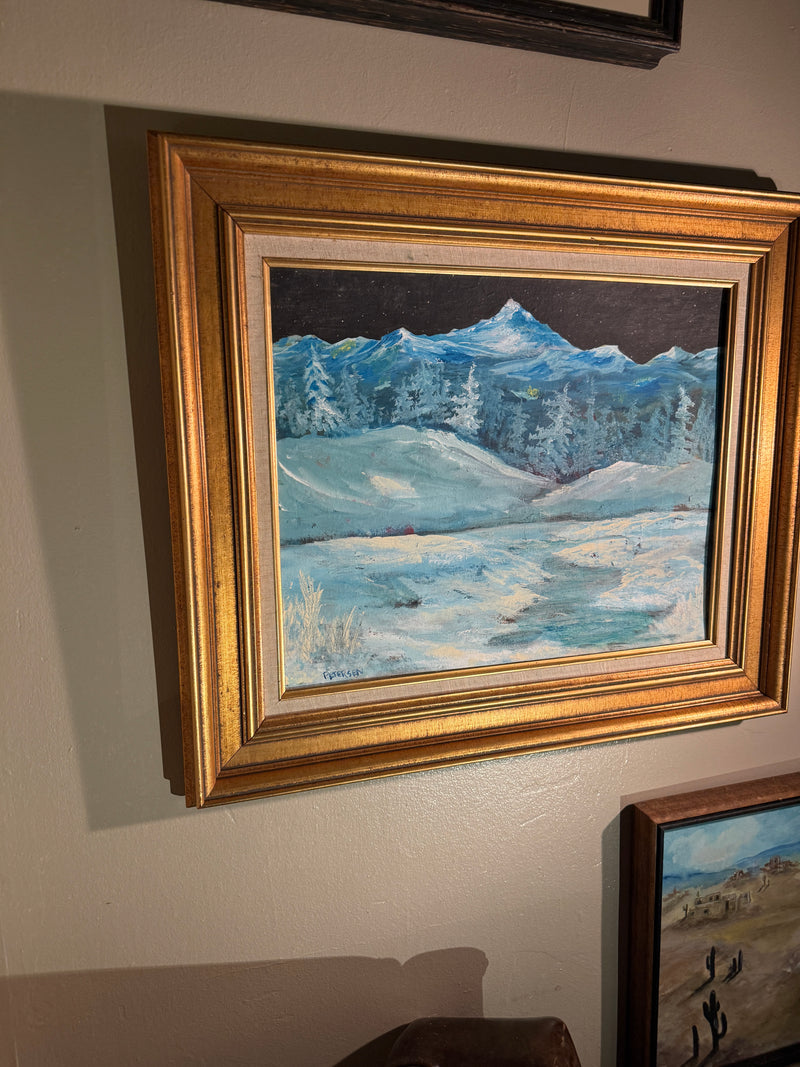
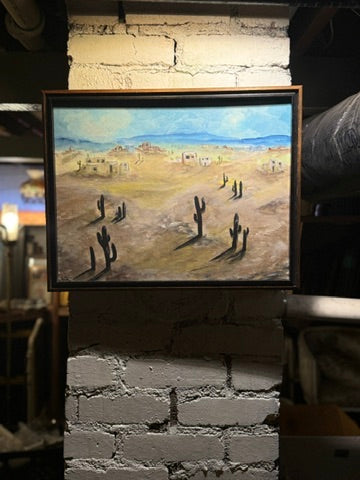
Petersen belongs to the generation of European-trained decorative painters who gave early twentieth-century Los Angeles its public imagery, and he is one of the few whose working life spanned from the Rosslyn Hotel to the 1980s. Because so many of his murals were destroyed, his easel paintings carry an unusual weight: they are the most direct way left to see how a muralist's eye for broad masses, clear horizons and strong design translated to the land of the West. A desert village, a ranch among dark volcanic rock, a snowbound range: these are the subjects of a painter who never stopped working from the landscape around him.
A Life in the Record
Born in Copenhagen, Denmark, on October 17.
Apprenticeship in Copenhagen, then study in Paris, Rome and Munich on a Danish government scholarship while working as a decorator.
Emigrates to the United States; works in Nebraska, Oregon and Washington.
First Los Angeles commission: six history murals for the Rosslyn Hotel lobby.
Major mural cycles in San Francisco, Los Angeles and Glendale; builds his Hollywoodland home in 1927; Hawaiian sketches exhibited in 1929.
Dated easel paintings of harbours, desert canyons and the San Luis Obispo countryside.
Honolulu celebrates his 100th birthday with an Einar Petersen Day.
Dies in Los Angeles on December 6, aged 101.
Petersen spent decades painting the West on the scale of a building, and most of those walls are gone. His canvases are what survive of that vision, and they carry the muralist's clarity of design into quiet, open country. We hold three of them, and together they show a painter at ease with desert, ranch and mountain alike.Viridian Eclection, Reno
Inquire About Available Works
Works by Einar Petersen come to the Eclection one at a time. If you own a work by Einar Petersen, or have letters, photographs or papers connected with the artist, we would like to hear from you.