Joseph Capecchi
Sculptor and Painter · Florence to St. Paul · The Cathedral of Saint Paul
Joseph Angelo Capecchi was a Florentine sculptor who spent more than half a century giving the Cathedral of Saint Paul its bronze, its carving and its colour, and who, when the scaffolding came down, went out to the lakes with an easel. He arrived in Minnesota in 1906 as a seventeen-year-old carver and died there in 1983 as the patriarch of a family that is still caring for the building he helped finish. His sculpture is public and documented. His paintings were private, made for the family and for himself, and they almost never leave it.
Florence, Piazza Madonna
He was born on 22 July 1889 in Florence, on the Piazza Madonna, the small square beside the Medici Chapels in the market quarter of San Lorenzo. He grew up in a city whose carvers, casters and gilders had supplied the churches of Europe for five hundred years. The family album keeps a studio portrait of the Capecchis taken in Florence around 1924, the whole family in their best clothes, long after Joseph had gone. The craft he carried to America was Florence's oldest export.
A Cathedral Rising on Summit Hill
He reached St. Paul in 1906, the year Archbishop John Ireland began the great domed cathedral on Summit Avenue. The Giuliani Statuary Company, an Italian firm on East Seventh Street, hired him to carve decorative work for the new building. He never really left the job. Over the next five decades he rose to run the company, which became the St. Paul Statuary Company, and for a time he also kept the Florentine Art Shop, importing art from Italy. On 16 April 1914 he married Louise Ungaretti, daughter of an Italian family of the city, and together they raised five children: Florence, Joseph, Bernice, Lois and Paul.
The Sculptor of St. Paul
His figures stand all over the Twin Cities. In 1928 he modelled a bust of Governor Al Smith. In 1932 his statue of St. Thomas Aquinas was set over the entrance of Aquinas Hall at the College of St. Thomas, where the university still describes him as a noted local religious artist; ten years later he made the O'Shaughnessy shrine on the same campus. He carved altars for the College of St. Catherine, made a model for a statue of the railroad builder James J. Hill, and filled parish churches across the Midwest with saints, altars and Stations of the Cross.
His greatest work was saved for the Cathedral. In 1951 he sculpted the Selby and Dayton Avenue entrances, with their tall columns and carved botanical ornament. In 1954 he chose the red, blue and bright yellow scheme that still colours the interior of the dome. In 1956 he designed the bronze plaques honouring Bishop John Murray and the 1936 visit of Cardinal Pacelli, the future Pope Pius XII, and modelled all fourteen Stations of the Cross in clay to be cast in bronze. In 1958 he made the plaster model for the Infant of Prague in the Chapel of St. Joseph.
The Mosaics He Never Claimed
High in the dome, seventy feet above the floor, four mosaics of the cardinal virtues each measure 25 by 15 feet. They were set by artisans of the Vatican studios, and the credit went to Rome. It was Capecchi who painted the colour sketches they worked from. He never said so. His grandson Mark remembers him looking up and asking whether those weren't beautiful mosaics, and never once telling him they were his.
The Painter at the Lake
Away from the studio, Capecchi painted. A photograph in the family album shows him standing at an easel in the open air at Crooked Lake, Wisconsin in 1940, working on a framed lake scene of tall trees, still water and a far shore. Painting in oils became his great pleasure in retirement, and a grandson recalled him at eighty-one still painting at home in West St. Paul. These were not commissions. They were a sculptor's holidays: the same eye that modelled saints for a cathedral, resting on water and pine.
Two Generations on the Walls
His sons followed him into the trade. Joseph E. Capecchi, born in 1917 and known all his life as Joe Jr., served in the Second World War from 1941 to 1946 and came home to the family business. In the 1950s the sons painted the Cathedral dome to their father's scheme, and Joe Jr. and his brother Paul later laid the gold leaf on the Quadriga, the gilded chariot group above the entrance of the Minnesota State Capitol. When an arsonist's fire blackened the Cathedral in the 1970s, it was the Capecchis, sons and grandsons together, who cleaned and repainted it; in the 1980s they repaired its water damage. Father and son died within a month of each other in early 1983. The family archive, kept today by his grandson Dr. Joseph G. Capecchi, himself a painter, preserves the photographs, the captions and the memory.
Why Capecchi Matters
Capecchi belongs to a generation of Italian immigrant artisans who built the visual world of American Catholic churches with their hands and then disappeared from the record behind the names of architects and bishops. His sculpture can still be seen and touched in St. Paul. His paintings are far rarer: not a single one has been recorded at auction. A signed Capecchi landscape is a piece of that family's private art, the work of a household that spent a century making beautiful things for one city.
A Life in the Record
Born 22 July in Florence, Italy, on the Piazza Madonna.
Arrives in St. Paul at seventeen and is hired by the Giuliani Statuary Company to carve decorative work for the new Cathedral.
Marries Louise Ungaretti on 16 April. Their five children include Joseph E., known as Joe Jr., born 1917, and Paul.
His figure of St. Thomas Aquinas is installed over Aquinas Hall at the College of St. Thomas.
Photographed painting outdoors at Crooked Lake, Wisconsin, a framed lake scene on his easel.
Sculpts the Selby and Dayton Avenue entrances of the Cathedral, then sets the red, blue and yellow colour scheme of the dome.
Designs the fourteen Stations of the Cross, modelled in clay and cast in bronze, and the plaster model for the Infant of Prague.
Dies 26 January, aged 93. His sons and grandsons continue to care for the Cathedral he helped build.
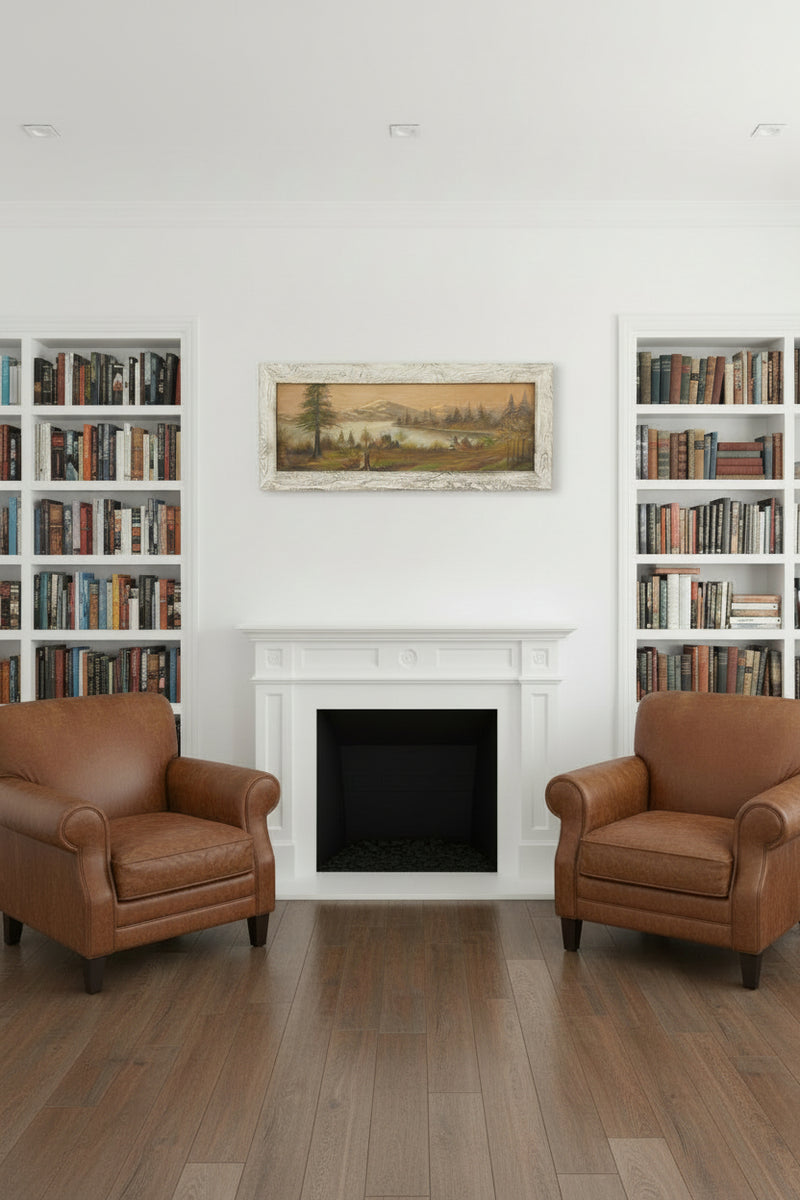
A man who spent fifty years modelling saints for a cathedral does not paint a tree casually. Look at how the pine is built up stroke by stroke, how the mountain sits back in the haze. This is a sculptor's eye resting on a lake, and a family's name on the corner.Viridian Eclection, Reno
Inquire About Available Works
Paintings by the Capecchi family come to the Eclection one at a time. If you own a painting or a sculpture signed Capecchi, or have family photographs or papers, we would like to hear from you.