Joseph Wallace King
Portrait Painter · Winston-Salem to Florence · The Vinciata Manner
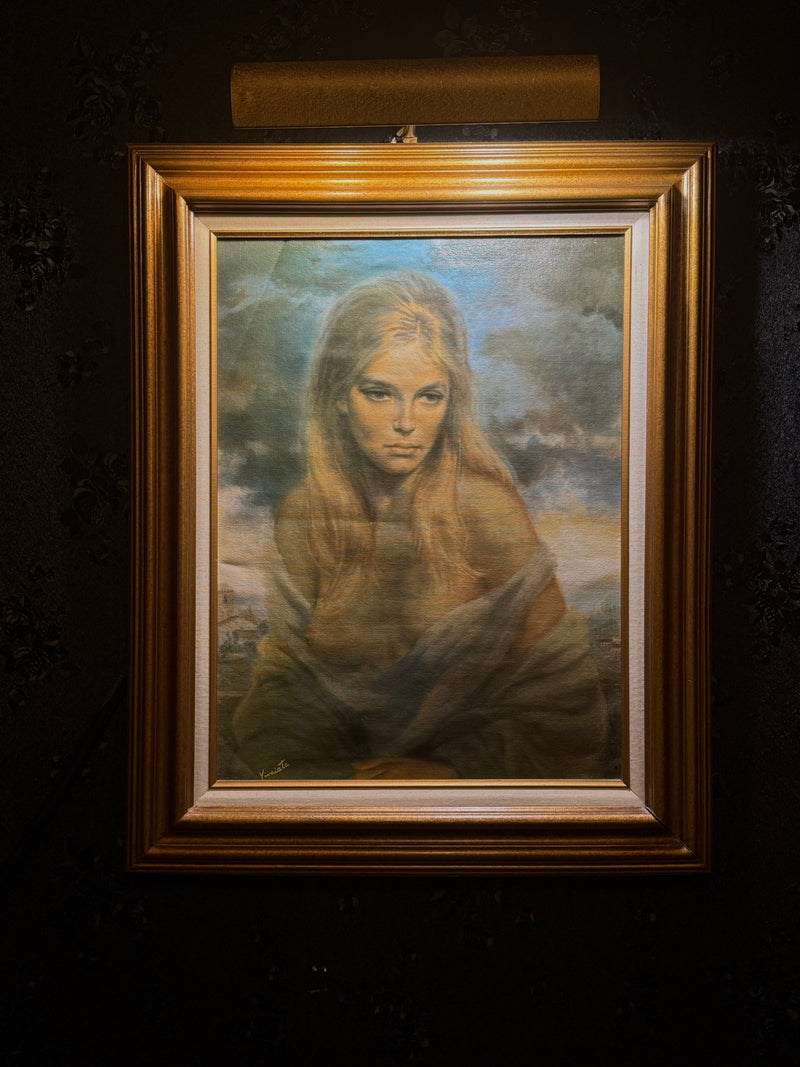
Joseph Wallace King led two artistic lives and kept them under two names. As Joseph Wallace King he was a society portraitist from Winston-Salem, North Carolina, whose sitters ran from Admiral Richard Byrd to Queen Elizabeth II and President Richard Nixon. As Vinciata, a name he took from a castle near Florence, he painted idealised women and nudes in the soft, glazed manner of the High Renaissance, and for some twenty years showed them at Hammer Galleries in New York. Girl of Valdarno, dated 1972 on the estate's own record of his work, is one of the best known of those images.
A Plantation Childhood and a Lost Arm
King was born on 11 May 1911 at Leatherwood Plantation in Horsepasture, Virginia, the eleventh of thirteen children of Annie Gordon Staples and Joseph Wallace King. His father managed a whiskey distillery, a plug tobacco company and his wife's family plantation. When the boy was three, the family house burned to the ground on Christmas Eve. At eleven, in July 1922, he lost his left arm after an accident on a seesaw. The estate's biography records that the loss turned him away from a childhood ambition of walking the tightrope and toward drawing and painting.
Winston-Salem, Washington and a Ventriloquist's Act
At Reynolds High School in Winston-Salem art classes proved decisive. He won a statewide poster contest in 1928 and again in 1930, and in October 1927 presented a portrait to Charles Lindbergh. In 1929 the Carolina Theatre in Winston-Salem hired him at twenty-two dollars a week. He went on to dress windows for department stores in Washington, D.C., toured clubs and theatres as a ventriloquist with a dummy named Brandywine, and studied at Catholic University and the Corcoran school when money allowed. In March 1930 he married his high school sweetheart and model, Earline Heath. A portrait of Admiral Byrd followed in 1931, and portrait commissions eventually drew him back to Winston-Salem for good.
The Birth of Vinciata
The decisive turn came through a patron. Charles Babcock, husband of the R.J. Reynolds heiress Mary Reynolds, backed the young painter, and King converted a blacksmith shop on the Reynolds estate into a studio. With that support he travelled to Italy and France to study the old masters at first hand, and out of those journeys came what the estate calls his Vinciata style. Elon University, which holds a large group of his paintings, describes the Vinciata works as stylistically reminiscent of the High Renaissance masters. He showed with success at Bernheim-Jeune Dauberville in Paris and was represented by Victor Hammer of Hammer Galleries in New York, where he exhibited exclusively for twenty years until a final show in 1977.
Portraits of the Powerful
Under his own name King remained a portrait painter of real reach. His recorded sitters include Queen Elizabeth II, in a portrait remembered for its relaxed pose, President Richard Nixon and several members of the Saudi royal family. Elon's collection includes his sketch of Nixon, an early portrait of the Queen and a self-portrait painted in the Vinciata manner. His work was noticed in Newsweek, Town & Country and Time and Tide.
Legislator and Showman
King never separated art from public life. Elected to the North Carolina House in 1950, he proposed highway rest stops and personalised licence plates, and he lost his seat in 1952, the same year he helped stage the celebrated Sultan of Kuwait hoax that raised money for the local Arts Council. In April 1990, nearly eighty, he drew national attention with a Lady Godiva ride through Winston-Salem in protest at a city tax increase. He made a film, Somebody Moved My Mountain, in 1975, and wrote an anecdotal autobiography, There Ain't No Rags in Beverly Hills.
Italy and the Last Portrait
In 1981 King married Deborah Coleman, who became his model, secretary and translator, and the couple lived much of the time in Italy. He died in January 1996, aged eighty-four, of a heart attack while at work on a portrait of a young girl. He left a large bequest of paintings to Elon University in North Carolina, where his widow also established an archive of his papers and photographs.
Why Vinciata Matters
Vinciata pictures sit at an unusual crossroads. They were painted by a trained, widely connected portraitist who looked hard at Leonardo and Botticelli, yet they found their largest audience in American living rooms, and the most popular compositions, Girl of Valdarno among them, circulated widely as framed reproductions on canvas. That makes the distinction between an original oil and a period reproduction the single most important question for any collector, and it makes a well framed example a genuine document of how Renaissance taste was brought home to postwar America by a one-armed painter from Winston-Salem.
A Life in the Record
Born 11 May at Leatherwood Plantation, Horsepasture, Virginia.
Loses his left arm at eleven and turns to drawing and painting.
Hired by the Carolina Theatre, Winston-Salem; studies in Washington; paints Admiral Richard Byrd.
Serves in the North Carolina House of Representatives.
Paints Girl of Valdarno under the name Vinciata.
Final exhibition at Hammer Galleries, New York, after twenty years of representation.
Rides as Lady Godiva through Winston-Salem in protest at a city tax increase.
Dies in January, aged 84, while at work on a portrait.
Vinciata brought the hush and glow of Renaissance portraiture into the American home, and Girl of Valdarno is the image that carried it furthest. We value it as a document of postwar taste by a painter whose own life was as theatrical as his pictures were serene.Viridian Eclection, Reno
Inquire About Available Works
Works by Joseph Wallace King come to the Eclection one at a time. If you own a work by Joseph Wallace King, or have letters, photographs or papers connected with the artist, we would like to hear from you.