Lee Reynolds
Studio Signature · Vanguard Studios · Beverly Hills · Mid-Century Decorative Painting
Lee Reynolds is one of the most familiar signatures in American decorative painting, and one of the most misunderstood. It is not quite the name of a painter. It is the trade name of Vanguard Studios in Beverly Hills, the business built in the 1960s by the artist and entrepreneur Lee Reynolds Burr, which supplied hand-painted canvases to furniture stores and interior designers across the country. Understanding that distinction is the key to collecting these pictures well, and to enjoying them for what they are.
Lee Reynolds Burr
Lee Reynolds Burr was born in Los Angeles in 1936, the son of Hazel Stuart Burr and Charles Reynolds Burr. Reynolds, his own middle name, was shared with his father. He attended Los Angeles High School, served in the United States Army and was honourably discharged in 1956, and took a fine arts degree at the University of Southern California.
Vanguard Studios
Burr founded Vanguard Studios in Beverly Hills in the 1960s; one dealer history gives the year as 1965. The idea was to put original oil paintings within reach of households that could not afford gallery art. Burr designed compositions and prototypes, and a team of artists he selected reproduced them by hand in assembly-line fashion for distribution to furniture retailers, decorators and showrooms. One account describes a hybrid method in which backgrounds were hand-painted, linework was sometimes silk-screened, and the final passages were finished by hand, allowing a staff painter to complete several large canvases in a day. His obituary describes the company as the leading national designer and manufacturer of wall decor, and Burr himself called it the largest distributor of decorative art in the world at the time.
A Name, Not a Hand
Burr was candid about what the signature meant. In his own words, Lee Reynolds was simply a trade name, attached to numerous artworks and designs at Vanguard. Paintings bearing the signature Lee Reynolds, he stated, were in every case painted by staff artists in the employ of the studio, and he insisted that Vanguard sold decorative art rather than collector art. By his own count he made no more than about two hundred original paintings and sculptures, while estimates for the canvases signed with variations of his name run into the hundreds of thousands, with one dealer history putting the figure above half a million.
After 1974
In December 1974 Vanguard Studios was sold to the Kirsch Company, which continued to use the Lee Reynolds name on its paintings; those works, as one gallery history puts it, were done by others. Burr went on to found East Park Gallery in Sylmar, California, in 1981, and his own large commissions hung in Joe Robbie Stadium in Miami and, as a twenty-one-foot triptych, at Los Angeles International Airport for more than two decades. He retired to Indian Wells in 1998 and died on 4 December 2017, aged eighty-one.
The Look of a Vanguard Canvas
Vanguard's range ran from mid-century abstraction to florals, usually at generous scale. The pictures were designed to answer a room, keyed to the colours of the upholstery and carpets of their decade, which is why they now read so vividly as documents of American interiors.
Why Lee Reynolds Matters
A Lee Reynolds canvas is a genuine hand-painted product of a named, well-documented studio, and a defining artefact of how postwar America decorated its homes. It is not the unique work of a single identified painter, and Burr would have been the first to say so. Collected on those honest terms, the best of them offer something rare at their price: real oil paint, real scale and real surface, with a story that belongs to the history of American design as much as to the history of painting.
A Life in the Record
Lee Reynolds Burr born in Los Angeles.
Honourably discharged from the United States Army.
Founds Vanguard Studios in Beverly Hills (1965 in one dealer history).
Vanguard grows into a leading national maker of wall decor, its canvases signed Lee Reynolds and painted by staff artists.
Vanguard sold to the Kirsch Company in December; the Lee Reynolds name continues in use.
Burr founds East Park Gallery in Sylmar, California.
Burr dies on 4 December, aged eighty-one.
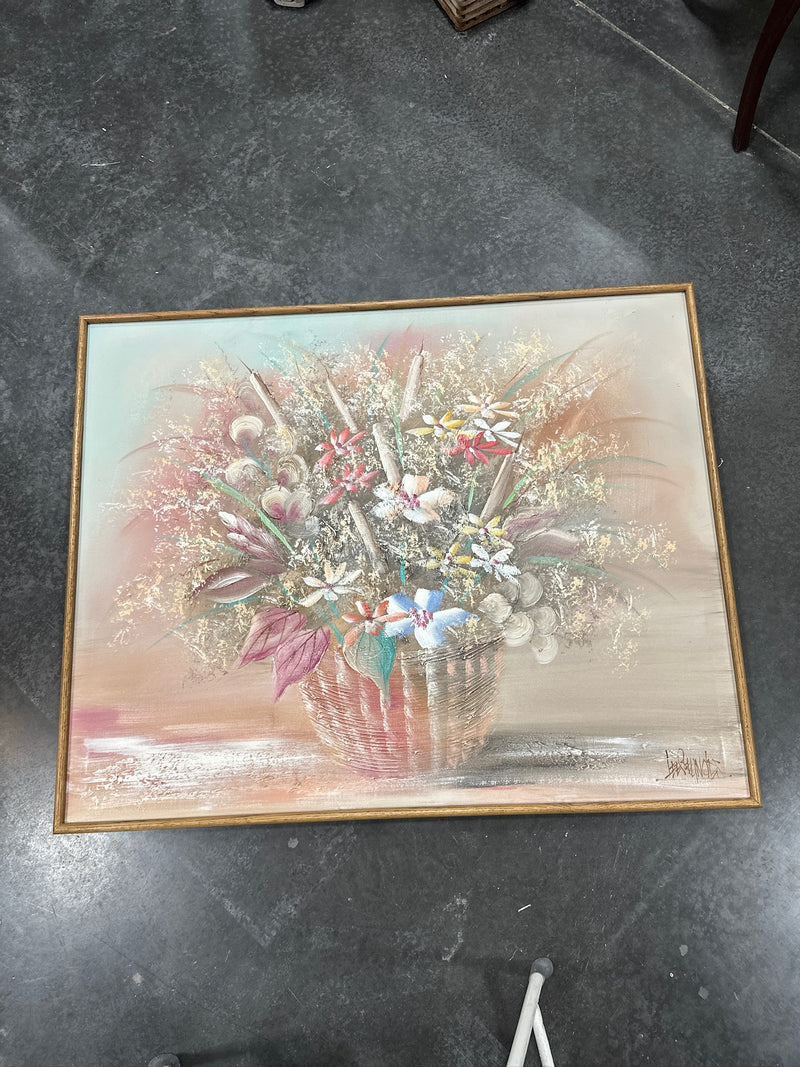
A large impasto floral signed Lee Reynolds enters the Eclection in Reno.
We value a Lee Reynolds canvas for what it truly is: a hand-built decorative painting from the studio that defined the American living-room wall. This floral is a strong example, heavily worked with the knife and held to a disciplined palette, and we present it as studio work, with the signature understood as the studio's name rather than one painter's hand.Viridian Eclection, Reno
Inquire About Available Works
Works by Lee Reynolds come to the Eclection one at a time. If you own a work by Lee Reynolds, or have letters, photographs or papers connected with the artist, we would like to hear from you.