Tassone
Draughtsman of the Hudson Valley · The Rosendale Trestle, Wallkill Valley Railroad
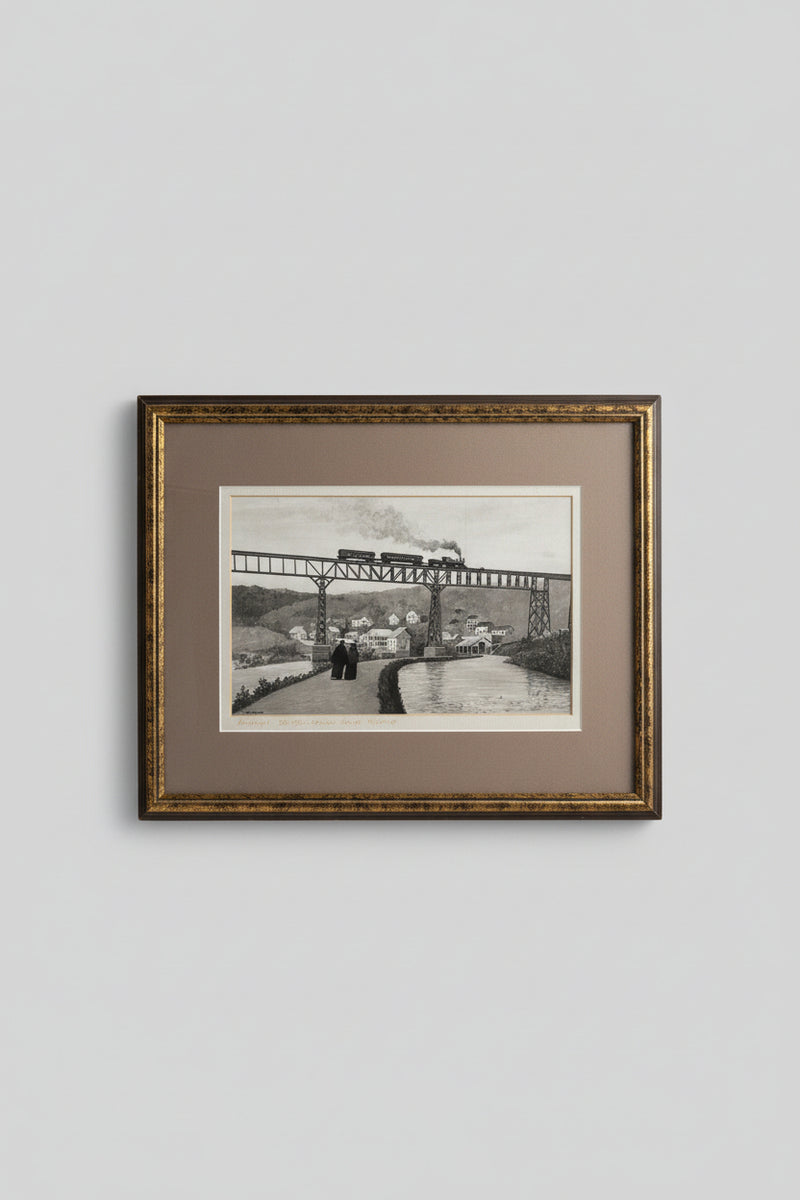
Tassone is the name lettered in neat block capitals in the lower left corner of our grisaille drawing of the Rosendale Trestle, the iron railroad bridge that has carried the Wallkill Valley line one hundred and fifty feet above Rondout Creek since 1872. The same artist signed the mat again by hand, in gold ink, beside a hand-lettered title: Rosendale Trestle, Wallkill Valley Railroad. We have not yet identified the artist, and this page sets out what the drawing itself tells us, what we know of its subject, and where the search has gone so far.
The Bridge
The Wallkill Valley Railroad was built north from Montgomery and New Paltz toward Kingston in the early 1870s, and at Rosendale it had to cross the deep valley of the Rondout Creek, the Delaware and Hudson Canal and the village road. The answer was a continuous iron truss on tall lattice towers, some 940 feet long and about 150 feet above the water. When it opened to traffic in April 1872 it was described as the highest span bridge in the United States, and the New York papers wrote it up as a piece of extraordinary railroad history. The line carried Rosendale natural cement, among other freight, the cement that went into the Brooklyn Bridge and the pedestal of the Statue of Liberty.
The trestle carried trains for more than a century, latterly at a crawl, until Conrail closed the line in 1977. It stood unused for decades, was bought with the railbed by the Wallkill Valley Land Trust and the Open Space Institute, and reopened on 29 June 2013 as the centrepiece of the Wallkill Valley Rail Trail.
A Drawing from a Photograph
The bridge was photographed from the moment it was finished. A large albumen print by John Reid of Paterson, New Jersey, in the Canadian Centre for Architecture, shows the Rosendale Bridge with a train, people and the Rondout Creek, and carries the bridge's dimensions and the names of its patentees and builders in the margin. Tassone's drawing contains exactly those elements: a small train of period coaches drawn by a wood burning locomotive high on the truss, the creek curving away beneath it, the village of Rosendale on the slope, and two figures in long dark coats standing on the path in the foreground. The costume and the locomotive belong to the 1870s or 1880s, not to the artist's own day, and the composition strongly suggests the drawing was made from one of those early photographs, or from a postcard after them.
The Hand
The drawing is in grisaille, shades of grey and black on white, which suits a picture made after a black and white photograph. The lattice of the towers is drawn with real precision, every diagonal accounted for, while the hillside, the trees and the water are handled more loosely in soft tone. The village houses are clean and simple. It is the work of a patient and practised draughtsman, the kind of picture made for a railroad enthusiast, a local historical society or a collector of Hudson Valley scenes.
Why Tassone Matters
Regional landmark drawings like this one were made in their thousands in the decades when the old railroads were closing, and they record a kind of affection the official histories leave out. This one shows the Rosendale Trestle as it was in its first years, when it was a wonder, and it was framed and signed with care. Its maker deserves a full name, and we will keep looking for it.
A Life in the Record
The Wallkill Valley Railroad builds the Rosendale bridge over Rondout Creek; opened April 1872.
John Reid of Paterson photographs the bridge with a train, people and the creek.
Conrail closes the Wallkill Valley line; the trestle falls out of use.
Tassone's drawing, after the early photographs, signed in the image and on the mat (date not recorded).
The restored trestle reopens as part of the Wallkill Valley Rail Trail.
Two people stop on the towpath, a train crosses a hundred and fifty feet above them, and the whole iron lattice is drawn stroke by stroke. Tassone went back to the bridge's first photographs to draw it, and signed it twice.Viridian Eclection, Reno
Inquire About Available Works
Works by Tassone come to the Eclection one at a time. If you can read the first name on the mat, know other Hudson Valley drawings signed Tassone, or own one, please tell us.