Wayne Zavosky

Wayne Zavosky

Realist Painter and Illustrator · Palo Alto and Culver City, California · Active 1968 to 1983

For a year this page was an open file: one canvas, a signature reading Zavosky 79', and no painter anywhere in the auction records or artist indexes. The name finally surfaced in two small notices from the first week of September 1974. The Westchester-Ladera Observer announced that artist Wayne Zavosky of Culver City would be the featured speaker at the Culver City Art Association, and the Los Angeles Times listed the same evening, describing a painter whose artistic emphasis was on realism. His subject that night was balance and control of composition, and how composition works with subject, colour and emotion.

The notice gave more than a name. By then Zavosky had written for American Artist magazine, had illustrated a new book called U. Zoo, was working on an art book of his own, and was preparing a show to tour Europe. Following the name backward through the archive turned up a whole early career: a young painter from the San Francisco Peninsula who studied at Foothill College, held a solo show at the Palo Alto library while still a student, won a painting prize from a juror at the California College of Arts and Crafts, and was singled out by the Los Angeles Times within two years of moving south. In 1983 he appears in the credits of a Columbia Pictures feature as a prop builder. Our dancer, signed and dated 1979, sits squarely in the middle of that working life.

The Record

1965

Listed among the graduating seniors of the San Francisco Peninsula in the Palo Alto Times.

1968

A Foothill College student, he holds a solo show of untitled paintings at Palo Alto's Main Library in March. Anne Holmes reviews it alongside a show by a painter twice his age.

1969

Wins a cash prize for painting in the Foothill College all-campus art show, judged by Prof. Larry McClary of the California College of Arts and Crafts, and graduates that June.

1971

Now in Los Angeles. A Los Angeles Times review of the show at Barnsdall singles out his "realistic-poetic" paintings.

1974

Living in Culver City. Featured speaker at the Culver City Art Association on September 11, with writing in American Artist, an illustrated book and a European touring show in preparation.

1979

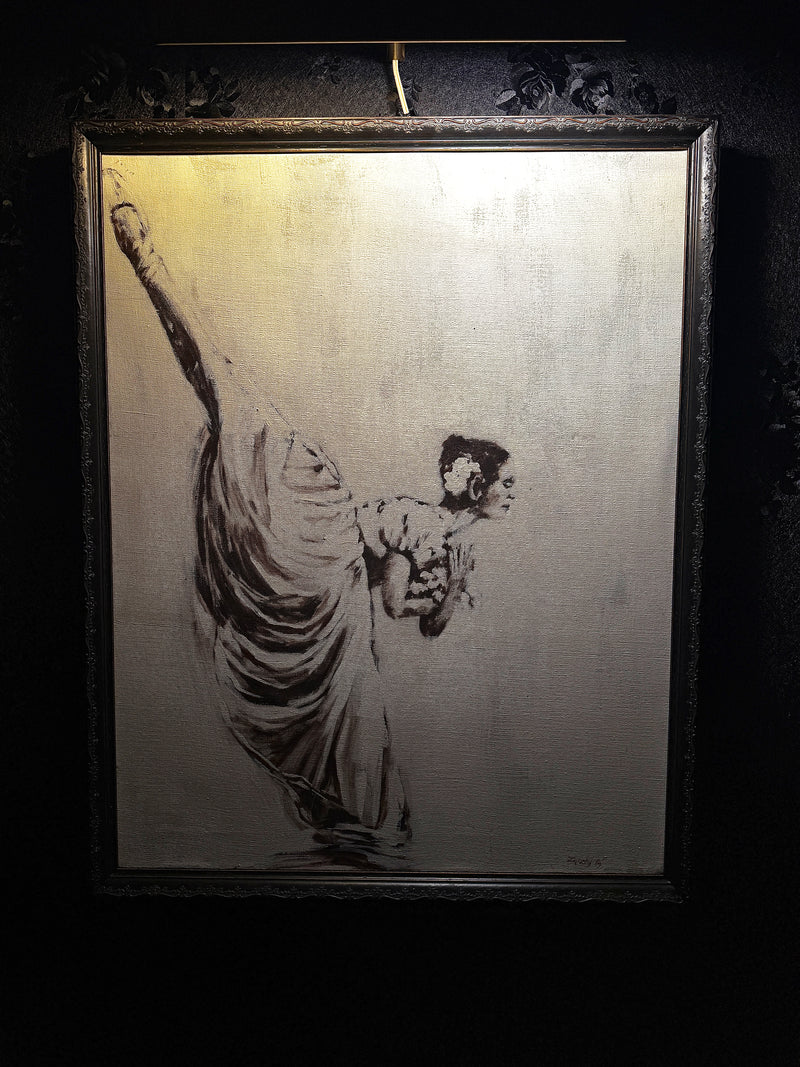
Paints the dancer in arabesque penchée now at the Eclection, signed and dated Zavosky 79'.

1983

Credited as a prop builder on the Columbia Pictures feature Spacehunter: Adventures in the Forbidden Zone.

2026

Identified by Viridian Eclection through the 1974 Culver City notices, after a year as an unsolved signature.

A rare surname, a realist figure painter working in Los Angeles in the seventies, and a figure painting signed with that name in 1979. We attribute the dancer to Wayne Zavosky. What we are still looking for is a second signed canvas to set beside it.
Viridian Eclection, Reno

Help Complete the Record

If you knew Wayne Zavosky, studied with him, own another of his paintings, or have a copy of U. Zoo or his writing for American Artist, we would like to hear from you. Every lead is checked and, where it holds up, added to this page with credit.

Inquire About This Piece
A hand that signed the way it painted.
Signed lower right · Zavosky 79'
Reading the Signature

A hand that signed the way it painted.

Zavosky 79'

The signature sits low at the right, small and upright, in the umber of the figure. The Z opens with a long leading stroke. The second letter is an open, angular a that is easy to misread as a v, which is how the name was mistranscribed before, ourselves included. The rest, o-s-k-y, is clear, with a looped descender on the y. There is no first name or initial: by 1979 the surname alone was his signature.

The date carries a small habit of the hand, 79', with the apostrophe after the numerals rather than before them. It is the first thing we will look for when another canvas by Wayne Zavosky surfaces, and the detail most likely to confirm one.

Inquire About This Piece →
A young painter who had tried all the latest isms.
Dancer in Arabesque Penchée · 1979
What the Critics Saw

A young painter who had tried all the latest isms.

A promising blend of schooled art and hip philosophy.

In March 1968 the Palo Alto Times critic Anne Holmes reviewed Zavosky's library show against an exhibition of watercolours at Stanford by a painter twice his age. On the surface, she wrote, the palms went to the older man, but he played safe, while the student risked something with every canvas. Some of it missed: she called a black, tree-framed sunset ghastly. But she praised a blue and green composition of pictorial symbols as beautifully executed, dynamically arranged and paradoxically serene, and judged a clipper ship by moonlight not really good but plainly imaginative, its school realism offset by an inventive perspective. He was already painting from loaded images, a skull, the Grim Reaper, Innocent Youth, and making them work.

A year later at Foothill his second-prize entry was a painting of orange, yellow and white nudes, figures the reviewer described as composed with complexity and arranged like the petals of a flower. In July 1971 the Los Angeles Times, reviewing the show at Barnsdall, singled out his realistic-poetic paintings, with those of Curtis Hoekzema, as a promising blend of schooled art and hip philosophy. The dancer of 1979 is the mature version of exactly that: a realist figure, carefully built, set in a field of open ground.

View the Painting →
A dancer bowing into a penchée, palms together.
1979 · Umber and white on canvas
The Painting

A dancer bowing into a penchée, palms together.

Two colours, one gesture, and a great deal of empty canvas.

The dancer folds forward from the hip while one leg sweeps up behind her in a long arabesque penchée, the skirt falling from it in deep diagonal folds. Her hands are pressed palm to palm at the chest, white flowers are tucked at the temple and gathered at the bodice, and her face, seen in profile, is that of a mature performer rather than a girl. Nearly half of the canvas is left as open ground.

The face and hands are built in flat blocks of dark and light that read like a photograph translated into paint, which suggests the painter worked from a performance image. The drapery, by contrast, is laid in with fast, loaded strokes and left alone. It is not production-line decorator work: there is no stock composition behind it, and none of our searches has turned up a repeat.

View the Painting →

From the Archive

Every statement on this page comes from a dated source below. Where we are inferring rather than reading, we say so.

How the painter was found

The signature was first misread as Zyvosky, and searches under every near spelling returned nothing in LiveAuctioneers, WorthPoint, Invaluable or the listed-artist indexes. Reading the name correctly opened the newspaper archive. Of the hundreds of California pages that carry the surname, seventeen name a Wayne Zavosky, all of them in California, running from the Peninsula to Culver City in 1974. The two September 1974 notices are the ones that call him an artist outright and place him in Los Angeles in the decade the dancer was painted.

Why we make the attribution

  • The name. Zavosky is among the rarest surnames in America, with a single household recorded in the 1920 census. Wayne Zavosky is the only painter of that name in any record we have found.
  • The place and decade. He was exhibiting, lecturing and writing about painting in Los Angeles in the 1970s. The canvas surfaced within a day's drive.
  • The kind of painter. The 1974 notices describe an emphasis on realism and on composition, subject, colour and emotion. The 1968 to 1971 reviews describe a figure painter working from charged images. The dancer is a realist figure, carefully composed, painted in a restricted palette.
  • What is still missing. A second signed and documented work by him, for comparison of the hand and the habit of the apostrophe after the date.

Still open

His writing for American Artist, the illustrated book U. Zoo, his own art book and the European touring show announced in 1974 have not yet been traced. Nor has his work after 1983. We will add each one as it is found.

Sources

Every Original Is One of One

View the Full Collection