American Oak Writing Desk & Side Chair, Quartersawn Golden Oak, c. 1910–1930
Viridian Eclection


The Piece A compact single-pedestal desk and its chair, sold together the way they were used. The desk is quartersawn oak at a scale that makes it useful now — narrow enough for a hallway, deep eno...
The Piece
A compact single-pedestal desk and its chair, sold together the way they were used.
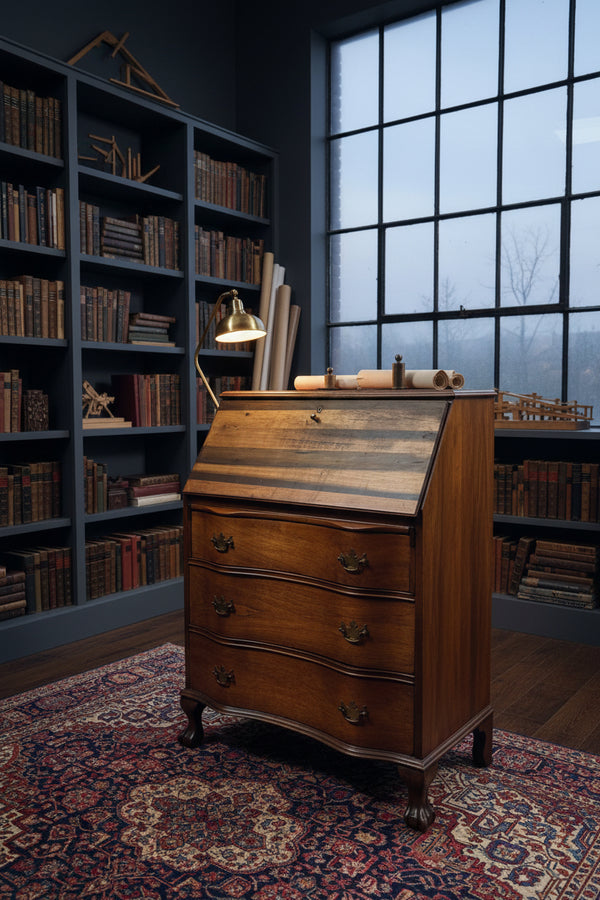
The desk is quartersawn oak at a scale that makes it useful now — narrow enough for a hallway, deep enough to actually work at. Three drawers stack on the right pedestal, two still carrying their original brass keyhole escutcheons, each faced with an applied rectangular pull cut from the same oak as the front. Above them, hidden until you want it, a full pull-out writing slide extends the work surface by most of a foot — the detail that separates a real desk of this period from a table with drawers. The kneehole is open and unpaneled, the apron plain, and the legs are square and gently tapered, with the ray flake of quartersawn oak running up their faces in that flecked, tiger-striped figure that only shows when the log is cut on the quarter.
The chair is the right chair, which matters more than it sounds. Solid oak, with a saddle-scooped plank seat, a shaped crest rail, splayed rear legs, and a bentwood arch bracing the front — a factory side chair from the same decade and the same golden-oak vocabulary. The seat has worn down to a soft sheen in the middle and the grain has raised slightly around it. Somebody sat here for years.
Both pieces carry the warm golden tone that gives the period its name, worn through where hands and papers went and dark where they didn't.
History & Provenance
Between roughly 1900 and 1930, American factories in Grand Rapids, Rockford, and Jamestown turned out oak desks like this one by the tens of thousands — for schoolrooms, boarding houses, back offices, and the corner of a bedroom where a family kept its correspondence. Quartersawn oak was the standard because it was hard, it resisted warping, and the cut exposed the medullary rays as a decorative figure without any carving required.
The desk carries the transitional vocabulary of the moment: the tapered leg and unornamented apron of the Arts and Crafts reform applied to a form that was still, underneath, a Victorian office desk. The chair belongs to the same world — the plank-seat side chair was the default seat of American working rooms for thirty years.
Neither piece carries a surviving maker's stamp, which is ordinary for the type. Most left the factory with a paper label glued under a drawer or beneath a seat and lost it within a decade. What matters here is that the two have stayed together, and pairs that have stayed together are far less common than either piece alone.
Product Details
| Field | Detail |
|---|---|
| Object | Writing desk with pull-out slide, and matched side chair — sold as a set of two |
| Origin | American |
| Form — Desk | Single right pedestal, three drawers, open kneehole, square tapered legs, plain apron |
| Form — Chair | Saddle-scooped plank seat, shaped crest rail, splayed rear legs, bentwood front arch |
| Material | Quartersawn oak, golden oak finish, brass keyhole escutcheons |
| Marks | No maker's mark located on either piece |
| Era | c. 1910–1930 |
| Condition | Both pieces structurally sound and ready to use. Desk: honest surface wear to the top including ring marks and darkened spots, scattered nicks to edges and legs, finish worn on the writing slide; drawers run smoothly; original hardware. Chair: seat worn smooth through the center with slightly raised grain, joints tight. Condition Guaranteed. |
| Availability | One of a Kind — 1 Available |
Why It Belongs in Your Home
The reason to buy a desk this size is that it fits where a desk shouldn't. Under a window in a bedroom, against the long wall of an entry as a console with drawers that actually hold things, in a guest room that has to double as an office two weeks a year — a full-size desk kills all three of those rooms and this one doesn't.
Buying it with the chair solves the harder problem. A desk alone sends you looking for a seat that won't fight it, and almost everything modern does: wrong height, wrong wood, wrong century. This chair was made for this scale, sits at the right height, and stows fully under the top when you're not using it. Pull it out and the corner becomes a workspace; push it in and it reads as a console with a chair beside it.
It's oak, so it goes with everything old and most things new. Against a dark wall the pair reads warm; against cream it recedes and lets whatever's above it do the talking.
Same two notes as before on the photography: these are booth shots with the fence controller, the toaster, and the basket in frame. Before it goes up, re-shoot at 3:4 against neutral ground — the pair together straight on, the chair alone, a leg detail showing the ray flake, the brass escutcheons, and the slide pulled out. The slide shot and the pair-together shot are the two that sell it.
Want me to build the PDP layout page for this one, or keep moving through the write-ups?
Every piece is packed with professional-grade materials: multiple foam layers, double-boxing, directional and fragile handling labels. For large furniture we use custom timber crating. We photograph packing before dispatch and can provide images on request.
White-glove delivery is complimentary within 100 miles of Reno, NV. National shipping quotes provided at checkout. All shipments are photographed and documented. Damage claims must be filed with the carrier; we provide all documentation needed to support your claim.
Local pickup is available at Viridian HQ (Reno, NV) with 2–4 days notice. Contact us to arrange. Private viewings also available.
All antique and vintage items are sold as described and all sales are final. Each listing includes detailed condition notes and photographs so you can make a fully informed decision. We encourage buyers to ask questions — about condition, dimensions, finish, provenance — before purchasing.
Antiques are irreplaceable and one-of-a-kind. Carrier handling is outside our control once a piece has left our facility, and major carriers including FedEx do not insure antiques. We do everything within our power to ensure safe transit, but cannot accept liability for carrier damage. If damage occurs in transit, we will provide full documentation to support your carrier claim.
Have a question? — we're happy to provide additional photos, condition detail, or discuss the piece directly.