Antique Forged Wrought Iron Pricket Candle Holders, Pair, c. 1870–1910
Viridian Eclection


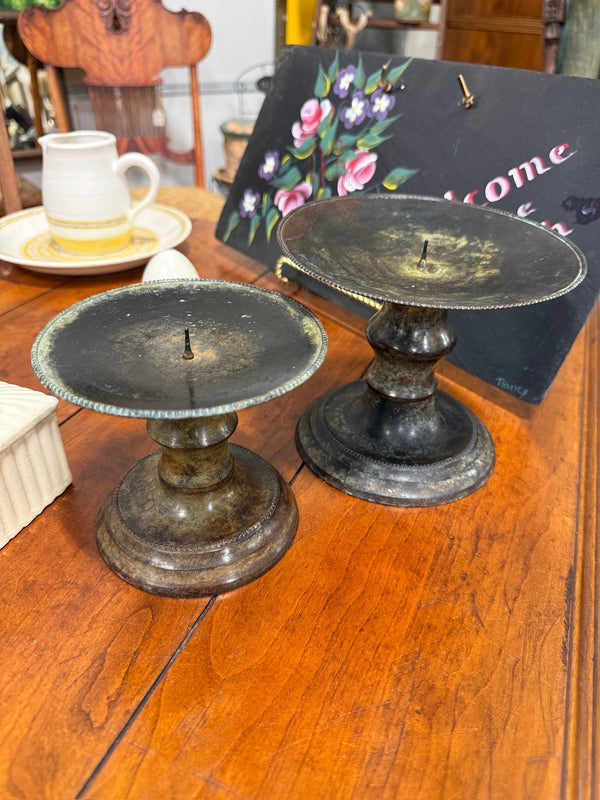
The Piece A pair of hand forged wrought iron candle holders, each a wide shallow pan carried low over a flat spiral scroll, with a short pricket spike standing in the centre of the pan. The scroll ...
The Piece
A pair of hand forged wrought iron candle holders, each a wide shallow pan carried low over a flat spiral scroll, with a short pricket spike standing in the centre of the pan.
The scroll is the whole design. A length of bar has been drawn out, tapered, and coiled into a flat spiral of about a turn and a half that lies down on the table, then swept up and over to carry the pan. It works as foot, stem and counterweight at once, and it means the candle sits low and wide rather than up on a stalk.
The pans are shallow saucers, generously proportioned against the height of the piece, so they catch drips properly instead of decoratively. The pricket at the centre of each is short and blunt, meant to take a pillar or a thick taper pushed down onto it.
The forging shows everywhere. Hammer facets run along the bar, the section is oval and slightly faceted rather than true round, the taper thins unevenly the way a drawn bar does, and the two scrolls are close but not identical, one curling a little tighter than the other with the terminals sitting at different angles.
Both carry old candle wax around the spike, pale and hardened into the corrosion, and the two have aged differently: one has gone a warm brown with an olive cast, the other a colder dark grey.
History & Provenance
These are entirely hand work, and two details carry the date.
The first is the joint at the spike. The shank does not sit in a drilled socket and it is not brazed or riveted with a separate rivet. It passes up through the pan and the end of it has been upset, split, and the two halves folded down and peened flat against the metal, so the displaced iron stands in a rosette around the hole. That is a split tenon set hot on an anvil, and it is a joint a smith makes because he has a fire and a hammer, not one a shop makes because it is quick.
The second is what the split reveals. The tongues have torn open along a stringy, laminated grain rather than shearing clean, and the same longitudinal fibre shows on the outer curve of the scrolls. That is wrought iron, with its slag stringers running the length of the bar. It is not mild steel, which splits with a clean face and shows no fibre at all. Wrought iron was the ordinary smith's bar through the nineteenth century, was displaced by cheap mild steel from the 1880s onward, and by the 1910s a shop working from stock was using steel. Fibrous wrought iron in a domestic object is therefore a real ceiling, not a guess.
The pans agree. The undersides show shallow overlapping planishing facets and the rim varies in thickness and runs slightly out of true around its circumference. A spun pan carries concentric tool rings and a dead true rim; a pressed pan is of uniform thickness with a sharp even edge. These have neither. They were raised by hammer over a stake.
Taken together that is a smith making a working object from wrought bar for household use, in an era when candles were still the light in the room. It is not a revival piece. Arts and Crafts ironwork of the early twentieth century advertises itself, with heavy stock, hammer texture left deliberately coarse as a style statement, and applied riveted collars. There is none of that here. These are plain, thin, economical and quick, and the hammer work is functional rather than expressive.
No maker's mark, stamp or label is present on either piece, which is expected for country smith work and gives an outer limit rather than a starting point.
A correction is owed. These were first catalogued at c. 1920 to 1970 on a reading that the pans were machine formed and that the spike joint could not be resolved under the wax. Both readings were wrong. Close examination of the joint and of the pan undersides shows hand raising and a hot split tenon in fibrous wrought iron, and the date has been moved back accordingly.
Product Details
| Era | c. 1870–1910. Dated from construction and material. The spike is a split tenon, upset and peened hot through the pan, and the split has opened along a fibrous laminated grain that identifies the bar as wrought iron rather than mild steel. Mild steel displaced wrought iron as the general smith's stock from the 1880s onward and had replaced it by the 1910s, which sets the ceiling. The pans are hammer raised over a stake with overlapping planishing facets and an untrue rim, with no spinning rings or pressing marks. No mark or label is present, and that absence gives an outer limit only |
| Maker | Unattributed smith work. No mark found |
| Form | Low pricket candle holders. Hammer raised circular drip pan with a central spike, carried on a tapered bar coiled into a flat spiral scroll foot |
| Material | Wrought iron, hand forged throughout |
| Quantity | Sold as a pair. Close but not identical, as hand work is |
| Marks | None |
| Dimensions | Each approximately 7 in. long by 5 in. across the pan by 4 in. high |
| Condition | Very good honest condition, offered as found. Both sound and heavy with no cracks, breaks or repairs. Scrolls true and both sit flat without rocking. Pans undented, prickets straight and firm. Old hardened candle wax around both spikes and light surface corrosion throughout. Differing patina between the two, one warm brown, the other dark grey. Not cleaned, wire brushed or waxed |
Why It Belongs in Your Home
Most candle holders lift the flame up. These put it down, which is a different and more useful thing. Low light on a dining table lets people see each other over it rather than around it, and on a mantel, a hearth or a windowsill a low flame reads as warmth instead of ceremony.
The scroll gives them a shadow, and that is the part worth paying for. Lit from above or beside, the flat spiral throws a curl of shadow across whatever they stand on, so the object keeps working when the candle is out.
Black iron is the easiest material in the house to place. It sits against oak, walnut, stone, plaster, linen and brick without needing anything to mediate, and a pair gives a surface symmetry that a single piece cannot.
What separates these from the forged iron a shop can buy new is that they are wrought iron, hand raised and hot joined, made when a candle was the light and not the mood. For a dealer that is a pair you can catalogue as antique and defend on the object itself, which is a different conversation from selling atmosphere.
Every piece is packed with professional-grade materials: multiple foam layers, double-boxing, directional and fragile handling labels. For large furniture we use custom timber crating. We photograph packing before dispatch and can provide images on request.
White-glove delivery is complimentary within 100 miles of Reno, NV. National shipping quotes provided at checkout. All shipments are photographed and documented. Damage claims must be filed with the carrier; we provide all documentation needed to support your claim.
Local pickup is available at Viridian HQ (Reno, NV) with 2–4 days notice. Contact us to arrange. Private viewings also available.
All antique and vintage items are sold as described and all sales are final. Each listing includes detailed condition notes and photographs so you can make a fully informed decision. We encourage buyers to ask questions — about condition, dimensions, finish, provenance — before purchasing.
Antiques are irreplaceable and one-of-a-kind. Carrier handling is outside our control once a piece has left our facility, and major carriers including FedEx do not insure antiques. We do everything within our power to ensure safe transit, but cannot accept liability for carrier damage. If damage occurs in transit, we will provide full documentation to support your carrier claim.
Have a question? — we're happy to provide additional photos, condition detail, or discuss the piece directly.
You'll Also Love
Browse Candle Holders →