Antique Pine Two-Door Cupboard in Wormwood Boards, c. 1875–1910
Viridian Eclection


The Piece A small country pine cupboard built from solid boards riddled with old woodworm, with two plank doors over an open two-compartment base. Behind the doors are two fixed shelves dividing th...
The Piece
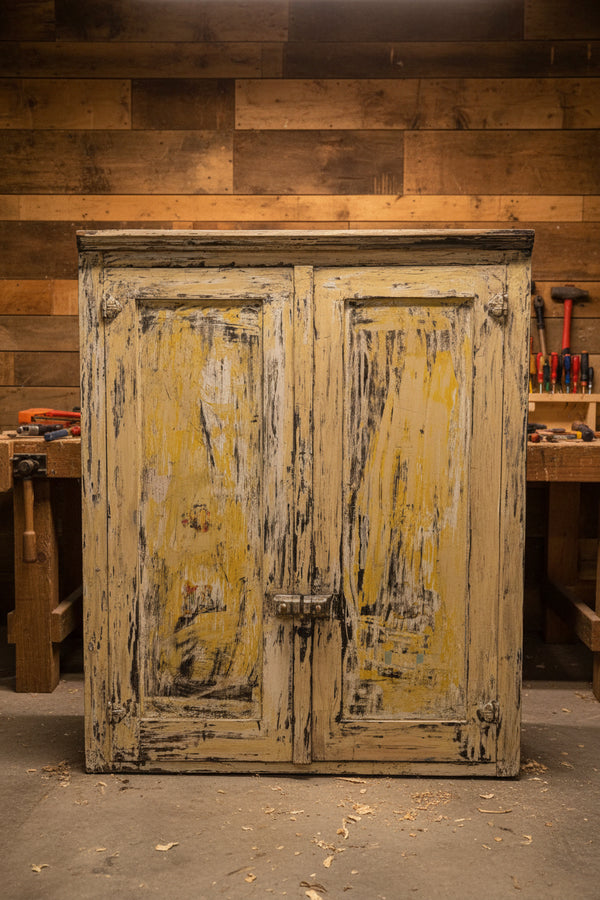
A small country pine cupboard built from solid boards riddled with old woodworm, with two plank doors over an open two-compartment base. Behind the doors are two fixed shelves dividing the interior into three bays, and below the door line the case continues into a pair of open cubbies split by a central divider, so the lower third stays accessible without opening anything.
The top is a separate board with a rounded moulded edge that oversails the case on three sides. The sides are single wide boards running the full height, and the back is solid plank laid up in wide horizontal boards with the seams showing. There is no plywood anywhere on the piece.
The front carries two original catches. At the top of the door gap is a hand-forged iron turn button: a flat S-scroll swinging across the gap on a square-shanked pivot. It is not a casting. The outline wanders, the thickness changes along its length, the two ends are not mirror images, and the pivot aperture is square rather than round, which is how a smith fixed a turn before round machine screws became the default. Below it is a cast openwork escutcheon of rococo scrollwork with a shaped thumb bar.
The wood is a warm orange-brown with strong flame figure through the door faces and the top, and the worm holes read dark against it across the whole front.
History & Provenance
Two things date this cupboard, and both of them are on the front of it.
The older is the forged iron turn button. A smith made it, one at a time, which is why no two parts of it match. Country cupboards were fastened this way for centuries, so on its own it sets no floor. What it tells you is the kind of shop this came out of: one where the nearest blacksmith was a shorter trip than the nearest hardware catalogue.
The newer of the two is the one that actually dates the piece. Cast cabinet latches of this sort, an openwork escutcheon with a shaped thumb bar, only became generally available once foundries were turning out furniture hardware in volume, which happened from about 1870. Before that a cupboard of this class got a wooden turn or a smith-made iron one, because a cast latch was not a thing you could simply buy. The rococo scrollwork on it is a Victorian revival idiom, and by the Edwardian period the same fittings are noticeably plainer. That puts the latch in the last quarter of the nineteenth century or the first decade of the twentieth.
The construction agrees. Single pine boards wide enough to run the full height of a case side, and a back laid up in wide solid planks rather than thin panel, were ordinary while that stock was cheap and became uncommon once it was not. Commercial casework had largely moved to narrower glued-up stock by the years after the First World War.
Then there is the worm, which is worth a paragraph because worm holes are one of the most commonly faked signals in the furniture trade. Refinishers produce them with ice picks, finishing nails and sixteenth-inch drill bits, and the giveaways are consistent: the fakes come out shallow, they sit in tidy clusters of four or five meant to imitate an emergence, and at least one edge of each hole is dull where the tool was levered back out. What is here does not read that way. The holes vary in size, the distribution is genuinely uneven across the two doors rather than following a formula, and there are elongated surface grooves where old galleries running just under the skin of the timber have broken through. Faking does not bother to reproduce those. Infestation on this scale is the work of decades.
Taken together the cupboard is offered as c. 1875 to 1910.
Two honest notes on its present state. It has been refinished, so the surface is a modern one over old wood and not an original patina. And the keeper plate that the thumb bar now works into is a twentieth-century casement window catch, fitted by the current owner to make the latch close properly; the escutcheon and thumb bar it works against are original to the cupboard, as is the iron turn above. Anyone wanting the front entirely correct would swap that one keeper for a period cupboard catch, which is a ten-minute job.
Product Details
| Type | Small country two-door pine cupboard with open base compartments |
| Material | Solid pine with extensive old woodworm, solid plank back, no plywood |
| Storage | Two fixed interior shelves behind the doors, two open cubbies below |
| Hardware | Original hand-forged iron turn button on a square-shanked pivot; original cast rococo escutcheon and thumb bar; replacement keeper plate and hinges |
| Finish | Refinished by the current owner over the original boards |
| Era | c. 1875–1910 |
| Width | 24 in. |
| Depth | 12 in. |
| Height | 33 in. |
| Condition | Structurally sound and standing square, doors hanging true and both catches working. Extensive old woodworm throughout the doors and case, left visible rather than filled. Refinished surface. Replacement keeper plate and hinges, and several redundant drilled holes near the latch from earlier fittings. General marks and handling wear consistent with age. |
Why It Belongs in Your Home
The size is the useful thing. At two feet wide and a foot deep it slots into a hallway, a bathroom, a mudroom or beside a bed, where a full-depth cupboard would not go, and the open base means the things you reach for daily stay out while everything else goes behind doors.
The wormwood is the reason to want it. Reclaimed boards with this much beetle history in them are sought after in their own right, and here they are the faces rather than something hidden, so the whole front reads as texture. A cupboard this small that is genuinely of its period, still wearing the hardware it was built with, is harder to find than the big ones.
Every piece is packed with professional-grade materials: multiple foam layers, double-boxing, directional and fragile handling labels. For large furniture we use custom timber crating. We photograph packing before dispatch and can provide images on request.
White-glove delivery is complimentary within 100 miles of Reno, NV. National shipping quotes provided at checkout. All shipments are photographed and documented. Damage claims must be filed with the carrier; we provide all documentation needed to support your claim.
Local pickup is available at Viridian HQ (Reno, NV) with 2–4 days notice. Contact us to arrange. Private viewings also available.
All antique and vintage items are sold as described and all sales are final. Each listing includes detailed condition notes and photographs so you can make a fully informed decision. We encourage buyers to ask questions — about condition, dimensions, finish, provenance — before purchasing.
Antiques are irreplaceable and one-of-a-kind. Carrier handling is outside our control once a piece has left our facility, and major carriers including FedEx do not insure antiques. We do everything within our power to ensure safe transit, but cannot accept liability for carrier damage. If damage occurs in transit, we will provide full documentation to support your carrier claim.
Have a question? — we're happy to provide additional photos, condition detail, or discuss the piece directly.
You'll Also Love
Browse Cabinets →