Coronet Limoges Chrysanthemum Charger, Rococo Molded Rim with Heavy Gilding, George Borgfeldt, c. 1906–1920
Viridian Eclection


The Piece A large French porcelain charger in the full Belle Époque manner, with a boldly molded rococo rim and a spray of chrysanthemums drifting across the well. The rim is the first thing you no...
The Piece
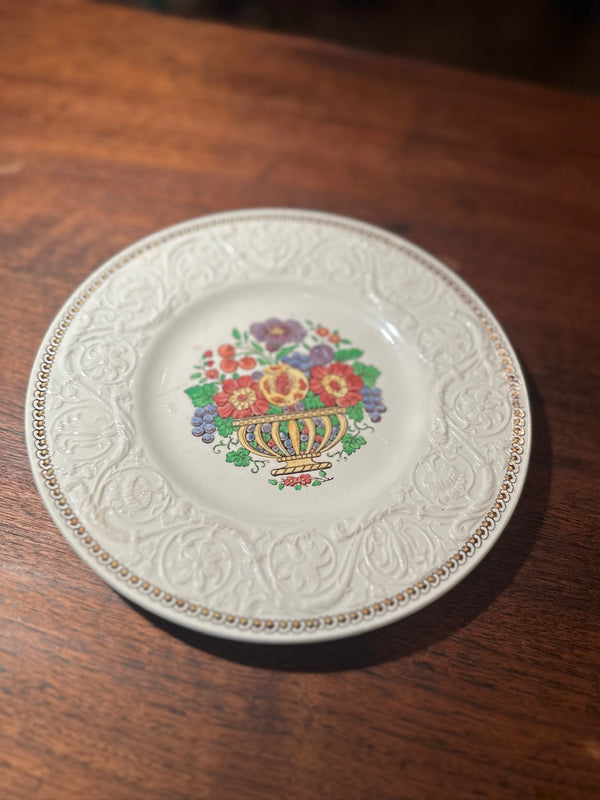
A large French porcelain charger in the full Belle Époque manner, with a boldly molded rococo rim and a spray of chrysanthemums drifting across the well. The rim is the first thing you notice: deep undulating scallops, raised shell and scroll relief pressed into the blank itself, and a beaded inner edge, all finished in a wide band of matte gold that carries a bright burnished highlight along the outermost lip.
The decoration is loose and confident. Shaggy chrysanthemums in raspberry and shell pink open across the center, worked up against creamy whites and pale acid-greens, with a few tighter buds and a single rose tucked into the upper left. The palette stays deliberately soft — nothing is outlined, edges dissolve into the white ground, and the whole thing reads more like a watercolor than a china pattern. The porcelain beneath is the hard-paste Limoges body: thin, dense, and bright, and the light passes through the thinner passages when you hold it up.
The reverse carries the green Coronet crown mark and a second green whiteware mark, both under the glaze.
History & Provenance
Coronet was not a French factory. It was the mark of George Borgfeldt & Company of New York — one of the great American importing houses of the period — who commissioned porcelain blanks from the Limoges factories, had them decorated to their own specification, and stamped the results with their crown. The mark was in use roughly between 1906 and 1920, which dates this piece closely, and the presence of two marks is exactly what you would expect: one for the whiteware maker, one for the decorating and importing house.
The chrysanthemum is a period signal in itself. Western taste discovered the flower through the Japonisme wave of the 1870s and 80s, and by the turn of the century it had become the fashionable bloom of the age — a favorite of the Art Nouveau decorators for exactly the reason it appears here: the ragged, asymmetrical petals suit a loose painterly hand far better than a rose does. Limoges gilding of this weight was reserved for the better grades of the trade; the wide matte-and-burnished band on this rim is real gold, applied and fired, not a printed lustre.
Product Details
| Field | Detail |
|---|---|
| Object | Charger or cake plate |
| Origin | Limoges, France; decorated and imported by George Borgfeldt & Co., New York, under the Coronet mark |
| Form | Wide shallow plate with deeply scalloped rococo rim, molded shell and scroll relief, and beaded inner edge |
| Material | Hard-paste Limoges porcelain with polychrome floral decoration and a broad fired-gold rim band |
| Marks | Green underglaze Coronet crown mark reading LIMOGES CORONET FRANCE, with a second green star-form Limoges whiteware mark |
| Era | c. 1906–1920, the years the Coronet mark was in use |
| Condition | Very good antique condition. No chips, cracks, hairlines, or restoration, and the porcelain rings true. Decoration is bright and unfaded. The gold rim shows honest wear with thinning and light rubbing along the raised high points of the scallops, as gilded porcelain of this age nearly always does, and a few small dark firing specks appear in the ground. Condition Guaranteed. |
| Availability | One of a Kind — 1 Available |
Why It Belongs in Your Home
A charger this size is a decorating tool, not just a dish. Hang it on a wall — alone above a doorway, or as the anchor of a plate grouping — and the gold rim does the work of a frame. Lean it on a plate stand on a console, a mantel, or the back of a sideboard and it fills the space a small painting would, for considerably less. Use it as a cake stand top, a cheese board, or the base of a centerpiece and it earns its keep at the table.
The palette is the argument for it: soft pink, cream, and acid green against white, with a gold edge that picks up brass, candlelight, and warm wood. It sits as easily in a modern room as a traditional one, which is more than most antique porcelain can claim. A note on care: hand wash in warm — not hot — water with a soft cloth, and keep the gold out of the path of any scrubbing. Never the dishwasher and never the microwave; detergent strips fired gold in a single cycle and metallic gilding will arc. Store with felt or paper between plates rather than stacking bare.
Every piece is packed with professional-grade materials: multiple foam layers, double-boxing, directional and fragile handling labels. For large furniture we use custom timber crating. We photograph packing before dispatch and can provide images on request.
White-glove delivery is complimentary within 100 miles of Reno, NV. National shipping quotes provided at checkout. All shipments are photographed and documented. Damage claims must be filed with the carrier; we provide all documentation needed to support your claim.
Local pickup is available at Viridian HQ (Reno, NV) with 2–4 days notice. Contact us to arrange. Private viewings also available.
All antique and vintage items are sold as described and all sales are final. Each listing includes detailed condition notes and photographs so you can make a fully informed decision. We encourage buyers to ask questions — about condition, dimensions, finish, provenance — before purchasing.
Antiques are irreplaceable and one-of-a-kind. Carrier handling is outside our control once a piece has left our facility, and major carriers including FedEx do not insure antiques. We do everything within our power to ensure safe transit, but cannot accept liability for carrier damage. If damage occurs in transit, we will provide full documentation to support your carrier claim.
Have a question? — we're happy to provide additional photos, condition detail, or discuss the piece directly.