Franciscan Desert Rose Dinnerware Collection, c. 1940s–1950s Hand-Painted California Earthenware
Viridian Eclection


The Piece The most beloved dinnerware pattern America ever produced, in its original California form. Each piece of Desert Rose begins with an embossed border — wild roses, buds, and briar stems ra...
The Piece
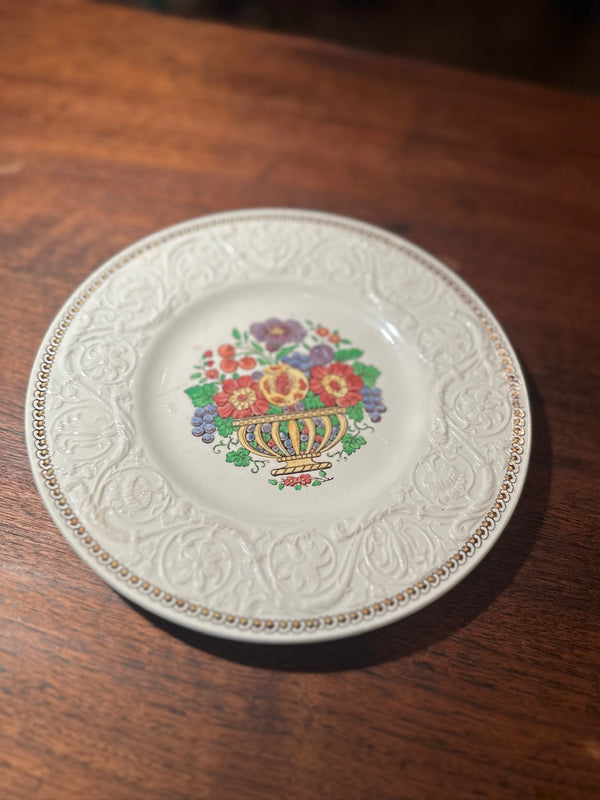
The most beloved dinnerware pattern America ever produced, in its original California form. Each piece of Desert Rose begins with an embossed border — wild roses, buds, and briar stems raised in relief from the cream earthenware itself — then brought to life by hand: blush-pink petals, speckled yellow centers, and leaf-green foliage brushed on by decorators at the Gladding, McBean & Co. plant in Los Angeles. No two pieces carry quite the same stroke, which is exactly the point.
This collection comprises dinner plates, saucers, and fruit bowls, each bearing the circular "Franciscan — Made in California U.S.A." backstamp of the pattern's early decades — the mark collectors look for, from the era before production ever left American soil.
History
Gladding, McBean & Company began in 1875 as a Northern California maker of clay pipe and architectural terracotta — its tilework still faces landmark buildings across the West. In 1934 the company turned its kilns to tableware under the Franciscan name, and in 1941 introduced Desert Rose: a pattern that captured California's romance with its own wild landscape and never let go. It went on to become America's best-selling dinnerware pattern of all time, gracing everyday tables for four decades until the Los Angeles plant closed in 1984 and production passed overseas.
The English-made pieces that followed never carried the same hand; it is the California originals — heavier in the hand, warmer in the glaze, each rose painted by a decorator on a Glendale production line — that collectors seek today. Desert Rose has since become the signature of the collected American kitchen: familiar enough to feel like memory, distinctive enough to anchor a table.
Product Details
| Attribute | Detail |
|---|---|
| Period | c. 1940s–1950s (early circular California backstamp) |
| Origin | Los Angeles, California |
| Maker | Gladding, McBean & Co., Franciscan Ware |
| Material | Cream earthenware, embossed and hand-painted underglaze decoration |
| Style | American traditional / California ranch |
| Pieces | Dinner plates, saucers, and fruit bowls; count to be confirmed |
| Condition | Good vintage condition with honest use. Scattered small rim chips to the painted border on several pieces, noted in photographs and reflected in pricing; glaze and painted decoration remain strong throughout. Condition Guaranteed. |
Why It Belongs In Your Home
Desert Rose is the rare pattern that works harder mixed than matched. A stack of these plates warms open shelving instantly; a single fruit bowl catches rings and keys on an entry console; the full run sets a Sunday table that feels inherited rather than bought. The palette — cream, blush, leaf green — is the soft heart of the collected kitchen, and because these are early California pieces, they carry the weight and warmth the pattern was famous for. Millions of American tables started here. Yours can pick up the thread.
Every piece is packed with professional-grade materials: multiple foam layers, double-boxing, directional and fragile handling labels. For large furniture we use custom timber crating. We photograph packing before dispatch and can provide images on request.
White-glove delivery is complimentary within 100 miles of Reno, NV. National shipping quotes provided at checkout. All shipments are photographed and documented. Damage claims must be filed with the carrier; we provide all documentation needed to support your claim.
Local pickup is available at Viridian HQ (Reno, NV) with 2–4 days notice. Contact us to arrange. Private viewings also available.
All antique and vintage items are sold as described and all sales are final. Each listing includes detailed condition notes and photographs so you can make a fully informed decision. We encourage buyers to ask questions — about condition, dimensions, finish, provenance — before purchasing.
Antiques are irreplaceable and one-of-a-kind. Carrier handling is outside our control once a piece has left our facility, and major carriers including FedEx do not insure antiques. We do everything within our power to ensure safe transit, but cannot accept liability for carrier damage. If damage occurs in transit, we will provide full documentation to support your carrier claim.
Have a question? — we're happy to provide additional photos, condition detail, or discuss the piece directly.