Hand-Thrown Studio Stoneware Mug, Oatmeal and Iron-Speckled Exterior with Turquoise Interior, Impressed Potter's Chop to the Foot, c. 1970s
Viridian Eclection


The Piece A wheel-thrown stoneware mug, barrel-bodied and heavier in the hand than a factory cup, with a pulled handle that loops from just under the rim down to the swell of the belly. The outsi...
The Piece
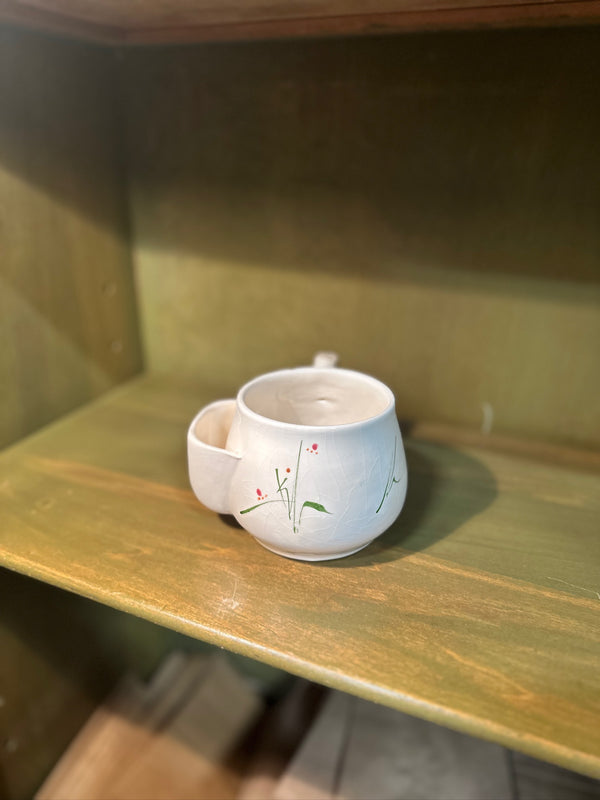
A wheel-thrown stoneware mug, barrel-bodied and heavier in the hand than a factory cup, with a pulled handle that loops from just under the rim down to the swell of the belly.
The outside is a warm oatmeal cream, and it is not a flat colour — small dark iron specks are scattered through it, pushed up from the clay during the firing.
Around the shoulder the glaze changes: a dark olive-brown band where two glazes meet and run together, mottled and slightly granular, breaking down over the cream in uneven fingers.
Inside, the mug is turquoise, deep and soft, with the throwing rings showing as a spiral under the glaze and the colour lifting over the rim so that it reads as a band of blue-green from the outside.
The foot is unglazed, cleanly trimmed, and shows the bare buff-pink stoneware body. Pressed into the centre is the potter's chop mark.
History & Provenance
The chop is the reason to turn it over, and it belongs to a tradition roughly five thousand years old. Potters have marked their work since ancient Mesopotamia, Egypt, Greece and Rome — one of the oldest signed ceramics to survive is a Greek vase of about 530 BCE inscribed “Exekias made and painted me”.
The word chop comes from the Asian seal, the Japanese hanko, and that is what a studio potter's mark is: a personal stamp, cut once and pressed into the wet clay of everything they make. It goes on the foot, where it is hidden in use and found only by someone who picks the piece up — which is rather the point.
A chop is not a factory backstamp, and the difference matters. A backstamp names a company and exists for production records. A chop names one pair of hands, and its function is to build a traceable body of work across a career. This mug came off one person's wheel.
Everything else about it agrees. The throwing rings spiral up the inside where the potter's fingers rose through the wall. The handle was pulled — drawn down from a lump of clay by hand rather than cast or extruded — and it thickens and thins the way only a pulled handle does. The iron specks come from an iron-bearing stoneware body firing through its glaze, and the way the shoulder glaze breaks and runs is a wood or gas kiln behaving unpredictably, not a controlled industrial firing.
The chop is clear and complete, but it is not resolved to a maker here. No name, studio, place or date appears anywhere on the piece, and it is offered unattributed rather than assigned to a potter on a guess.
Dated on the material and the making — reduction-fired speckled stoneware, a personal chop, and the oatmeal-and-turquoise palette of the studio pottery movement as it ran through American workshops and university programmes: c. 1970–1995.
Product Details
| Field | Detail |
|---|---|
| Object | Hand-thrown studio stoneware mug |
| Form | Barrel body on a trimmed unglazed foot, with a hand-pulled handle attached below the rim and at the belly; throwing rings visible inside |
| Glaze | Oatmeal cream exterior with iron speckling, a mottled olive-brown break band at the shoulder where two glazes overlap, and a turquoise interior carrying up over the rim |
| Material | Iron-bearing buff stoneware, reduction fired |
| Marks | An impressed potter's chop to the unglazed foot — a personal maker's seal, not a factory backstamp. No name, studio or date. Offered unattributed. |
| Era | c. 1970–1995. Dated on the reduction-fired speckled body, the personal chop and the studio-pottery glaze palette. |
| Condition | Good and fully usable. The mug is sound with no cracks, no crazing and no repairs; it stands level, the rim is smooth and complete all the way round, the handle is firmly attached with no stress lines at either join, and the glazes are bright and unworn inside and out. There is one small chip to the edge of the unglazed foot, low on the base where it does not show when the mug is standing and does not affect how it sits or holds liquid. Expect the glaze to be uneven where it breaks at the shoulder, and the iron specks throughout — both are the firing, not faults. Condition Guaranteed. |
| Availability | One of a Kind — 1 Available |
Why It Belongs in Your Home
People end up with a favourite mug whether they plan to or not, and it is almost never the one that came in a set.
This one has the qualities that decide it. There is real weight to it, so it feels like something. The wall is thick, so coffee stays hot longer than it does in thin porcelain. The handle was pulled by hand to fit a hand, which is why it sits better than a cast one. And the barrel shape means it does not tip when you set it down in a hurry.
The colours do the rest. Oatmeal with iron flecks and a turquoise interior is a combination no factory would sign off on and no two kiln loads produce identically — you get the blue-green surprise every time you look down into it.
It is equally good doing something else. On a desk it takes pens and scissors; on a windowsill, a cutting of ivy; on a dresser, keys and coins. And for a gift it is unusually easy, because a handmade mug is a thing almost everybody uses and almost nobody buys for themselves.
A note on care, and with studio stoneware most of it is permission rather than prohibition. It is fine to use every day. Wash it by hand in warm water with a little mild soap, which is gentler than a dishwasher on a glaze that may have been fired to a studio's own recipe rather than a commercial standard.
Keep the unglazed foot out of standing water. Bare stoneware absorbs, and a mug left sitting in a wet sink or a puddled draining board will draw water up into the foot and stain it. Dry the base as well as the cup.
Avoid sudden temperature changes — no going from the refrigerator to a hot oven, and let boiling water go off the boil before it goes in. Use no abrasive pad or scouring cream on the glazed surfaces, and no bleach soak, which can lift into a crazed or porous foot and stay there. Coffee and tea staining inside lifts with a paste of bicarbonate of soda and a soft cloth.
Every piece is packed with professional-grade materials: multiple foam layers, double-boxing, directional and fragile handling labels. For large furniture we use custom timber crating. We photograph packing before dispatch and can provide images on request.
White-glove delivery is complimentary within 100 miles of Reno, NV. National shipping quotes provided at checkout. All shipments are photographed and documented. Damage claims must be filed with the carrier; we provide all documentation needed to support your claim.
Local pickup is available at Viridian HQ (Reno, NV) with 2–4 days notice. Contact us to arrange. Private viewings also available.
All antique and vintage items are sold as described and all sales are final. Each listing includes detailed condition notes and photographs so you can make a fully informed decision. We encourage buyers to ask questions — about condition, dimensions, finish, provenance — before purchasing.
Antiques are irreplaceable and one-of-a-kind. Carrier handling is outside our control once a piece has left our facility, and major carriers including FedEx do not insure antiques. We do everything within our power to ensure safe transit, but cannot accept liability for carrier damage. If damage occurs in transit, we will provide full documentation to support your carrier claim.
Have a question? — we're happy to provide additional photos, condition detail, or discuss the piece directly.