Harbor Village with Sailboats, Signed M. Feller, Oil, c. 1950–1970
Viridian Eclection


The Painting A harbor village worked in heavy oil, signed M. FELLER in white at the lower right. Moored sailboats crowd the upper third, their sails built up in thick ridges of lavender, cream and ...
The Painting
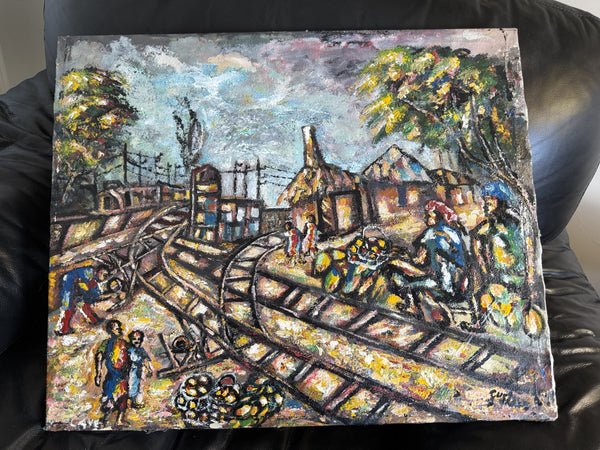
A harbor village worked in heavy oil, signed M. FELLER in white at the lower right. Moored sailboats crowd the upper third, their sails built up in thick ridges of lavender, cream and yellow against a bruised gray sky. Below them a red hulled boat sits at the quay. Fish houses push in from both sides, one with a pale sign lettered in red, another with a vermilion roof where a single white gull has settled.
Down the center runs a flight of stone steps, tipped up toward the viewer in the flattened way modernist painters handled perspective. Three figures occupy them. Two stand together at the top in yellow and ochre, and one woman in a dark red cloak stands alone further down, facing out. Two gulls cut across the bottom of the picture.
The paint is the point. It is applied thickly and fast, brush and knife together, and in places it stands proud of the canvas by a visible depth. The sails and the roof are built in slabs. The steps are scraped and dragged. Under strong light the surface throws its own shadows.
The color is more disciplined than the handling suggests. Most of the picture sits in grayed slate, putty, olive and smoke. Against that the artist placed four saturated notes and no more: the red hull, the vermilion roof, the yellow coats, one lit yellow window. That restraint is what makes the bright passages carry.
It remains in what appears to be its original frame, a limed blond wood with a narrow gray blue slip at the opening.
History & Provenance
The signature reads M. FELLER, painted directly into the wet surface rather than added afterward in ink. It is clear and unambiguous.
It has not been possible to identify the artist. A search of the available online records for twentieth century painters named Feller returns no M. Feller with a body of harbor or marine work. The piece is offered as signed and unattributed, which is an honest statement of what is known rather than a suggestion that nothing is there. A great many capable American painters of this generation exhibited locally, sold through galleries and decorators, and never entered the reference literature at all.
What can be said with more confidence is when. The frame is the best evidence on the object. Limed blond wood with a gray blue inner slip is a specific American framing fashion, tied to the pale, light filled interiors of the nineteen fifties and the decade that followed, and it was not used before or much after. The frame fits the canvas exactly and shows the same age as the picture. Behind it is a brown hardboard backing taped at the edges with masking tape that has gone dark amber and lost its grip, hung on screw eyes and twisted braided wire. Nothing has been replaced.
The painting itself agrees. The flattened space, the tipped up steps, the heavy knife work and the grayed palette with isolated saturated accents belong to the American absorption of School of Paris modernism that ran through the nineteen fifties and sixties, when working harbor subjects were treated as structure and color rather than as topography. On the frame, the backing and the handling together, it is offered as c. 1950 to 1970.
One honest note on the subject. The scene is a composed harbor rather than a recorded one. The signage is lettered but not legible, the architecture is generic to the North Atlantic fishing coast, and nothing in the picture names a place. It would be a guess to call it any particular harbor, and this listing does not.
Product Details
| Subject | Harbor village with moored sailboats, fish houses, stone steps and figures |
| Medium | Oil on canvas, heavy impasto worked with brush and knife |
| Signature | M. FELLER, lower right, painted into the surface in white |
| Attribution | Signed and unattributed. No listed artist of that name located in available records |
| Date | c. 1950 to 1970, on the evidence of the frame, the backing and the handling |
| Frame | Limed blond wood with a gray blue inner slip, appears original to the picture |
| Backing | Brown hardboard, masking tape at the edges, screw eyes and twisted braided wire |
| Palette | Grayed slate, putty, olive and smoke, with isolated accents of red, vermilion and yellow |
| Condition | Very good. Paint film stable with no flaking, cleavage or loss. Impasto peaks intact. Canvas taut in the frame. Light surface grime consistent with age and uncleaned. Frame with scattered rubbing and small nicks to the limed finish, and minor chipping at the outer edges. No tears, no punctures, no visible restoration or inpainting |
Why It Belongs in Your Home
Most mid-century harbor paintings are competent and forgettable. This one is neither, and the reason is restraint.
A weaker painter given this subject reaches for color everywhere: blue water, white sails, red roofs, the whole postcard. This artist put almost the entire picture in grays and then spent the color budget in four places. The red hull, the vermilion roof, two yellow coats. Everything bright in the painting is doing work, and that is a decision somebody made on purpose.
The handling backs it up. The paint is laid on with real speed and confidence, thick enough to cast shadow, and it still resolves into drawing when you step back. The gull on the roof is three strokes. The woman on the steps is maybe six. Neither is fussed over and both read.
It wants a wall where the light rakes across it rather than hits it flat, because the surface is half the picture. Morning or late afternoon light from the side will make the impasto stand up. Over a console, in a stairwell, beside a window, in a study.
The limed frame is a gift as well. Blond wood against heavy dark paint is a mid-century pairing that modern rooms happen to want again, and it keeps the picture from going heavy on a pale wall.
A note on care. Do not clean it. There is a light film of age grime, and removing that is a conservator's job on an impasto surface where solvent pools in the valleys. Keep it out of direct sun, dust the frame rather than the paint, and handle it by the frame.
Every piece is packed with professional-grade materials: multiple foam layers, double-boxing, directional and fragile handling labels. For large furniture we use custom timber crating. We photograph packing before dispatch and can provide images on request.
White-glove delivery is complimentary within 100 miles of Reno, NV. National shipping quotes provided at checkout. All shipments are photographed and documented. Damage claims must be filed with the carrier; we provide all documentation needed to support your claim.
Local pickup is available at Viridian HQ (Reno, NV) with 2–4 days notice. Contact us to arrange. Private viewings also available.
All antique and vintage items are sold as described and all sales are final. Each listing includes detailed condition notes and photographs so you can make a fully informed decision. We encourage buyers to ask questions — about condition, dimensions, finish, provenance — before purchasing.
Antiques are irreplaceable and one-of-a-kind. Carrier handling is outside our control once a piece has left our facility, and major carriers including FedEx do not insure antiques. We do everything within our power to ensure safe transit, but cannot accept liability for carrier damage. If damage occurs in transit, we will provide full documentation to support your carrier claim.
Have a question? — we're happy to provide additional photos, condition detail, or discuss the piece directly.