J. & G. Alcock Scinde Flow Blue Soup Plate, c. 1840s Staffordshire Ironstone
Viridian Eclection


The Piece A true early Victorian antique, and Flow Blue at its most intense. This paneled soup plate carries the celebrated Scinde pattern: a chinoiserie landscape of pagodas, garden terraces, and ...
The Piece
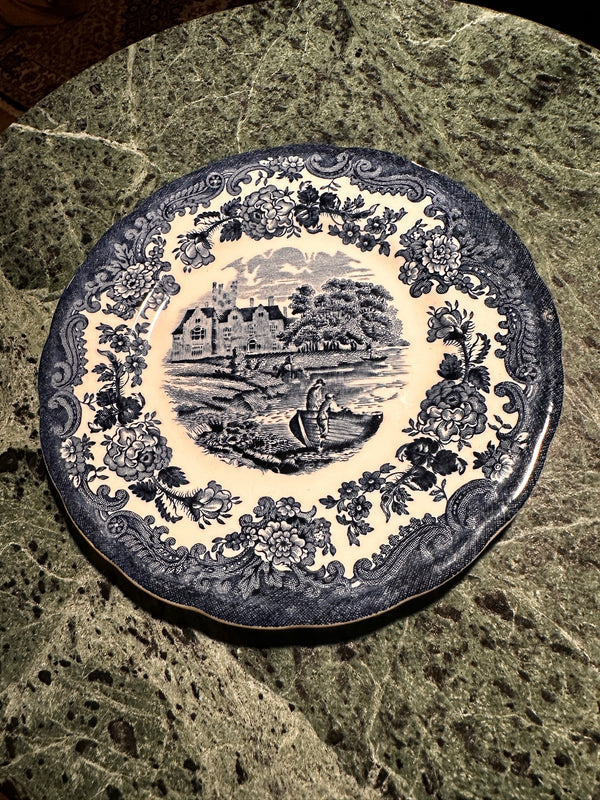
A true early Victorian antique, and Flow Blue at its most intense. This paneled soup plate carries the celebrated Scinde pattern: a chinoiserie landscape of pagodas, garden terraces, and windswept trees rendered in cobalt so saturated it drifts into the glaze like ink in water. That soft, smoky bleed — the "flow" in Flow Blue — was the whole point: deep-toned pieces like this one, where the border goes nearly midnight, are precisely what collectors of the pattern hunt for.
The twelve-sided rim gives the plate its architecture, framing the central scene the way a mat frames a print. The reverse carries both marks that matter: the Scinde cartouche printed in blue, and the impressed "Oriental Stone" stamp of J. & G. Alcock of Cobridge, Staffordshire — placing this piece firmly in the 1840s, when the pattern was new and the news that inspired it was still in the papers.
History
Flow Blue was born in Staffordshire around 1830, when potters discovered that introducing volatile chlorides into the kiln made cobalt transfer prints blur softly into the glaze. What began as a happy accident became a sensation — especially in America, where the dreamy, ink-washed blue felt more luxurious than crisp transferware and filled homesteads and city sideboards alike for the rest of the century.
Scinde is among the most collected of all Flow Blue patterns, and its name is a time capsule: it refers to the Scinde (Sindh) region in present-day Pakistan, annexed by Britain in 1843 in one of the most talked-about campaigns of the era. Staffordshire potters, ever quick to bottle the news, dressed the exotic-sounding name in a romantic chinoiserie landscape. The brothers John and George Alcock produced their Scinde at Cobridge during their brief partnership in the 1840s, on the durable ironstone body they marketed as "Oriental Stone" — the impressed mark this plate still bears. A piece from their kilns has now survived roughly one hundred and eighty years of tables.
Product Details
| Attribute | Detail |
|---|---|
| Period | c. 1840s |
| Origin | Cobridge, Staffordshire, England |
| Maker | J. & G. Alcock; printed Scinde cartouche and impressed "Oriental Stone" mark |
| Material | Ironstone with flown cobalt transfer decoration |
| Style | Victorian Flow Blue / chinoiserie |
| Dimensions | To be confirmed (soup plates in this pattern are typically 10–10.5") |
| Condition | Very good antique condition with deep, desirable color. Light glaze wear and scattered minor surface specks consistent with 180 years of age; small area of rim roughness visible in photographs. No cracks or restoration noted. Condition Guaranteed. |
Why It Belongs In Your Home
Flow Blue earns its wall space as readily as its shelf space — a single Scinde plate on a stand, or hung against plaster, reads like a small painting, and the near-black border makes every color around it richer. On a table it's the layering piece: under white ironstone, over walnut, beside unpolished silver. And it carries the kind of story this shop exists for — a Staffordshire kiln, a headline from 1843, an ocean crossing, and a blue that has refused to fade for nearly two centuries. This is not in the style of an antique. It is one.
Every piece is packed with professional-grade materials: multiple foam layers, double-boxing, directional and fragile handling labels. For large furniture we use custom timber crating. We photograph packing before dispatch and can provide images on request.
White-glove delivery is complimentary within 100 miles of Reno, NV. National shipping quotes provided at checkout. All shipments are photographed and documented. Damage claims must be filed with the carrier; we provide all documentation needed to support your claim.
Local pickup is available at Viridian HQ (Reno, NV) with 2–4 days notice. Contact us to arrange. Private viewings also available.
All antique and vintage items are sold as described and all sales are final. Each listing includes detailed condition notes and photographs so you can make a fully informed decision. We encourage buyers to ask questions — about condition, dimensions, finish, provenance — before purchasing.
Antiques are irreplaceable and one-of-a-kind. Carrier handling is outside our control once a piece has left our facility, and major carriers including FedEx do not insure antiques. We do everything within our power to ensure safe transit, but cannot accept liability for carrier damage. If damage occurs in transit, we will provide full documentation to support your carrier claim.
Have a question? — we're happy to provide additional photos, condition detail, or discuss the piece directly.