Japanese Hand-Painted Porcelain Ewer, Lakeside Landscape in Autumn with Blossoming Trees, Gilt Rim and Loop Handle, Marked Made in Japan, Carrying an Old Family Label Reading "Aunt Nett", c. 1952–1969
Viridian Eclection


The Piece A small porcelain ewer, painted by hand with a landscape that runs the whole way round the body. The form is drawn out rather than squat: an ovoid body rising through a narrow waist t...
The Piece
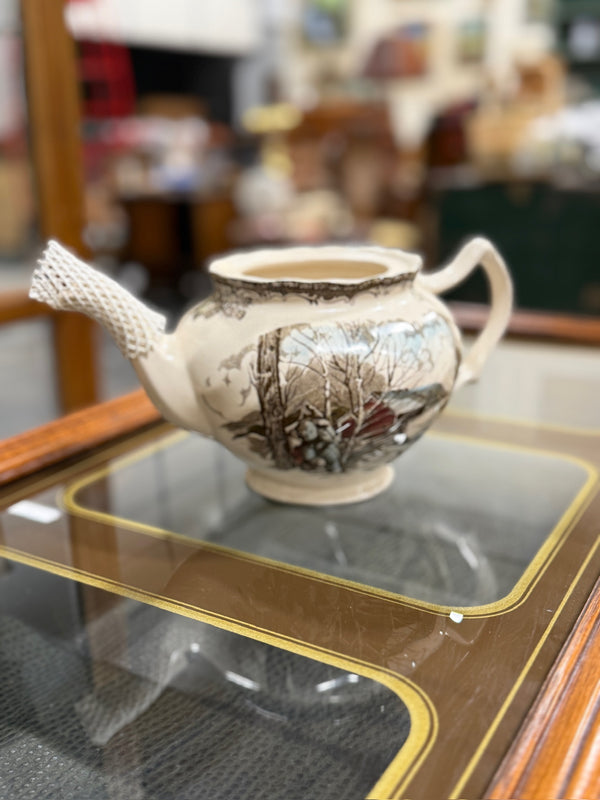
A small porcelain ewer, painted by hand with a landscape that runs the whole way round the body.
The form is drawn out rather than squat: an ovoid body rising through a narrow waist to a tall flared neck, finished with a high pulled spout and a wavy rim that dips and lifts. A thin loop handle springs from the shoulder and arches well above the rim.
The scene is a lakeside in autumn. A pale blue stretch of water crosses the lower body, broken by rocks and a fallen branch in the foreground. Behind it, trees in ochre and gold lean in from the left, a dark green conifer stands to the right, and between them sit masses of pink blossom drawn with fine bare branches. Lavender-grey hills close the distance, and a small stroke of orange-red sits at the waterline — the one hot colour in the whole composition, placed exactly where the eye lands.
It is painted, not printed. The foliage is dabbed with a loaded brush and the marks vary in weight and direction; the branches are drawn in single confident strokes; and the ground colour is laid in visible sweeps. A transfer print repeats the same line everywhere. This does not.
The rim and handle are gilded, and the gilding has worn thin in the places a hand would touch.
The foot carries a blue underglaze mark reading MADE IN JAPAN, and beside it a small paper label inscribed in ink: “Aunt Nett.”
History & Provenance
The mark on the foot brackets the date, and it does so by what it does not say as much as by what it does.
“Made in Japan” rather than “Nippon” puts it after 1921. American customs law had required imported goods to name their country of origin since 1891, and Japanese porcelain satisfied that by marking “Nippon” — until US Customs ruled in 1921 that Nippon was a Japanese word rather than an English one and would no longer serve. From that point the mark had to read Japan.
It is not marked “Occupied Japan,” which rules out 1947 to 1952. Through the Allied occupation, Japanese goods entering the United States were required to carry that wording. Its absence puts this ewer either side of those years.
The remaining evidence — the soft pastel palette, the scenic decoration made for the American gift trade, the blue underglaze stamp — sits with the later window: c. 1952–1975.
These were hand painted at volume, and that is not a contradiction. The post-war Japanese export potteries employed decorators who painted the same scene many times a day, at speed, from memory. The result is neither factory-uniform nor precious: every example differs, and the confidence in the brushwork comes from repetition rather than from deliberation. It is a kind of skill that industrial printing replaced entirely, and it is the reason these pieces still look alive.
The paper label is the part no catalogue can supply. Somebody in a family wrote “Aunt Nett” on a scrap of paper and stuck it to the bottom, which is what people do when an object comes to them from a particular person and they want that remembered. It records no maker and adds nothing to the attribution. It simply says that this ewer sat in a named woman’s house before it sat in anyone else’s, and that whoever inherited it thought that mattered.
The label is left in place and sold with the piece.
Product Details
| Object | Hand-painted porcelain ewer, decorative |
| Dimensions | Approximately 7 in tall by 3½ in at the widest |
| Form | Ovoid body rising to a tall flared neck with a high pulled spout and wavy rim; thin loop handle arching above the rim; low foot |
| Decoration | Hand-painted continuous lakeside landscape in autumn — water, rocks and a fallen branch in the foreground; ochre and gold trees, a dark conifer, pink blossoming trees and lavender hills behind; a single orange-red accent at the waterline. Gilding to the rim and handle. |
| Marks | Blue underglaze mark to the foot: MADE IN JAPAN. Beside it, an old paper label inscribed in ink: “Aunt Nett” — a family provenance note, not a maker’s mark. No maker is named or attributed. |
| Era | c. 1952–1975. “Made in Japan” rather than “Nippon” places it after the 1921 US Customs ruling; the absence of “Occupied Japan” excludes 1947–1952; the palette and the export-trade scenic decoration place it in the later window. |
| Condition | Good. The porcelain is sound with no chips, no cracks, no crazing and no repairs, and the rim and spout are smooth and complete. The painted decoration is bright and unfaded, with no rubbing to the colours. The gilding on the rim and handle is worn and thinned in the places a hand touches, showing the white body through in patches — this is handling wear rather than damage, and it is the normal condition of gilt on a piece that was picked up and washed. The interior and foot are clean. The paper label is intact and legible with soft edges. Condition Guaranteed. |
| Availability | One of a Kind — 1 Available |
Why It Belongs in Your Home
A painted object at seven inches does something a large one cannot: it makes people come closer.
The landscape on this ewer is legible from across a room only as colour — gold, pink, a stripe of blue. The trees, the fallen branch, the single red stroke at the waterline only resolve when someone is standing in front of it. That is the right behaviour for a small object on a shelf, and it is why hand-painted work keeps rewarding a room long after printed decoration has gone quiet.
It is the correct size for the places large vases fail. A bathroom shelf, a windowsill above a sink, a bedside table, the shallow depth of a plate rail, the corner of a desk. Anywhere you want something and have four inches to give it.
As a vase it wants very little. Three stems, or one. Sweet peas, ranunculus, a few sprigs of something from the garden, or a single branch of blossom to echo what is painted on it. The narrow neck does the arranging for you, which is the whole argument for a small-necked vessel.
The palette is unusually easy to place. Soft gold, pink and lavender against white porcelain sits naturally with cream paint, pale oak, brass, and old books, and it warms a cool room without introducing a strong colour you then have to answer for elsewhere.
And the label on the bottom means it arrives having belonged to somebody. Most decorative objects have no history you can point to. This one came from Aunt Nett, whoever she was, and somebody cared enough to write it down before passing it on.
A note on care. Hand wash only, in warm water with a little soap, and dry it immediately. Never a dishwasher: detergent strips gilding in a single cycle, and the gold on this rim and handle is already thin.
Do not scrub the gilt. Even a cloth used firmly will take more of it off. Wipe the gold with a light touch or leave it alone entirely.
Keep it out of the microwave for the same reason — metallic decoration and microwaves do not coexist — and avoid sudden temperature change, which thin porcelain resents.
If you use it for flowers, empty and dry it between arrangements. Standing water leaves a mineral ring inside a narrow neck that is difficult to reach and harder to remove.
Leave the paper label where it is. It is the only part of this object that cannot be replaced.
Every piece is packed with professional-grade materials: multiple foam layers, double-boxing, directional and fragile handling labels. For large furniture we use custom timber crating. We photograph packing before dispatch and can provide images on request.
White-glove delivery is complimentary within 100 miles of Reno, NV. National shipping quotes provided at checkout. All shipments are photographed and documented. Damage claims must be filed with the carrier; we provide all documentation needed to support your claim.
Local pickup is available at Viridian HQ (Reno, NV) with 2–4 days notice. Contact us to arrange. Private viewings also available.
All antique and vintage items are sold as described and all sales are final. Each listing includes detailed condition notes and photographs so you can make a fully informed decision. We encourage buyers to ask questions — about condition, dimensions, finish, provenance — before purchasing.
Antiques are irreplaceable and one-of-a-kind. Carrier handling is outside our control once a piece has left our facility, and major carriers including FedEx do not insure antiques. We do everything within our power to ensure safe transit, but cannot accept liability for carrier damage. If damage occurs in transit, we will provide full documentation to support your carrier claim.
Have a question? — we're happy to provide additional photos, condition detail, or discuss the piece directly.