Lenox “Aristocrat” Gold-Encrusted Saucer, Wide Acid-Etched Band on Ivory Porcelain, Gold Wreath Mark, Trenton, New Jersey, 1953 or Later
Viridian Eclection


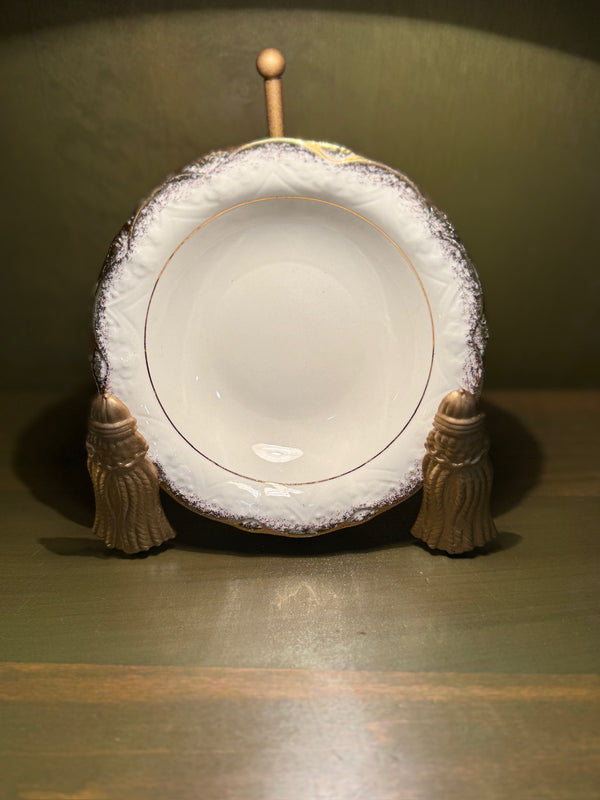
The PieceA small ivory porcelain dish with a gold band so wide it is most of the object.The rim carries a gold-encrusted border roughly an inch deep. Burnished gold runs along the outer edge and ag...
The Piece
A small ivory porcelain dish with a gold band so wide it is most of the object.
The rim carries a gold-encrusted border roughly an inch deep. Burnished gold runs along the outer edge and again as a fine line on the inside, and between them lies a broad acid-etched panel worked with a dense repeating pattern of linked ovals and scales — matte gold against bright, so the band reads as texture rather than a flat stripe.
Inside the band the surface is left plain, and the porcelain is the warm ivory that Lenox is known for rather than a cold white.
At the centre is a shallow recessed ring: this piece is a saucer, and that ring is the seat a cup sits in.
Underneath, printed in gold: a laurel wreath enclosing a script L, and beneath it LENOX, ARISTOCRAT, © LENOX INC., MADE IN U.S.A.
History & Provenance
The colour of that wreath is the date, and it is a clean one.
Lenox has used a laurel wreath enclosing a script L since 1906, and collectors date the ware by what colour the wreath is printed in. A green wreath belongs to roughly 1906 through the 1930s. A gold wreath — this one — points to 1953 or later, the period of factory-decorated dinnerware and the post-war bridal-china boom. The printed pattern name alongside the device is consistent with the later marks rather than the early ones.
Aristocrat is the pattern, and it is the plainest kind of luxury: no flowers, no picture, no colour at all. Just ivory porcelain and a wide gold-encrusted band. Gold encrusting is a specific and expensive technique — the surface is acid-etched to a pattern and then gilded, so the gold sits at two different levels and the design shows as matte against burnished. It is what separates a gold band that cost money from a gold line that did not. The pattern is long discontinued.
The firm is one of the genuine American success stories in porcelain. Walter Scott Lenox and Jonathan Coxon Sr. founded the Ceramic Art Company at Trenton, New Jersey in 1889 with an unreasonable ambition: to make an American porcelain that could stand against the Irish and English translucent wares rather than imitate them. The company reorganised under the Lenox name in 1906, and the artist's palette mark of the early years gave way to the laurel wreath.
It worked. In 1918 Lenox became the first American maker to supply official White House china, beginning under Woodrow Wilson, and it supplied presidential services for administrations after that. Until then every White House service had been imported.
Dated on the gold wreath: 1953 or later.
Product Details
| Object | Saucer in ivory porcelain — the centre carries a recessed cup ring |
| Dimensions | Approximately 6 in across |
| Pattern | Aristocrat — gold-encrusted band, discontinued |
| Decoration | Wide gold-encrusted rim band roughly 1 in deep: burnished gold at the outer edge and as an inner line, framing a broad acid-etched panel of linked ovals and scales in matte gold. No other decoration. |
| Marks | Printed in gold to the underside: laurel wreath enclosing a script L, with LENOX · ARISTOCRAT · © LENOX INC. · MADE IN U.S.A. |
| Maker | Lenox, Inc., Trenton, New Jersey |
| Era | 1953 or later, on the gold wreath mark. Lenox wreath marks printed in green belong to c. 1906–1930s; the gold wreath is post-1953. |
| Condition | Very good. No chips, no cracks, no crazing and no repairs. The rim is smooth all the way round. The gold band is bright and complete with its etched pattern fully readable and no rub-through to the porcelain. The ivory body is clean and even. The reverse carries a small stray fleck of gold near the foot ring, left from the decorating bench, and a few faint grey marks. Condition Guaranteed. |
| Availability | One of a Kind — 1 Available |
Why It Belongs in Your Home
An inch of gold around a six-inch circle is a disproportionate amount of gold, and that is the entire appeal.
There is no pattern to like or dislike, no flowers to date it, no colour to match. Ivory and gold, and a band wide enough to read from across a room. It is the most forgiving decoration there is.
The etching is what to look at up close. Acid-etched gold sits at two levels, matte against burnished, so the band holds a pattern of linked ovals that appears and disappears as the light moves. A printed gold line cannot do that, and the difference is obvious the moment you tilt it.
It is the right size for the jobs a plate is too big for. On a dresser it takes rings and cufflinks; on a desk, paper clips and stamps; beside a bed, a watch. Under a candle, the gold throws light back up.
On an easel it works as a small piece of graphic art — a gold ring on ivory, which is about as clean a composition as a shelf can hold.
And the name means something. Lenox built an American porcelain good enough to end a century of importing White House china, and did it from Trenton. Aristocrat is long out of production, so the only ones available are the ones that survived.
It also pairs. A single saucer is an orphan until a cup turns up, and Aristocrat cups do turn up; if you find one, this completes it.
A note on care, and gold is the whole of it. Hand wash in warm water with a soft cloth and dry at once. Never a dishwasher: detergent takes gold-encrusted decoration off permanently, and here the gold is not a detail, it is the object.
Never a microwave. Gold is metal and it will arc.
Do not scour it, and do not use silver polish or any abrasive cleaner on the band. Etched gold has a texture that polish flattens.
Stack it with a felt pad or a paper round between pieces. Gold wears wherever porcelain rests against it, which is how most gold-banded china ends up dull at the rim.
Every piece is packed with professional-grade materials: multiple foam layers, double-boxing, directional and fragile handling labels. For large furniture we use custom timber crating. We photograph packing before dispatch and can provide images on request.
White-glove delivery is complimentary within 100 miles of Reno, NV. National shipping quotes provided at checkout. All shipments are photographed and documented. Damage claims must be filed with the carrier; we provide all documentation needed to support your claim.
Local pickup is available at Viridian HQ (Reno, NV) with 2–4 days notice. Contact us to arrange. Private viewings also available.
All antique and vintage items are sold as described and all sales are final. Each listing includes detailed condition notes and photographs so you can make a fully informed decision. We encourage buyers to ask questions — about condition, dimensions, finish, provenance — before purchasing.
Antiques are irreplaceable and one-of-a-kind. Carrier handling is outside our control once a piece has left our facility, and major carriers including FedEx do not insure antiques. We do everything within our power to ensure safe transit, but cannot accept liability for carrier damage. If damage occurs in transit, we will provide full documentation to support your carrier claim.
Have a question? — we're happy to provide additional photos, condition detail, or discuss the piece directly.