Millers Falls No. 99 Adjustable Hacksaw Frame with Pistol Grip, Greenfield Mass., with a Wood-Handled Pad Saw, c. 1950–1970
La Rue Tool & Supply Co


The Piece Two metal-cutting saws, sold together. The first is a Millers Falls No. 99 hacksaw frame. The back is a slotted steel arm with three index positions, so one frame takes 8, 10 or 12 inch b...
The Piece
Two metal-cutting saws, sold together.
The first is a Millers Falls No. 99 hacksaw frame. The back is a slotted steel arm with three index positions, so one frame takes 8, 10 or 12 inch blades; the nose carries a knurled wing-nut tensioner that draws the blade up tight. The grip is a moulded black pistol handle, shaped for a full fist rather than a bar.
Cast into the frame: MILLERS FALLS TOOLS arched around 1868 in a triangle, with GREENFIELD, MASS. and MADE IN USA alongside.
It is fitted with a Victor Molyflex high-speed-steel blade, marked 1218–36.
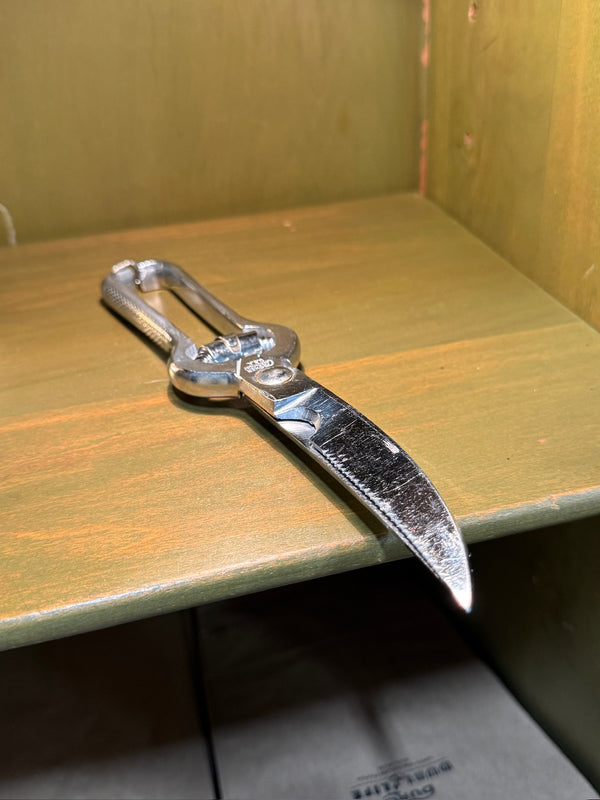
The second is a pad saw: a hacksaw blade set into a shaped beech handle and held by two rivets, with the teeth running the full length and the tip left open. No frame, no back, nothing above the cut line.
History & Provenance
“Greenfield, Mass.” is the date, and it is stamped into the tool. Millers Falls took its name from the village of Millers Falls, Massachusetts, where the works stood and the home office sat from 1868 until 1931. In 1931 the company bought Goodell-Pratt at Greenfield and moved there, and Greenfield remained the address until the whole operation went to Deerfield in 1978. A frame reading Greenfield cannot be earlier than 1931 — and the 1868 in the triangle is the founding year, not the making year.
The pistol grip narrows it further. Hacksaw frames were made with straight wooden file-style handles for generations; the moulded pistol grip is what replaced them, and it replaced them because moulded thermoplastic made a shaped, hollow, one-piece handle cheap for the first time. That is a post-war change, not a pre-war one.
The adjustable back is the clever part and the reason these survive. A fixed frame takes one blade length and becomes scrap when that length goes out of stock. A slotted back with index holes takes three, which means the frame outlives every blade that ever goes into it — and it is why a saw made seventy years ago still works today with a blade bought this morning.
The blade in it is a working blade, not an ornament. Molybdenum high-speed steel holds its edge at temperatures that ruin carbon steel, which is what let hacksaws be pushed hard through steel stock rather than eased through it.
The pad saw solves the problem a frame creates. A hacksaw frame is a hoop, and the hoop is what stops you: it will not follow a cut deeper than the throat, and it will not go into a space narrower than itself. Put the same blade in a handle and the limit disappears — you lose the tension, and with it the speed and the straightness, and you gain access. Every pipe fitter, every sheet metal shop and every farm workshop had both.
Dated on the Greenfield address (1931 or later), the moulded pistol grip and the adjustable slotted back: c. 1950–1970.
Product Details
| Field | Detail |
|---|---|
| Object | Two metal-cutting saws sold together — a Millers Falls No. 99 adjustable hacksaw frame with blade, and a wood-handled pad saw. Frame approx. 16 in long overall; pad saw approx. 14 in. |
| Origin | Millers Falls Company, Greenfield, Massachusetts, USA (frame). Pad saw unmarked. |
| Form | Slotted steel back with three index positions for 8, 10 and 12 in blades; knurled wing-nut blade tensioner at the nose; moulded black pistol grip. Pad saw: hacksaw blade double-riveted into a shaped beech handle. |
| Material | Steel frame with moulded plastic grip; high-speed-steel blade; beech handle to the pad saw |
| Marks | Frame: MILLERS FALLS TOOLS / 1868 in a triangle, GREENFIELD, MASS., MADE IN USA, No. 99. Blade: Victor Molyflex, high speed steel, 1218–36. |
| Era | c. 1950–1970. Dated on the Greenfield address, which the company used only from 1931, together with the moulded pistol grip that replaced wooden handles after the war. |
| Condition | Very good working condition. The frame is straight and sound with no bends or cracks, the adjustment holes are clean, the tensioner turns freely and draws the blade taut, and the grip is firm with no splits. Expect honest shop wear — light surface scuffing and small marks to the steel, and handling polish to the grip. The blade is serviceable and, like any blade, a consumable. Condition Guaranteed. |
| Availability | Two Pieces — 1 Set Available |
Why It Belongs in Your Home
This is a tool you can still put to work, which is not true of most things this old.
Blades are standard and sold everywhere, the frame takes all three common lengths, and there is nothing in it to fail — no motor, no battery, no proprietary fitting. Cut a bolt down, take the end off a threaded rod, trim a bracket, open a seized padlock. It will outlast every cordless tool in the same drawer.
It also looks like something. Old American hand tools hang well — on a pegboard, on a leather strap, on nails above a bench — and the triangle mark with 1868 inside it reads across a room. A pair of saws on a workshop wall, a garage, a mudroom or a study says more about a house than a framed print of a tool does.
The pistol grip is the part people pick up and comment on. Hacksaws are mostly a straight bar; a shaped handle that fills the hand is a small piece of industrial design, and it is why this frame was worth keeping when the flimsier ones were thrown out.
A note on care, and old steel wants very little. Keep it dry and keep a film of oil on it. Bare steel in a damp garage pits within a season; a wipe with an oiled rag two or three times a year prevents it entirely.
Do not wire-wheel it or strip it back to bright metal. The darkened, evenly worn surface is what makes it read as a working tool with a history; take that off and what is left looks like a reproduction.
If you use it, release the blade tension when you put it away — a frame left under load for years takes a set — and remember the blade cuts on the push stroke, so let it come back light.
Blades are sharp. Store it where it will not be reached for blind, and keep it away from children.
Every piece is packed with professional-grade materials: multiple foam layers, double-boxing, directional and fragile handling labels. For large furniture we use custom timber crating. We photograph packing before dispatch and can provide images on request.
White-glove delivery is complimentary within 100 miles of Reno, NV. National shipping quotes provided at checkout. All shipments are photographed and documented. Damage claims must be filed with the carrier; we provide all documentation needed to support your claim.
Local pickup is available at Viridian HQ (Reno, NV) with 2–4 days notice. Contact us to arrange. Private viewings also available.
All antique and vintage items are sold as described and all sales are final. Each listing includes detailed condition notes and photographs so you can make a fully informed decision. We encourage buyers to ask questions — about condition, dimensions, finish, provenance — before purchasing.
Antiques are irreplaceable and one-of-a-kind. Carrier handling is outside our control once a piece has left our facility, and major carriers including FedEx do not insure antiques. We do everything within our power to ensure safe transit, but cannot accept liability for carrier damage. If damage occurs in transit, we will provide full documentation to support your carrier claim.
Have a question? — we're happy to provide additional photos, condition detail, or discuss the piece directly.