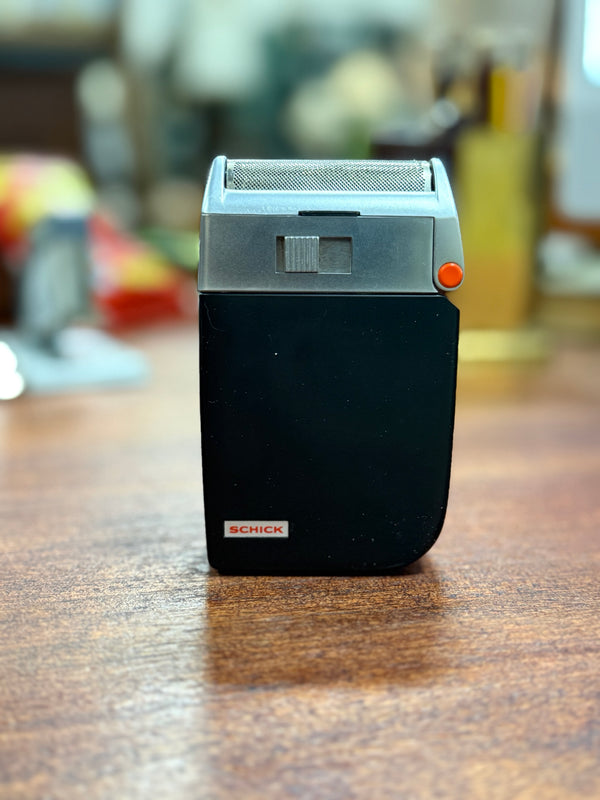
Remington 6 Electric Shaver, c. 1969–1970s Sperry Rand Era Grooming Piece
Viridian Eclection


The Piece A pocket monolith from the golden age of American gadgets: the Remington 6, black as a dress shoe, with a padded leatherette front panel, chrome "Comfort Dial" (CLOSER — TRIM — CLEAN), an...
The Piece
A pocket monolith from the golden age of American gadgets: the Remington 6, black as a dress shoe, with a padded leatherette front panel, chrome "Comfort Dial" (CLOSER — TRIM — CLEAN), and a gleaming multi-slot foil head that still catches the light like it did on the department-store shelf. The typography alone dates it beautifully — that squared-off REMINGTON wordmark with its blue "6" chip is pure late-sixties confidence, the same design language as transistor radios and dashboard consoles.
The leatherette grip panel — an oddly luxurious touch for a bathroom appliance — tells you who this was for: the man who wanted his morning routine to feel like closing a briefcase. It survives in handsome cosmetic condition, more objet than appliance now, though the mechanism is present and untested.
History
Remington effectively invented the American electric shave: its Model E of 1937 was the first commercially successful electric dry shaver in the United States, and for the next half century the Bridgeport, Connecticut brand fought Schick and Norelco for the nation's chins. By the late 1960s Remington was a division of Sperry Rand — the computer-age conglomerate — and its shavers wore the era's aesthetic proudly: matte black, chrome accents, dials instead of switches.
The Remington 6 belongs to that moment, with its adjustable Comfort Dial promising a personalized shave a decade before such things were marketing boilerplate. A footnote worth telling at the counter: barely a decade later, entrepreneur Victor Kiam famously liked his Remington shaver so much he bought the company — the 1979 deal behind one of the most quoted ad lines in television history. This little black box is from the years that made the brand worth buying.
Product Details
| Attribute | Detail |
|---|---|
| Period | c. 1969–early 1970s |
| Origin | United States; Remington, division of Sperry Rand, Bridgeport, Connecticut |
| Maker | Remington; model 6 with "Comfort Dial" |
| Material | Molded plastic, chrome, leatherette panel, steel foil head |
| Style | Late-sixties American industrial design |
| Dimensions | To be confirmed |
| Condition | Very good cosmetic condition; foil head bright, leatherette clean, light shelf wear. Mechanism untested — sold as a display piece. Condition Guaranteed. |
Why It Belongs In Your Home
Styled objects from the masculine mid-century — shavers, lighters, transistor radios — are the jewelry of a collected shelf, and this one earns its spot on looks alone. Stand it on a stack of vintage paperbacks in a study, tuck it into a bathroom vignette with a badger brush and a heavy tumbler, or gift it to the design-minded man who appreciates that even a Tuesday-morning shave once came with chrome. Fifty years of American mornings, one small black monument.
Every piece is packed with professional-grade materials: multiple foam layers, double-boxing, directional and fragile handling labels. For large furniture we use custom timber crating. We photograph packing before dispatch and can provide images on request.
White-glove delivery is complimentary within 100 miles of Reno, NV. National shipping quotes provided at checkout. All shipments are photographed and documented. Damage claims must be filed with the carrier; we provide all documentation needed to support your claim.
Local pickup is available at Viridian HQ (Reno, NV) with 2–4 days notice. Contact us to arrange. Private viewings also available.
All antique and vintage items are sold as described and all sales are final. Each listing includes detailed condition notes and photographs so you can make a fully informed decision. We encourage buyers to ask questions — about condition, dimensions, finish, provenance — before purchasing.
Antiques are irreplaceable and one-of-a-kind. Carrier handling is outside our control once a piece has left our facility, and major carriers including FedEx do not insure antiques. We do everything within our power to ensure safe transit, but cannot accept liability for carrier damage. If damage occurs in transit, we will provide full documentation to support your carrier claim.
Have a question? — we're happy to provide additional photos, condition detail, or discuss the piece directly.