Renaissance Revival Walnut Mirrored Étagère, Marble Top, c. 1865–1880
Viridian Eclection


The Piece An American Renaissance Revival étagère in walnut, the tall mirrored parlor piece that a Victorian household set against the best wall of the front room to hold its porcelain, bronzes and...
The Piece
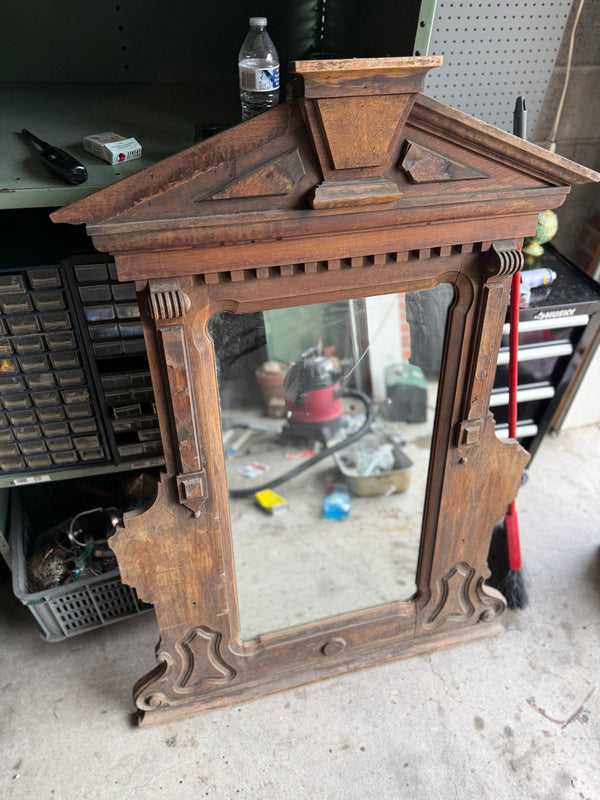
An American Renaissance Revival étagère in walnut, the tall mirrored parlor piece that a Victorian household set against the best wall of the front room to hold its porcelain, bronzes and photographs. The form rises from a serpentine marble-topped base to an arched pediment well over head height. The crest is an arched and molded pediment with a shaped cartouche at its center and a carved drop finial beneath, flanked by scrolled ears. Below it, a tall arched mirror plate in a molded walnut frame runs nearly the full height of the piece. Either side of the mirror the walnut is cut into a continuous pierced fretwork of C-scrolls and leafage, and three graduated shelves step down each side, each shelf shaped with a serpentine front and supported on a carved bracket, so the whole silhouette narrows toward the top like a cabinet of shelves hung on a mirror.
The base is a shaped walnut plinth with a molded serpentine front and a lower shelf, and set into it is a serpentine white marble top with a molded edge, the display surface for the largest object in the collection. The walnut carries an old finish with the deep reddish brown that American black walnut takes on with age, and the carving and fretwork are complete. The mirror plate is a period silvered glass with the soft haze and light spotting of original silvering, which reads as age rather than damage and can be left as it is or replated to taste.
The piece is in clean, sound condition. The fretwork, which is the first thing to break on an étagère, is intact on both sides, the shelves are present and firm, the marble is whole, and the frame is square. There is none of the grime, water staining or pest damage that walnut of this period picks up in storage. It is a large example of the form and has plainly spent its life indoors in a well kept house.
History & Provenance
The mirrored étagère was the showpiece of the American parlor from the 1860s into the 1880s, the decades when the Renaissance Revival dominated the furniture trade. The form took the French whatnot, a set of open shelves, and built it around a tall pier mirror, adding a marble top and a carved pediment, so that one piece did the work of a mirror, a display cabinet and a console. The pierced fretwork sides, the serpentine shelves on carved brackets, the arched pediment with a cartouche crest and the marble-topped plinth are all hallmarks of the American Renaissance Revival as produced in the Eastern and Midwestern factories of the period, in black walnut, the fashionable native hardwood of the day.
No maker's stamp, paper label or stencil has been found on this piece, and it is offered as an unattributed American étagère. The dating rests on construction and materials rather than style alone: the black walnut, the pierced fretwork, the white marble top and the period mirror plate are all consistent with manufacture between about 1865 and 1880, and nothing about the piece suggests a later reproduction. It came to us from the same source as a group of carved golden oak pieces of the following generation, each of which is offered separately.
Product Details
| Type | Mirrored étagère / parlor whatnot with marble top |
| Style | American Renaissance Revival |
| Origin | United States, unattributed |
| Date | c. 1865–1880 |
| Primary wood | American black walnut |
| Top | Serpentine white marble with molded edge |
| Mirror | Tall arched plate, period silvered glass with light haze and spotting |
| Carving | Arched pediment with cartouche crest and drop finial, pierced C-scroll fretwork sides, carved shelf brackets |
| Configuration | Three graduated shelves each side of the mirror, marble top, lower shelf |
| Finish | Old finish, deep reddish brown |
| Condition | Clean and sound; fretwork and shelves complete; marble whole; mirror original with age to the silvering |
| Scale | Large for the form, well above head height; measurements on request |
| Availability | 1 Available |
Why It Belongs in Your Home
An étagère is the one Victorian piece that still earns its wall. It is a mirror, a display case and an entry console in one footprint, and the graduated shelves are made for the kind of layered collection, ceramics, small bronzes, framed photographs, a plant or two, that gives a room its character. It belongs in an entry hall, where the mirror and the marble top take keys and flowers, or on the main wall of a living room or dining room, where the height balances a tall ceiling. The dark walnut sits beautifully against deep paint, patterned wallpaper or plain white plaster. For a designer client it is a complete, uncut, fretwork-intact example of a form that is usually found damaged or shortened, and it reads as sculpture even when the shelves are empty.
Every piece is packed with professional-grade materials: multiple foam layers, double-boxing, directional and fragile handling labels. For large furniture we use custom timber crating. We photograph packing before dispatch and can provide images on request.
White-glove delivery is complimentary within 100 miles of Reno, NV. National shipping quotes provided at checkout. All shipments are photographed and documented. Damage claims must be filed with the carrier; we provide all documentation needed to support your claim.
Local pickup is available at Viridian HQ (Reno, NV) with 2–4 days notice. Contact us to arrange. Private viewings also available.
All antique and vintage items are sold as described and all sales are final. Each listing includes detailed condition notes and photographs so you can make a fully informed decision. We encourage buyers to ask questions — about condition, dimensions, finish, provenance — before purchasing.
Antiques are irreplaceable and one-of-a-kind. Carrier handling is outside our control once a piece has left our facility, and major carriers including FedEx do not insure antiques. We do everything within our power to ensure safe transit, but cannot accept liability for carrier damage. If damage occurs in transit, we will provide full documentation to support your carrier claim.
Have a question? — we're happy to provide additional photos, condition detail, or discuss the piece directly.