Small Fixed-Blade Paring Knife, Ebonized Handle with Nickel Ferrule and Inlaid Maker's Medallion, c. 1930–1940
Viridian Eclection


The Piece A small working knife, and a study in how good a plain tool can look. The handle is a solid barrel of ebonized hardwood, swelling gently at the middle and drawing to a softly rounded butt...
The Piece
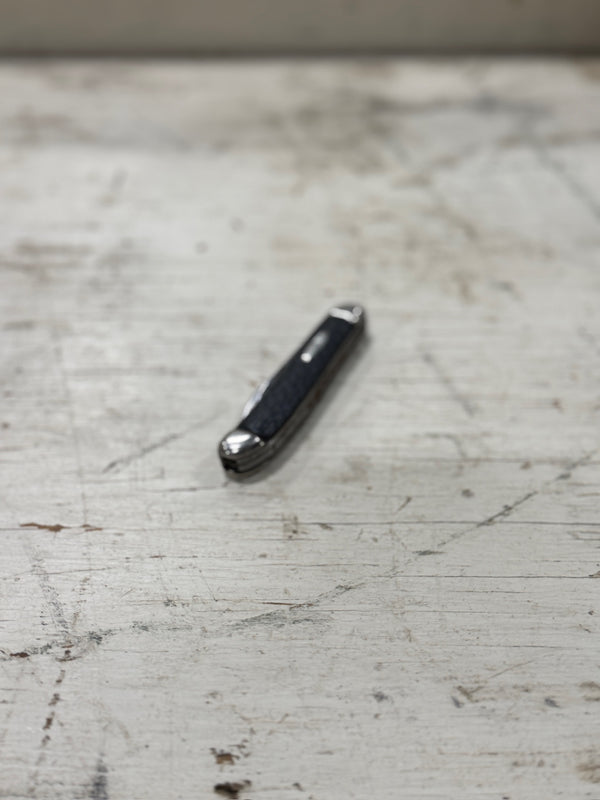
A small working knife, and a study in how good a plain tool can look. The handle is a solid barrel of ebonized hardwood, swelling gently at the middle and drawing to a softly rounded butt — shaped to sit in a closed fist rather than to be admired. The finish has worn to a low satin sheen across the high points where a hand went again and again, and the flat of the butt shows the pale ring of bare wood beneath.
A polished nickel ferrule caps the front, and from it emerges a short spear-point blade of carbon steel, hollow-ground with a shallow bevel and a fine grey patina across the flat. The proportions are the giveaway that this is a real tool: the handle is longer than the blade, because the work being done needed control rather than reach.
Set into the side of the handle is a small round medallion in red and white — the maker's mark, inlaid rather than stamped.
History & Provenance
The short-bladed knife with a barrel handle and a ferrule is one of the oldest and most persistent forms in European cutlery. In Solingen and Sheffield it was made by the thousands as a paring or "office" knife for the kitchen; on the workbench the same pattern served as a whittling and chip-carving knife; in the garden it was a budding and grafting knife. The design survived because it works — the ferrule keeps the tang from splitting the handle, the barrel shape keeps a wet hand from sliding, and the short blade takes the whole force of the grip out to the edge.
The inlaid red-and-white medallion places it with one of the great cutlery houses, which used exactly this kind of small handle escutcheon as their signature: Wüsthof's red trident and Victorinox's red shield are the two most familiar. Carbon steel and an ebonized wood handle put this comfortably in the mid-twentieth century, before stainless and molded synthetic handles took the category over entirely.
Product Details
| Field | Detail |
|---|---|
| Object | Fixed-blade paring / bench knife |
| Origin | European, likely German or Swiss |
| Material | Carbon steel blade; ebonized hardwood handle; nickel ferrule |
| Decoration | Undecorated; inlaid red and white maker's medallion to handle |
| Form | Short spear-point blade with barrel handle and ferrule |
| Era | c. 1930–1940 |
| Marks | Inlaid circular medallion in red and white to the handle side; maker not yet identified |
| Condition | Good, honest working condition. Blade straight and firm in the handle with no play; fine grey patina and light surface scratching to the steel, consistent with use and sharpening. Handle sound with no cracks; finish worn through to bare wood at the butt. Edge present and serviceable. Sold as a collectible tool; sharpen before kitchen use. Condition Guaranteed. |
| Availability | One of a Kind — 1 Available |
Why It Belongs in Your Home
Old hand tools are among the most satisfying small things to live with, because they look like what they do. This one earns a spot in a knife roll or a drawer and will still outperform most modern paring knives once it's taken back to a keen edge — carbon steel sharpens easier and cuts finer than stainless, which is the whole reason cooks and carvers still hunt for it. Off duty it styles beautifully: laid on a cutting board in a kitchen still life, dropped in a crock of wooden spoons, or set in a shadow box with other small tools. The black handle and bright ferrule read as graphic and modern against wood or stone.
Every piece is packed with professional-grade materials: multiple foam layers, double-boxing, directional and fragile handling labels. For large furniture we use custom timber crating. We photograph packing before dispatch and can provide images on request.
White-glove delivery is complimentary within 100 miles of Reno, NV. National shipping quotes provided at checkout. All shipments are photographed and documented. Damage claims must be filed with the carrier; we provide all documentation needed to support your claim.
Local pickup is available at Viridian HQ (Reno, NV) with 2–4 days notice. Contact us to arrange. Private viewings also available.
All antique and vintage items are sold as described and all sales are final. Each listing includes detailed condition notes and photographs so you can make a fully informed decision. We encourage buyers to ask questions — about condition, dimensions, finish, provenance — before purchasing.
Antiques are irreplaceable and one-of-a-kind. Carrier handling is outside our control once a piece has left our facility, and major carriers including FedEx do not insure antiques. We do everything within our power to ensure safe transit, but cannot accept liability for carrier damage. If damage occurs in transit, we will provide full documentation to support your carrier claim.
Have a question? — we're happy to provide additional photos, condition detail, or discuss the piece directly.