Vintage Italian Gilt Tole Six Light Crystal Chandelier, c. 1950–1975
Viridian Eclection


The Piece A gilt tole chandelier of the Florentine kind, built as a flowering plant rather than as a light fitting. A tapered central stem rises from a calyx of downturned leaves and carries two ti...
The Piece
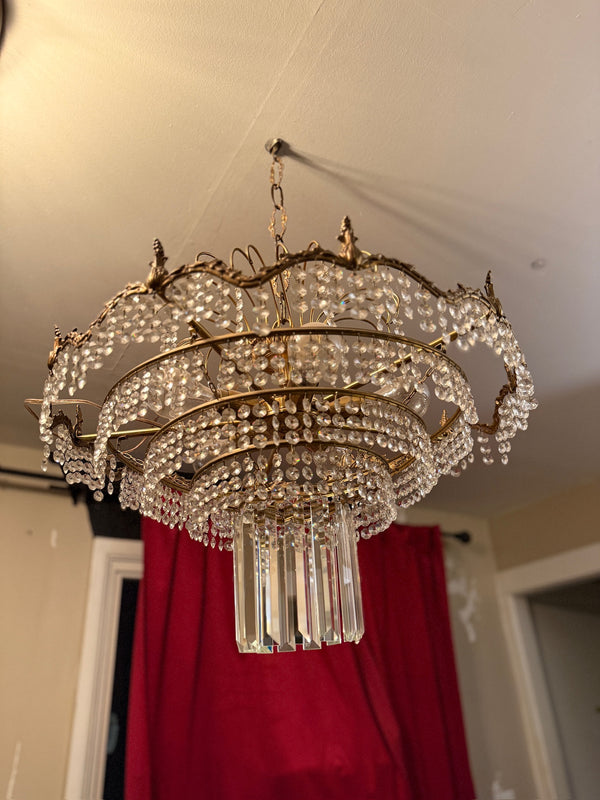
A gilt tole chandelier of the Florentine kind, built as a flowering plant rather than as a light fitting. A tapered central stem rises from a calyx of downturned leaves and carries two tiers of arms, each arm a length of hand bent strap steel dressed along its run with cut sheet metal leaves. Every arm finishes in a bobeche cut as a five pointed lily, the points curled up by hand so no two sit quite alike, and each holds a cream candle sleeve with a gilt drip collar at its base.
The crystal is the reason to own it. Pear and almond drops hang from the bobeches and from the leaf tips, hung the old way on twisted brass wire pins through small faceted octagon buttons, so that each drop sits on its own short chain of glass rather than being glued or clipped. Longer flat lozenges, bevelled on all four sides, fall at the outer points where they catch the most light, and a faceted crystal ball hangs from a ruffled gilt rosette at the very bottom as the terminal.
The gilding is worn in the way these always wear, bright and warm across the flat of the leaves and rubbed through at the folded edges and high points to a dark reddish ground. It reads as a hundred small highlights rather than as a uniform gold surface, which is what separates an honest old gilt finish from a resprayed one.
History & Provenance
Tole is painted or gilded sheet metal, and the Florentine workshops made it their own after the war. Florence had a long trade in gilding and in decorative metalwork, and through the 1950s and 1960s a cluster of small firms there turned out gilt tole furniture, mirrors, sconces and chandeliers in enormous quantity for the American and British export market. The formula was consistent: steel cut and bent by hand into leaves and flowers, a gesso or bole ground, gold leaf or gold finish over it, and crystal added by the piece. The result looked like eighteenth century Italian gilt work and cost a fraction of it, which is exactly why it sold.
The construction here places it in that tradition rather than in the earlier one it imitates. The arms are strap steel, not cast bronze. The leaves are cut from sheet and applied, not modelled. The bobeches are stamped and hand finished. The crystals are machine cut and pinned with brass wire, which is a continuous practice across two centuries and so dates nothing by itself, but combined with the metalwork it points squarely at the postwar Florentine workshops.
The candle sleeves are the other marker. Moulded cream plastic sleeves with gilt metal drip collars are a postwar fitting; earlier chandeliers used composition, paper or metal tubes. These are original to the fixture and show the gentle yellowing of age rather than the flat white of a replacement set.
Product Details
| Era | c. 1950–1975. Dated on construction rather than on a mark, which the piece does not carry, as is normal for the type. Hand bent strap steel arms with applied cut sheet metal leaves, stamped and hand finished lily bobeches, gold finish over a red ground, and original moulded candle sleeves with gilt drip collars together place it in the postwar Florentine gilt tole workshops rather than in the earlier Italian gilt metal tradition the form imitates |
| Origin | Italy, Florentine gilt tole tradition |
| Lights | Six candle arms in two tiers |
| Material | Gilt tole, which is gilded and hand worked sheet and strap steel, with cut crystal |
| Crystal | Faceted pear and almond drops and bevelled flat lozenges, pinned on twisted brass wire through octagon buttons, with a faceted crystal ball terminal |
| Fittings | Original cream candle sleeves with gilt drip collars, chain and canopy hardware present |
| Condition | Very good honest condition. Gilding warm and original with expected rub through at folded edges and high points revealing the reddish ground beneath. Crystal clean and bright with no clouding noted. Structure sound and arms true. Sold as found and not rewired by us; a buyer intending to install it should have it inspected and rewired by a licensed electrician as a matter of course with any vintage fixture |
Why It Belongs in Your Home
Gilt tole and crystal is the rare combination that is both formal and light. Cast bronze at this scale reads heavy and demands a formal room; a tole chandelier of the same size reads as foliage, so it will hang happily over a round breakfast table, in a powder room, at the top of a stair, or in a bedroom where a grander fixture would be oppressive. The crystal does the work at night and the gilt does it by day, and because the leaves are open rather than solid the fixture never blocks a sightline. It also sits comfortably with almost anything: against plaster and limewash it looks continental, against dark paint it looks theatrical, and over a modern table it does the job of a piece of sculpture that happens to give light.
Every piece is packed with professional-grade materials: multiple foam layers, double-boxing, directional and fragile handling labels. For large furniture we use custom timber crating. We photograph packing before dispatch and can provide images on request.
White-glove delivery is complimentary within 100 miles of Reno, NV. National shipping quotes provided at checkout. All shipments are photographed and documented. Damage claims must be filed with the carrier; we provide all documentation needed to support your claim.
Local pickup is available at Viridian HQ (Reno, NV) with 2–4 days notice. Contact us to arrange. Private viewings also available.
All antique and vintage items are sold as described and all sales are final. Each listing includes detailed condition notes and photographs so you can make a fully informed decision. We encourage buyers to ask questions — about condition, dimensions, finish, provenance — before purchasing.
Antiques are irreplaceable and one-of-a-kind. Carrier handling is outside our control once a piece has left our facility, and major carriers including FedEx do not insure antiques. We do everything within our power to ensure safe transit, but cannot accept liability for carrier damage. If damage occurs in transit, we will provide full documentation to support your carrier claim.
Have a question? — we're happy to provide additional photos, condition detail, or discuss the piece directly.