Vintage Leather Bound Quartersawn Oak Boot Jack, c. 1925–1965
Viridian Eclection


The PieceA boot jack cut from quartersawn oak and finished the way a maker finishes something meant to last. The board tapers from a squared tail to a deep V fork at the working end, with a riser b...
The Piece
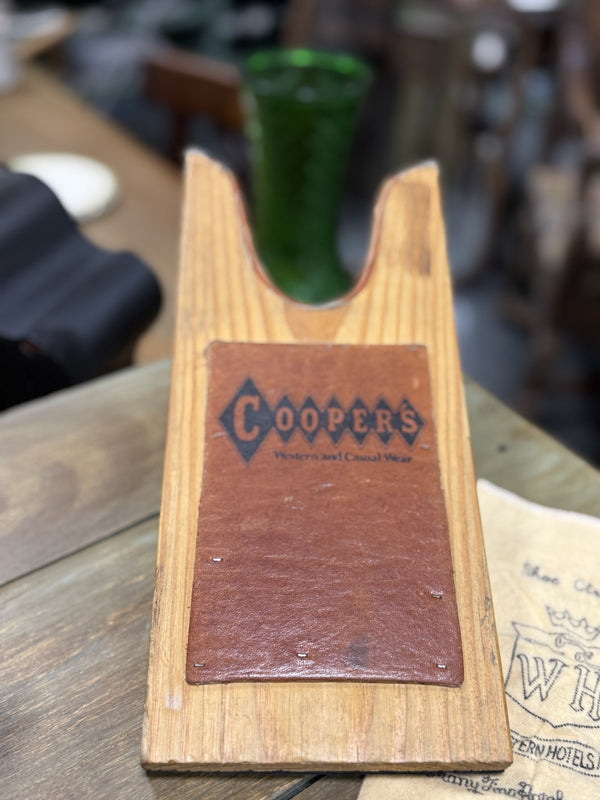
A boot jack cut from quartersawn oak and finished the way a maker finishes something meant to last. The board tapers from a squared tail to a deep V fork at the working end, with a riser block fastened beneath the tail so the fork sits proud of the floor.
The oak is the first thing worth noticing. It is quartersawn, so the medullary rays run across the grain as broad silvery flecks, and the surface is left light and open rather than stained down. That is a deliberate choice of stock for a utility object.
The whole perimeter is bound in black leather. It wraps the fork, runs around both arms and continues along the edges of the board, fastened with a regular line of staples that reads almost like stitching from a distance. The leather in the fork takes the heel, so the jack grips a boot without marking it.
Across the top face, where a foot presses down, is a black non slip tread panel with a coarse granular surface, stapled flat. At the tail a half round tab of the same black leather is fastened across the end with a hole punched through it, so the jack can hang on a peg or a nail rather than living on the floor.
Near the fork there is a faded ink stamp of two or three lines. It has soaked into the open pores of the oak and broken up, and it cannot be read.
History & Provenance
The stamp is the whole question and it does not answer. Under enlargement it resolves into fragments of blue grey ink spread across the oak pore structure, with no line of it legible enough to transcribe, so no maker, no place and no date is claimed from it.
What the object itself says is clearer. This is a made product rather than a shop project. The stock was selected quartersawn, the leather binding is cut to follow a curve and wrap an edge cleanly, the hang tab is a considered detail, and the whole thing is assembled to a repeatable pattern. Somebody was making these to sell.
The dating is deliberately wide, because the evidence will not carry a narrow range honestly. Every leather element is held with wire staples, and wire stitching and bench stapling were commercial from around the turn of the twentieth century and in ordinary use for leather and light goods well before the war, so the staples set a broad floor rather than a narrow one. The black tread panel has not been identified: emery cloth, rubber matting and later abrasive tape all present much the same way, and each would pull the date differently, so nothing has been concluded from it.
Neither the quartersawn oak nor the leather binding argues for a late date, and the general quality of the stock and the fitting sits more comfortably in the earlier half of that range than the later. No patent number, maker name or country of origin appears anywhere, and nothing has been read into that absence. Recovering the stamp, or identifying the tread material in the hand, would narrow this considerably.
Product Details
| Era | c. 1925–1965. Given as a wide range because the evidence will not honestly carry a narrow one. Wire staples throughout the leather binding and the hang tab set a broad floor from around the turn of the twentieth century, since wire stitching and bench stapling were in ordinary use for leather goods well before the war. The tread material has not been identified and nothing has been read into it. The faded ink stamp is illegible and contributes nothing to the dating. The absence of a patent number or country of origin sets no boundary |
| Form | Tapered board with a deep V fork and a fastened riser block, the standard lever type boot jack |
| Material | Quartersawn oak with prominent ray fleck, light finish, black leather binding and fork lining |
| Features | Full perimeter leather binding, non slip tread panel on the standing face, pierced leather hang tab at the tail |
| Marks | A faded two or three line ink stamp near the fork, illegible. No maker name, patent number or country of origin can be read |
| Dimensions | Approximately 15 in. long by 5 in. wide by 3 in. high |
| Condition | Very good and fully usable. Oak sound and clean with light handling marks. Leather binding complete around the fork, both arms and the board edges, supple with honest scuffing where heels have pressed and a little fraying at the fork tips. Tread panel intact and gripping. Hang tab sound. Staples present and tight throughout |
Why It Belongs in Your Home
The material is what sets this one apart. Quartersawn oak with the ray fleck showing is what good furniture is made from, and seeing it used on a floor tool is the kind of small excess that makes an object worth keeping.
It also solves the problem every boot jack has, which is where to put it. The hang tab means it goes on a peg by the door with the coats rather than underfoot, and the black leather and black tread against pale oak is a genuinely handsome combination.
If you wear boots it will outlast you. If you do not, it reads as sculpture in an entry, and almost nobody who picks it up will guess what it is until you tell them.
Every piece is packed with professional-grade materials: multiple foam layers, double-boxing, directional and fragile handling labels. For large furniture we use custom timber crating. We photograph packing before dispatch and can provide images on request.
White-glove delivery is complimentary within 100 miles of Reno, NV. National shipping quotes provided at checkout. All shipments are photographed and documented. Damage claims must be filed with the carrier; we provide all documentation needed to support your claim.
Local pickup is available at Viridian HQ (Reno, NV) with 2–4 days notice. Contact us to arrange. Private viewings also available.
All antique and vintage items are sold as described and all sales are final. Each listing includes detailed condition notes and photographs so you can make a fully informed decision. We encourage buyers to ask questions — about condition, dimensions, finish, provenance — before purchasing.
Antiques are irreplaceable and one-of-a-kind. Carrier handling is outside our control once a piece has left our facility, and major carriers including FedEx do not insure antiques. We do everything within our power to ensure safe transit, but cannot accept liability for carrier damage. If damage occurs in transit, we will provide full documentation to support your carrier claim.
Have a question? — we're happy to provide additional photos, condition detail, or discuss the piece directly.