Vintage Slatted Wood Crate Basket with Rope Beckets, c. 1920–1955
Viridian Eclection


The Piece A small open crate built of thin wooden laths on four corner posts, bleached silver by weather, with twisted rope loops at every corner. Each side is four courses of flat sawn lath la...
The Piece
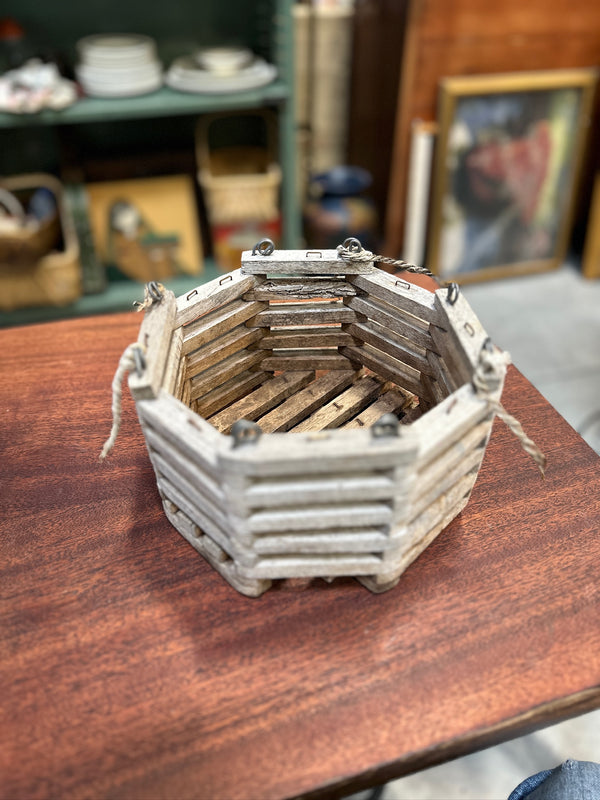
A small open crate built of thin wooden laths on four corner posts, bleached silver by weather, with twisted rope loops at every corner.
Each side is four courses of flat sawn lath laid horizontally with an open gap between them, the ends butting against a square corner post that runs the full height. The posts carry on below the bottom course and stand the crate up off the surface on four short feet.
The floor is a separate set of laths laid across the width with gaps between, so the whole box is open from every direction.
The fastenings are all the same: small U-shaped wire staples, driven by hand across each lath into the post behind it. There is no nail, screw, glue or joint anywhere in it.
At all four corners, a wire staple is driven over the top rail, and through each one is tied a length of twisted natural-fibre twine — pale tan, fuzzed along its length and frayed open at the ends.
The outer faces are silver-grey and fibrous with the grain standing proud. Inside, the laths are warmer and browner, with rust staining bled out around several of the staples and an ochre residue across part of the floor. One floor lath carries a faint, regular diamond crosshatch on its surface.
History & Provenance
This crate and the hexagonal basket listed alongside it are built by the same method, and it is worth saying so plainly: laths pinned with hand-driven wire staples onto corner posts, no joinery at all, and rope beckets tied through staples at the corners. They are of a piece.
That method is the signature of expendable working gear rather than housewares. It is fast to build, fast to mend, and cheap enough to lose. A cabinetmaker joins a box; a man who needs forty of them by Friday staples laths to posts.
The open build is deliberate and it is the reason the form exists. Water and grit fall straight through a slatted crate, the contents dry instead of souring, and it can be dunked, drained and stacked wet. Containers like this did the wet, dirty work of shellfish, produce and market handling, where a solid box would have held the mess in.
The rope loops are beckets — rope fitted to an object so it can be carried, hung, lashed or hauled. Tied through a staple at each of four corners, they let the crate be slung, roped down or lifted by two people. That is a rigging detail, not a decorative one.
The cordage dates it, and it dates it the same way as its companion. The twine is natural fibre: fuzzy along its length where individual fibres have lifted, frayed soft at the ends, and unevenly twisted. Synthetic rope stays slick, holds its lay and melts rather than fuzzes. Nylon and polypropylene displaced natural line from working gear through the 1950s and 1960s, so gear still rigged with hemp or sisal was rigged before that change. The staple-and-lath construction sets the earlier end, wire staples in this use belonging to the machine age rather than before it.
On that evidence it is offered as c. 1920–1955, unattributed. There is no stamp, brand, paint, label or name anywhere on it. What it carried is not recorded, so it is described as what it is rather than assigned a job it cannot prove.
One detail is worth stating without an explanation attached. A single floor lath carries a faint diamond crosshatch across its face, fine and regular and evenly spaced rather than drawn by hand, alongside a pale ochre residue. It is machine-uniform, but what left it is not something the crate can tell you, and no guess is offered here.
Product Details
| Object | Small open slatted wooden crate with rope beckets |
| Construction | Four courses of flat sawn lath per side on four square corner posts, every lath pinned with a hand-driven U-shaped wire staple; separate lath floor; corner posts extended below as feet |
| Fittings | A wire staple driven over the top rail at each of the four corners, with twisted natural-fibre twine tied through each one |
| Dimensions | Approximately 9 in long by 7 in wide by 4½ in tall, excluding the rope |
| Timber | Softwood laths, bleached silver-grey outside with the grain raised; warmer and browner inside |
| Marks | None. No stamp, brand, paint, label or name anywhere. A faint regular diamond crosshatch and an ochre residue on one floor lath, origin unknown. Offered unattributed. |
| Era | c. 1920–1955, on the cordage and the fastenings. The twine is natural fibre — fuzzed along its length, frayed soft at the ends, unevenly twisted — and natural-fibre line was displaced from working gear by nylon and polypropylene through the 1950s and 1960s. The staple-fastened lath construction sets the earlier end. |
| Condition | Sound as a display object, with the honest wear of something that lived outdoors. The crate stands square and firm on all four feet and holds its shape under its own weight. All four corner posts are present, the floor is complete, and the staples are in place throughout with surface rust and rust bleed into the wood around several of them. The wood is heavily weathered: silvered and fibrous outside, with raised grain, softened edges and short splits at a few lath ends. The twine is present at all four corners but frayed, broken at some ends, and does not form a continuous carrying loop. Not to be loaded or lifted by the rope. Condition Guaranteed. |
| Availability | One of a Kind — 1 Available |
Why It Belongs in Your Home
An open slatted box does something a solid one cannot: it shows you what is in it and throws a grid of shadow while doing it.
Silvered, fibrous, gap-built wood catches light along every lath edge. Set it on a shelf of smooth ceramics and painted wood and it is the thing the eye stops on, and it does that work for a fraction of what a piece of sculpture costs.
The proportions are the useful part. At nine by seven it is the size of a deep letter tray, which puts it in play almost anywhere: post and keys in an entry, onions and garlic on a counter, seed packets and labels on a potting bench, soap and flannels in a bathroom, remotes on a low table, or a row of small pots dropped in on their own saucers.
It stacks visually with other things and argues with none of them. Silver-grey, pale tan and rust, against linen, stoneware, zinc, iron, brick and old wood.
And it reads as equipment rather than decoration from across a room, which is the whole difference. Hand-driven staples, rope beckets at four corners, posts worn to feet, bleached by years of weather. Nothing about it was designed to be charming, which is exactly why it is.
It also pairs. The hexagonal basket listed alongside it is built the same way, by the same method, and the two shown together make an obvious and well-priced group for a shelf, a shop display or a photograph.
A note on care, and the first point matters. Do not carry it by the rope. The twine is old, frayed and broken in places, and it is there as evidence rather than as a handle. Lift it from underneath with both hands.
Do not wash it and do not oil it. Weathered wood takes up water and holds it inside the laths, and oil will turn the silver grey to blotchy brown and take the whole character out of it. Dust it with a dry brush.
Keep it indoors and dry. It has already had its outdoor life, and another wet winter would start working the staples loose.
If you set anything damp in it, put a liner or a saucer underneath. The rust bleed around the staples shows exactly what standing moisture does to this piece.
Every piece is packed with professional-grade materials: multiple foam layers, double-boxing, directional and fragile handling labels. For large furniture we use custom timber crating. We photograph packing before dispatch and can provide images on request.
White-glove delivery is complimentary within 100 miles of Reno, NV. National shipping quotes provided at checkout. All shipments are photographed and documented. Damage claims must be filed with the carrier; we provide all documentation needed to support your claim.
Local pickup is available at Viridian HQ (Reno, NV) with 2–4 days notice. Contact us to arrange. Private viewings also available.
All antique and vintage items are sold as described and all sales are final. Each listing includes detailed condition notes and photographs so you can make a fully informed decision. We encourage buyers to ask questions — about condition, dimensions, finish, provenance — before purchasing.
Antiques are irreplaceable and one-of-a-kind. Carrier handling is outside our control once a piece has left our facility, and major carriers including FedEx do not insure antiques. We do everything within our power to ensure safe transit, but cannot accept liability for carrier damage. If damage occurs in transit, we will provide full documentation to support your carrier claim.
Have a question? — we're happy to provide additional photos, condition detail, or discuss the piece directly.