Early 20th-Century Open-Back Armchair with Preserved Woven Seat & Custom Leather Upholstery c. 1910-1930s
Viridian Eclection
The Piece
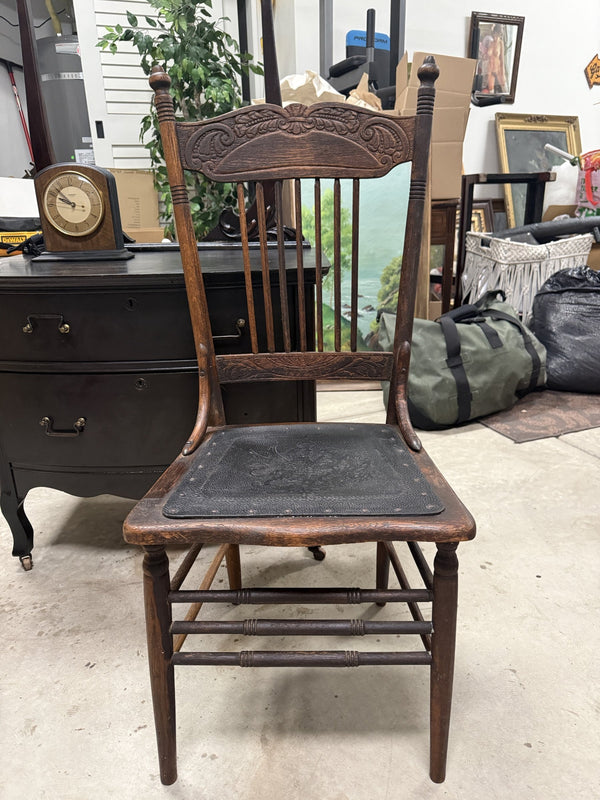
An early twentieth century open back armchair of approximately 1910 to 1930, defined by an elegant pierced splat, restrained classical detailing and a frame that balances refinement with everyday usability. It sits in the transitional period between late Victorian ornamentation and the lighter, more architectural sensibilities of the early modern era.
The form is deliberate and graceful. The open back gives visual lightness while gently scrolled arms and subtly tapered legs anchor the piece. The solid wood frame carries a warm, naturally aged patina, the pierced backrest is worked with symmetrical openwork and softly carved rosette medallions, and hand applied beaded detailing runs along the crest rail, the stiles and the outer frame. The curved arms have edges softened by decades of use.
The beading is subtly irregular and the carving restrained rather than exuberant, the marks of a period when furniture was still largely shaped by hand. The wood finish has been left intact, showing honest wear, minor surface variation and a depth of tone that only comes with time. There has been no attempt to over refinish or homogenize the surface.
The seat has been updated without erasing what came before. A newly fabricated leather seat has been installed above the original basket woven or straw seat foundation, which has been intentionally retained beneath it, and the upholstery is secured with period appropriate brass tacks.
History & Provenance
Chairs of this type emerged during a period of aesthetic transition in furniture design. The beading and carved rosettes nod to classical and Victorian traditions, while the open back, cleaner lines and reduced ornamentation anticipate the functional priorities of the early twentieth century.
That hybrid approach reflects changing domestic habits. Furniture was no longer intended solely for formal display, and pieces were expected to be lighter, more versatile and better suited to daily life. The open back armchair became a favored solution, and chairs of this kind were used in writing rooms, sitting areas and private bedrooms rather than in formal reception rooms.
Originally chairs like this were seated with woven rush or straw, materials chosen for availability and breathability. The preserved woven foundation on this example is a direct link to that original intent, and it keeps the chair's construction logic legible while continuing to provide structural support.
The chair carries no maker's mark on record, so the dating and the origin, likely European or American, rest on idiom and construction: the pierced splat, the hand applied beading, the tapered legs and the woven seat base.
Product Details
| Era | Early twentieth century, c. 1910 to 1930 |
| Origin | Likely European or American |
| Form | Open back armchair with pierced splat and carved rosette medallions, scrolled arms and tapered legs |
| Materials | Solid wood frame, original woven basket or straw seat base, new leather upholstery with brass tacks |
| Maker | Unmarked. Attribution rests on idiom and construction |
| Style | Transitional, with classical revival influence |
| Condition | Structurally sound and stable. Original wood finish retained with visible patina and age appropriate wear. New leather seat in excellent condition. Original woven seat base intact beneath the leather. No structural compromises and no artificial aging |
| Dimensions | To be confirmed |
Why It Belongs in Your Home
The chair occupies a middle ground that is rare in period seating: it is neither frozen in time nor aggressively modernized, so preservation and use coexist in the same object.
The retained woven foundation records how the chair was originally made and used. The leather seat means it can be used now without fragility. Together they read as intentional rather than improvised.
At a desk it becomes a writing chair with character. In a bedroom or sitting room it reads as sculptural without being precious. It suits a buyer who values craftsmanship over trend and restraint over excess, and who wants an object that carries its history forward rather than hiding it.
Every piece is packed with professional-grade materials: multiple foam layers, double-boxing, directional and fragile handling labels. For large furniture we use custom timber crating. We photograph packing before dispatch and can provide images on request.
White-glove delivery is complimentary within 100 miles of Reno, NV. National shipping quotes provided at checkout. All shipments are photographed and documented. Damage claims must be filed with the carrier; we provide all documentation needed to support your claim.
Local pickup is available at Viridian HQ (Reno, NV) with 2–4 days notice. Contact us to arrange. Private viewings also available.
All antique and vintage items are sold as described and all sales are final. Each listing includes detailed condition notes and photographs so you can make a fully informed decision. We encourage buyers to ask questions — about condition, dimensions, finish, provenance — before purchasing.
Antiques are irreplaceable and one-of-a-kind. Carrier handling is outside our control once a piece has left our facility, and major carriers including FedEx do not insure antiques. We do everything within our power to ensure safe transit, but cannot accept liability for carrier damage. If damage occurs in transit, we will provide full documentation to support your carrier claim.
Have a question? — we're happy to provide additional photos, condition detail, or discuss the piece directly.