Maple Swivel Desk Chair, Channel-Tufted Back with Nailhead Trim, c. 1940–1960
Viridian Eclection


The Piece A mid-century wooden swivel desk chair of the kind that once furnished every bank, law office, and newsroom in America. The frame is solid hardwood in a warm honey finish, with back stile...
The Piece
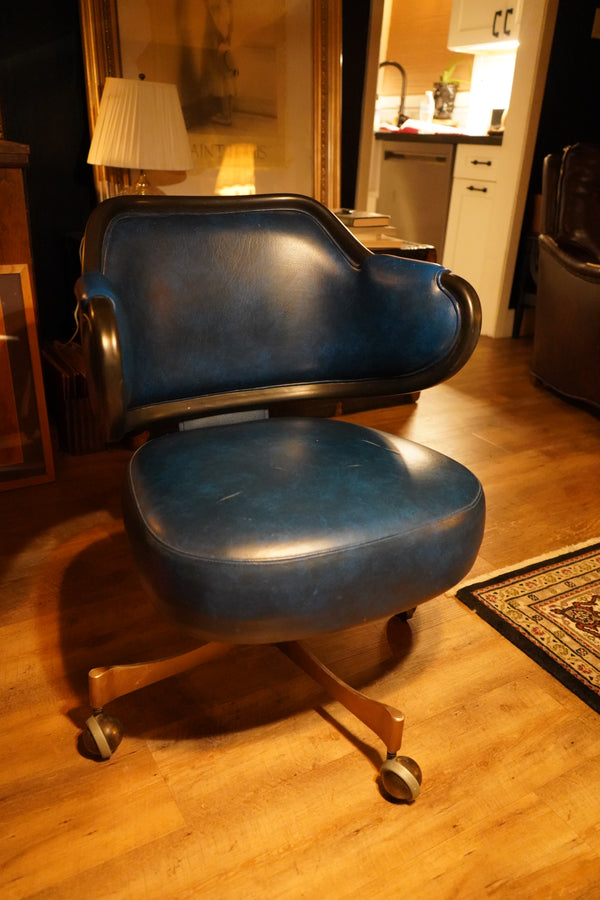
A mid-century wooden swivel desk chair of the kind that once furnished every bank, law office, and newsroom in America. The frame is solid hardwood in a warm honey finish, with back stiles that sweep up in a long shallow curve and cap the upholstery in a shaped crown rail — a detail that costs money to make and is the reason these chairs still look like furniture rather than office equipment.
The back panel is channel-tufted in caramel vinyl, four deep vertical rolls that catch light across the top and give the chair its silhouette from across a room. Turn it around and the reverse is the surprise: a single smooth panel bordered on three sides by a run of domed brass nailheads, finished as carefully as the front. The seat is a low-profile cushion in rust-toned woven tweed with a piped vinyl edge.
Underneath it is all mechanism. A four-arm wooden star base rides on original casters, and the column carries a cast-iron spring assembly with a threaded height adjustment and a tilt-tension knob — the same architecture Aeron chairs still use, executed in iron and hardwood eighty years earlier.
History & Provenance
The wooden swivel chair is an American invention with a long pedigree — Thomas Jefferson is credited with an early version — but it came into its own between the 1920s and the 1950s, when firms across the Midwest and New York State supplied hardwood office seating to a country that had just built the modern white-collar workplace. Chairs like this were specified by the hundred for institutions, and they were built to survive that: hardwood frames, iron mechanisms, and replaceable upholstery.
What distinguishes this example is the finishing. Channel tufting, a shaped crown rail, and hand-set nailhead trim on a surface most sitters would never see were the marks of the better manufacturers, not the budget ones. It has been used hard and honestly, and it has kept its structure — which is precisely what these chairs were engineered to do.
Product Details
| Field | Detail |
|---|---|
| Object | Swivel desk chair |
| Origin | American office furniture; maker unattributed |
| Form | Shaped hardwood frame with crown rail and channel-tufted back; upholstered seat on a four-arm wooden star base with casters, cast-iron spring column, threaded height adjustment, and tilt-tension control |
| Material | Solid hardwood in a honey finish; caramel vinyl back with domed brass nailhead trim; rust-toned woven tweed seat with piped vinyl edge |
| Marks | No visible maker's mark |
| Era | c. 1940–1960 |
| Condition | Good structural condition with honest working wear. The frame is solid and tight, the swivel and height mechanisms are intact, and the original casters are present. The seat fabric is worn through at the front right corner with fraying to the edge, and the finish shows rubbing and handling marks along the back stiles and base arms. Vinyl back and nailhead trim are intact and supple. Sold as found. Condition Guaranteed. |
| Availability | One of a Kind — 1 Available |
Why It Belongs in Your Home
A working antique in the truest sense: this is a chair you sit in every day, not one you look at. It brings warmth and real material to a home office where the alternative is molded plastic and mesh, and the compact footprint suits a desk in a bedroom, a corner of a living room, or a hallway workspace where a full executive chair would overwhelm. The honey frame and caramel vinyl sit naturally with walnut, oak, leather, brass, and vintage rugs.
The worn seat is the opportunity here. It's a single small cushion, straightforward for any upholsterer to recover, and a yard of good wool, leather, or mohair turns this into a genuinely handsome piece for a modest investment — or leave it as it is and let the wear read as history. A note on care: keep it out of direct sun, which hardens vinyl over time; feed the vinyl with a proper conditioner once or twice a year; and put a drop of light oil on the caster axles and the threaded column to keep the action smooth.
Every piece is packed with professional-grade materials: multiple foam layers, double-boxing, directional and fragile handling labels. For large furniture we use custom timber crating. We photograph packing before dispatch and can provide images on request.
White-glove delivery is complimentary within 100 miles of Reno, NV. National shipping quotes provided at checkout. All shipments are photographed and documented. Damage claims must be filed with the carrier; we provide all documentation needed to support your claim.
Local pickup is available at Viridian HQ (Reno, NV) with 2–4 days notice. Contact us to arrange. Private viewings also available.
All antique and vintage items are sold as described and all sales are final. Each listing includes detailed condition notes and photographs so you can make a fully informed decision. We encourage buyers to ask questions — about condition, dimensions, finish, provenance — before purchasing.
Antiques are irreplaceable and one-of-a-kind. Carrier handling is outside our control once a piece has left our facility, and major carriers including FedEx do not insure antiques. We do everything within our power to ensure safe transit, but cannot accept liability for carrier damage. If damage occurs in transit, we will provide full documentation to support your carrier claim.
Have a question? — we're happy to provide additional photos, condition detail, or discuss the piece directly.