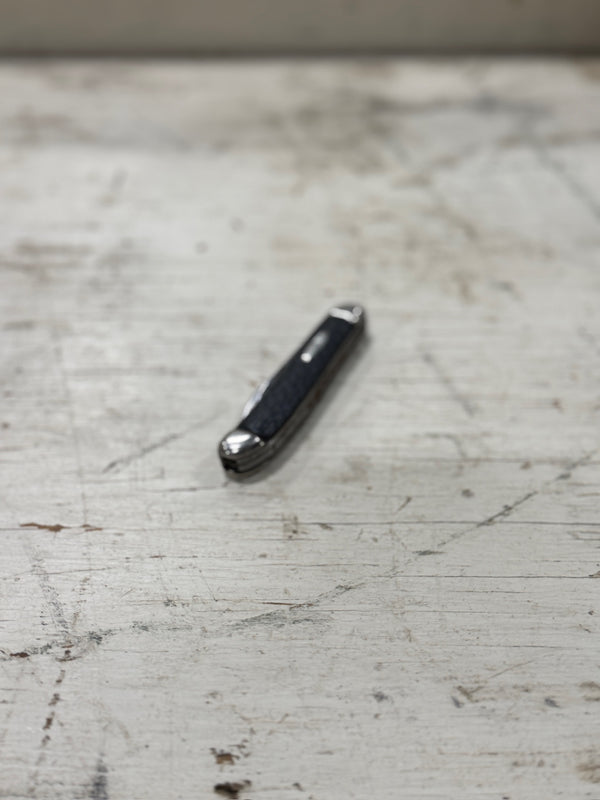
Imperial Fisherman's Toothpick Pocket Knife, Cracked Ice Celluloid with Fish Shield, Providence Rhode Island, c. 1942–1955
Viridian Eclection


The Piece A slim two-blade fishing knife in the toothpick pattern — long, narrow, and gently curved, with a spear-point main blade and a hook disgorger and scaler blade opening from the opposite en...
The Piece
A slim two-blade fishing knife in the toothpick pattern — long, narrow, and gently curved, with a spear-point main blade and a hook disgorger and scaler blade opening from the opposite end. The scales are cracked ice celluloid, a swirled cream and pearl imitation that catches light like the real thing, set between polished steel bolsters. Inset in the front scale is a small die-struck fish shield, scales and fins picked out in relief — the maker's signal that this knife had a job. The tang carries the Imperial mark and, on the reverse, the patent numbers 2170537 and 2281782.
History & Provenance
Imperial began with two brothers from Frosolone in the Italian Molise. Felix and Michael Mirando emigrated to Providence, Rhode Island in 1916 to be near its jewelry industry, where they began making skeletons for pocket-watch chain knives; with their friend Domenic Fazzano as manager they founded the Imperial Knife Company, which grew to become the largest knife manufacturer in the United States.
Their advantage was a method. Rather than milling solid frames, Imperial stamped handles from sheet and wrapped them — the construction protected by the two patents stamped on this blade, issued in 1939 and 1942. That let the company put a real working knife into a hardware store for the price of a sandwich, and it is why so many American men of the mid-century carried one. This particular pattern was made for a purpose: the second blade scales fish and frees a swallowed hook, and the fish shield told a buyer at a glance what the knife was for. It went in a tackle box, not a display case.
Product Details
| Field | Detail |
|---|---|
| Object | Two-blade folding fishing knife, toothpick pattern |
| Maker | Imperial Knife Company, Providence, Rhode Island |
| Marks | Imperial tang stamp; patents 2170537 and 2281782 to reverse tang |
| Blades | Spear-point main; hook disgorger and scaler secondary; carbon steel |
| Handle | Cracked ice celluloid over shell construction; steel bolsters |
| Shield | Die-struck fish, inset front scale |
| Era | c. 1942–1955 |
| Dimensions | [ pending — closed length ] |
| Condition | Good; both blades functional. See condition notes. Condition Guaranteed. |
| Availability | One of a Kind — 1 Available |
Why It Belongs in Your Home
There is a particular pleasure in an object made for one job and shaped entirely by it. This knife scales a fish, frees a hook, and cuts a line, and every line of it — the narrow curve, the twin ends, the little fish on the handle — follows from that. It came out of a Providence factory built by two immigrant brothers and it went into a tackle box that smelled of cedar and old line. Small enough for a jacket pocket, handsome enough for a shelf, and cheap enough that you can simply enjoy owning it.
Condition Notes
Grey patina and scattered dark pitting to both blades, consistent with carbon steel and use around water. Cracked ice celluloid scales sound with no cracks, shrinkage, or lifting; light yellowing and small surface marks consistent with age. Both blades open and close on a firm spring. Steel bolsters with light scratching. Sharpened during working life; not factory edge.
Care note for the listing: store this knife loose and dry, not sealed in a bag or a box with other knives. Celluloid outgasses as it ages, and the vapor will corrode blades — including neighboring ones. Present scales are stable, but the material rewards air.
Every piece is packed with professional-grade materials: multiple foam layers, double-boxing, directional and fragile handling labels. For large furniture we use custom timber crating. We photograph packing before dispatch and can provide images on request.
White-glove delivery is complimentary within 100 miles of Reno, NV. National shipping quotes provided at checkout. All shipments are photographed and documented. Damage claims must be filed with the carrier; we provide all documentation needed to support your claim.
Local pickup is available at Viridian HQ (Reno, NV) with 2–4 days notice. Contact us to arrange. Private viewings also available.
All antique and vintage items are sold as described and all sales are final. Each listing includes detailed condition notes and photographs so you can make a fully informed decision. We encourage buyers to ask questions — about condition, dimensions, finish, provenance — before purchasing.
Antiques are irreplaceable and one-of-a-kind. Carrier handling is outside our control once a piece has left our facility, and major carriers including FedEx do not insure antiques. We do everything within our power to ensure safe transit, but cannot accept liability for carrier damage. If damage occurs in transit, we will provide full documentation to support your carrier claim.
Have a question? — we're happy to provide additional photos, condition detail, or discuss the piece directly.