Los Angeles Console Radio, Quartersawn Oak, Station Dial, c. 1934–1939
Viridian Eclection


The Piece A large American console radio of the late 1930s in a quartersawn oak cabinet, built for the Los Angeles market. The cabinet is a tall floor-standing case with rounded front corners, a sl...
The Piece
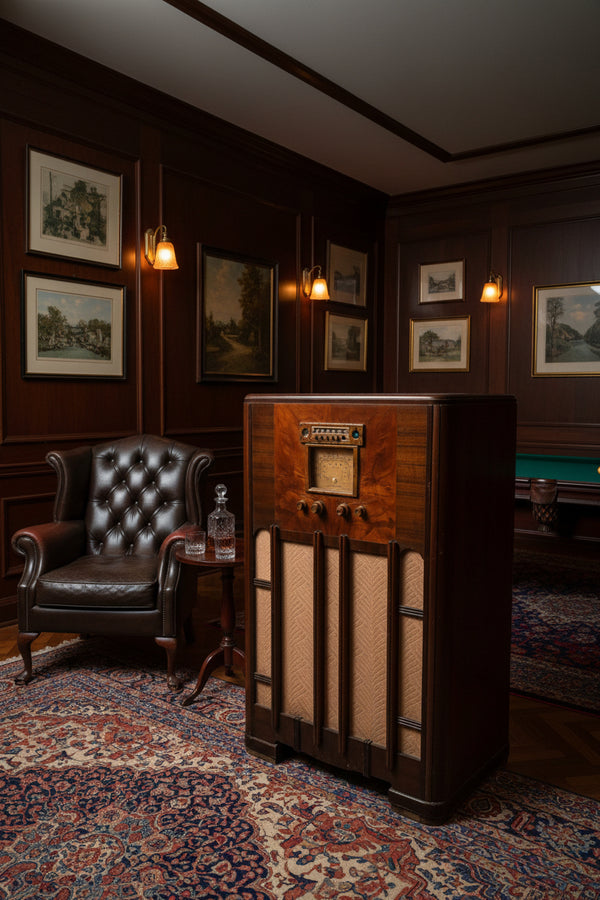
A large American console radio of the late 1930s in a quartersawn oak cabinet, built for the Los Angeles market. The cabinet is a tall floor-standing case with rounded front corners, a sloped control panel at the top and a wide speaker opening below, the speaker grille covered in its original brown woven cloth behind four vertical oak ribs. A heavy molded rail with rounded ends divides the control panel from the grille, and the sides are finished in reeded oak. The oak is quartersawn and shows strong ray fleck across the front panel under a brown finish.
The dial is the point of the piece. A large round airplane dial in a stepped brown Bakelite bezel carries a golden dial glass printed in three rings: the standard broadcast band from 550 to 1700 kilocycles, a shortwave band from 5.5 to 20 megacycles marked with Havana, London, Berlin, Rome, Madrid, Mexico City, Japan and South America, and around the outside the call letters of the Los Angeles stations of the day, KHJ, KFWB, KFVD, KNX, KFSG, KGFJ, KFOX, KFAC, KGER, KECA, KFI, KFSD, KMTR, KMPC and KEHE, each with a pointer at its frequency. A large knurled tuning knob sits at the base of the dial and three smaller knobs below it control volume, tone and band. The dial glass is intact and the knobs are present.
The cabinet is clean and complete, with wear to the finish along the lower front rail and the base molding and light wear to the top edges, consistent with eighty years of use in a house rather than storage. The grille cloth is original. The radio is offered as a cabinet and chassis in untested electrical condition; vintage sets of this type should be inspected and recapped by a radio technician before being run on modern household current.
History & Provenance
Station call letters on a dial were a Los Angeles habit. In the middle 1930s the West Coast radio makers, Packard-Bell and Gilfillan Brothers chief among them, printed the call letters of the local stations around the dial so a listener could tune by name rather than by frequency, and the practice marks a set as having been built and sold in Southern California. This dial fixes its own date. KEHE, the Evening Herald and Express station, used those call letters only from 1934 until 1939, when it was sold to Earle C. Anthony and became KECA, and the original KECA appears on the dial as well, so the glass was printed while both were on the air, between 1934 and 1939. The airplane dial, the shortwave band with its city names, and the heavy streamlined oak cabinet with rounded corners all belong to the same years, the high point of the big American console radio before the war.
No maker's badge is visible on the cabinet front and the set is offered as a Southern California console of the late 1930s pending identification of the chassis. The dating rests on the dial itself and on the cabinet construction rather than style alone. It came to us from the same source as a group of carved golden oak furniture of the turn of the century, each piece of which is offered separately.
Product Details
| Type | Floor console radio, broadcast and shortwave |
| Origin | United States, Southern California market, maker to be confirmed from the chassis |
| Date | c. 1934–1939 |
| Cabinet | Quartersawn oak with reeded sides and rounded front corners |
| Dial | Round airplane dial, golden glass, broadcast 550–1700 kc, shortwave 5.5–20 mc, Los Angeles station call letters |
| Controls | Large tuning knob, three smaller knobs |
| Grille | Original brown woven cloth behind four oak ribs |
| Finish | Old brown finish, wear to the lower front rail and base |
| Condition | Cabinet clean and complete; dial glass intact; knobs present; electrical condition untested, inspection recommended before use |
| Scale | Large for the form; measurements on request |
| Availability | 1 Available |
Why It Belongs in Your Home
A big prewar console radio is furniture first. This one has the mass and the figure of a good oak cabinet and a dial that is a piece of Los Angeles history in itself, and it reads as sculpture in a living room, a study or a bar whether or not it is ever switched on. Restored, it is a warm-sounding broadcast receiver and a conversation piece; left as it is, it is a side table with a glowing dial once a lamp is set on it. It suits a Craftsman bungalow, a mid-century den or a layered, collected room, and it is exactly the kind of piece that gives a hospitality or retail space its character. For a shop or designer client it is a large, honest, original West Coast console with its grille cloth and dial glass intact, which is rarer than it sounds.
Every piece is packed with professional-grade materials: multiple foam layers, double-boxing, directional and fragile handling labels. For large furniture we use custom timber crating. We photograph packing before dispatch and can provide images on request.
White-glove delivery is complimentary within 100 miles of Reno, NV. National shipping quotes provided at checkout. All shipments are photographed and documented. Damage claims must be filed with the carrier; we provide all documentation needed to support your claim.
Local pickup is available at Viridian HQ (Reno, NV) with 2–4 days notice. Contact us to arrange. Private viewings also available.
All antique and vintage items are sold as described and all sales are final. Each listing includes detailed condition notes and photographs so you can make a fully informed decision. We encourage buyers to ask questions — about condition, dimensions, finish, provenance — before purchasing.
Antiques are irreplaceable and one-of-a-kind. Carrier handling is outside our control once a piece has left our facility, and major carriers including FedEx do not insure antiques. We do everything within our power to ensure safe transit, but cannot accept liability for carrier damage. If damage occurs in transit, we will provide full documentation to support your carrier claim.
Have a question? — we're happy to provide additional photos, condition detail, or discuss the piece directly.