The Piece
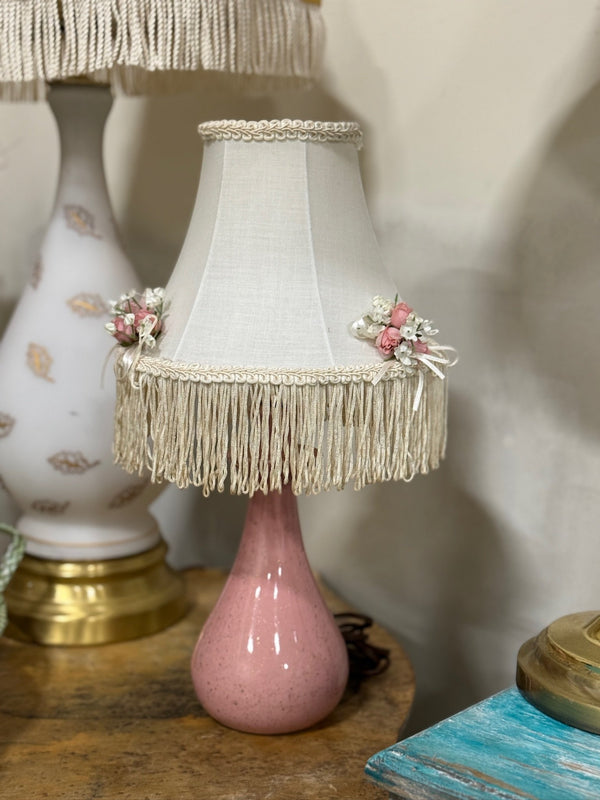
A wonderfully tactile mid-century ceramic lamp base: a full, low-shouldered gourd body tapering into a slender neck that opens again at a flat flaring collar — closer to a decanter than to any urn or column that came before it. The glaze is the whole argument here, a soft rose ground broken by fine dark speckling that scatters across the surface and pools where the body swells. Glossy without being slick, it shifts between coral and dusty pink depending on the light in the room. The cut-corner bell shade in oatmeal with dark brown binding sets a crisp geometry against all that softness.
History & Provenance
Speckled glaze is the signature surface of American mid-century ceramics. Iron oxide introduced into the glaze breaks through during firing as scattered dark flecks — an effect the studio potters of the 1940s prized as evidence of the hand and the kiln, and one the commercial potteries of California, Ohio, and Tennessee had industrialized by the mid-1950s for buyers who wanted studio character at department-store prices. The bottle form belongs to the same moment: as postwar interiors shed their historicist furniture, lamp bases followed, and the column and urn gave way to gourds, bottles, and teardrops owing more to Scandinavian glass and Japanese ceramics than to anything eighteenth-century.
Product Details
| Field | Detail |
|---|---|
| Object | Table lamp with shade |
| Origin | American |
| Material | Glazed ceramic; brass-tone fittings; woven fabric shade with dark binding |
| Decoration | Speckled rose glaze with iron-fleck breakthrough |
| Form | Gourd / bottle base with cut-corner bell shade |
| Era | c. 1955–1968 |
| Condition | Very good. Glaze bright and continuous with no chips, crazing, or losses to body, neck, or collar. Shade clean and structurally sound, binding intact. Condition Guaranteed. |
| Availability | One of a Kind — 1 Available |
Why It Belongs in Your Home
Rose isn't a color most people plan for, which is exactly why this one works — it reads as a warm neutral until you look straight at it, and then it's unmistakably pink. Set it against walnut, teak, or anything with a clean mid-century line and it belongs immediately. It's also the piece that rescues a room gone too grey. If the oatmeal shade ever feels safe, a crisp white or deep charcoal drum would push the base somewhere sharper.