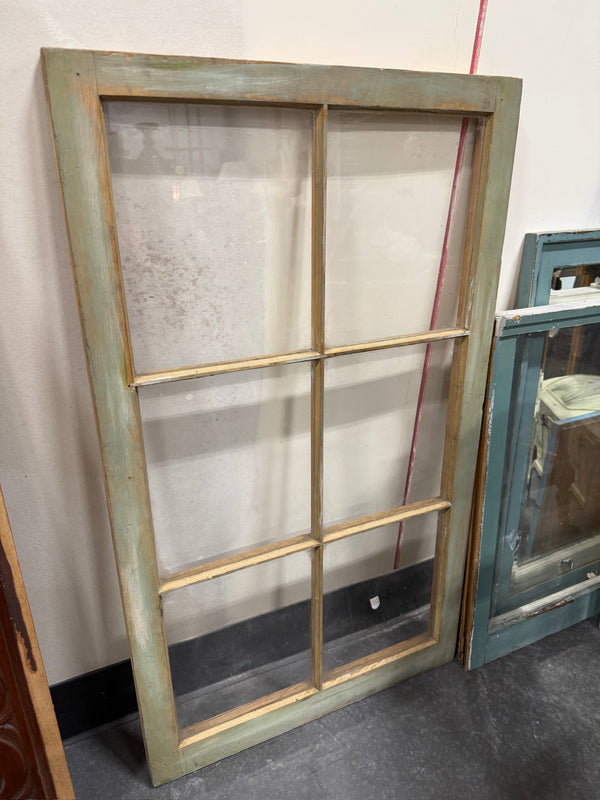
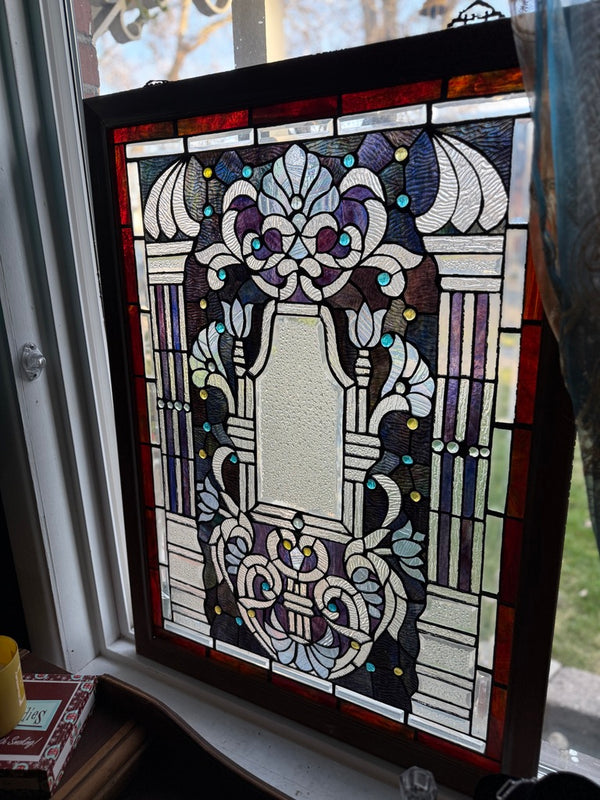
Salvaged Wood Window Sash, Chippy Green over White Paint with Original Glass, American, c. 1910–1940
Viridian Eclection


The Piece A wonderfully weathered salvaged window sash with exactly the paint history collectors hunt for: a soft sage-green top coat worn back through to an older white beneath, chipping and flaki...
The Piece
A wonderfully weathered salvaged window sash with exactly the paint history collectors hunt for: a soft sage-green top coat worn back through to an older white beneath, chipping and flaking across the rails and stiles in a way no one could reproduce on purpose. The frame is solid wood joined at mortise-and-tenon corners, and it retains its original glass — look through it at an angle and the glazing ripples and bends the reflection, the unmistakable tell of early sheet glass. The top rail still carries its cast-metal sash lift, thick with old paint and worn smooth where hands pulled it for decades. Dried glazing putty, old nail holes, and honest edge wear complete the picture.
History & Provenance
Wood sash windows were the standard glazing of American houses from the colonial period until aluminum and vinyl replacements swept through in the second half of the twentieth century. The single-light and simple divided-light configurations here belong to the early decades of the 1900s, when improved sheet glass made large panes affordable and the multi-pane grids of earlier eras gave way to cleaner divisions. Millions of these were pulled and burned during the replacement-window boom, and what survived did so mostly by accident — stacked in barns, garages, and basements. That scarcity, plus the wavy old glass and the layered paint, is why salvage sashes became one of the most in-demand architectural fragments of the last two decades.
Product Details
| Field | Detail |
|---|---|
| Object | Salvaged wood window sash |
| Origin | American |
| Material | Painted softwood frame; original glass; cast-metal sash lift |
| Decoration | Layered chippy paint — sage green over white; original hardware |
| Form | Rectangular sash, mortise-and-tenon joined |
| Era | c. 1910–1940 |
| Condition | Good, as-found architectural salvage. Frame sound and square with all glass present and intact. Heavy paint loss and chipping throughout, old glazing putty, nail holes, and edge wear — all original to the piece and the reason to want it. Paint is untested and should be assumed to be lead-based; sold as a decorative object, not for use as glazing or in a child's room. Condition Guaranteed. |
| Availability | One of a Kind — 1 Available |
Why It Belongs in Your Home
A salvaged sash is one of the fastest ways to give a flat wall depth and age. Hang it as-is over a bed, a sofa, or a mantel and it reads as a window onto the plaster behind it — instant architecture in a room that has none. Back it with a mirror, and it becomes the best-looking mirror in the house. Others clip photographs, dried botanicals, or seasonal greenery to the muntins, or lean it on a mantel and leave it entirely alone. Against limewash, exposed brick, or a deep matte paint, that green-over-white chippiness is the whole point.
Every piece is packed with professional-grade materials: multiple foam layers, double-boxing, directional and fragile handling labels. For large furniture we use custom timber crating. We photograph packing before dispatch and can provide images on request.
White-glove delivery is complimentary within 100 miles of Reno, NV. National shipping quotes provided at checkout. All shipments are photographed and documented. Damage claims must be filed with the carrier; we provide all documentation needed to support your claim.
Local pickup is available at Viridian HQ (Reno, NV) with 2–4 days notice. Contact us to arrange. Private viewings also available.
All antique and vintage items are sold as described and all sales are final. Each listing includes detailed condition notes and photographs so you can make a fully informed decision. We encourage buyers to ask questions — about condition, dimensions, finish, provenance — before purchasing.
Antiques are irreplaceable and one-of-a-kind. Carrier handling is outside our control once a piece has left our facility, and major carriers including FedEx do not insure antiques. We do everything within our power to ensure safe transit, but cannot accept liability for carrier damage. If damage occurs in transit, we will provide full documentation to support your carrier claim.
Have a question? — we're happy to provide additional photos, condition detail, or discuss the piece directly.