Vintage Norsk Tinn Pewter Hardanger Bridal Candle Holder, c. 1950–1975
Viridian Eclection


The Piece A small waisted pewter vessel, cast in one piece, standing on a felted base. The lower body is a cylinder carrying a relief frieze in panels, each panel divided from the next by a narrow ...
The Piece
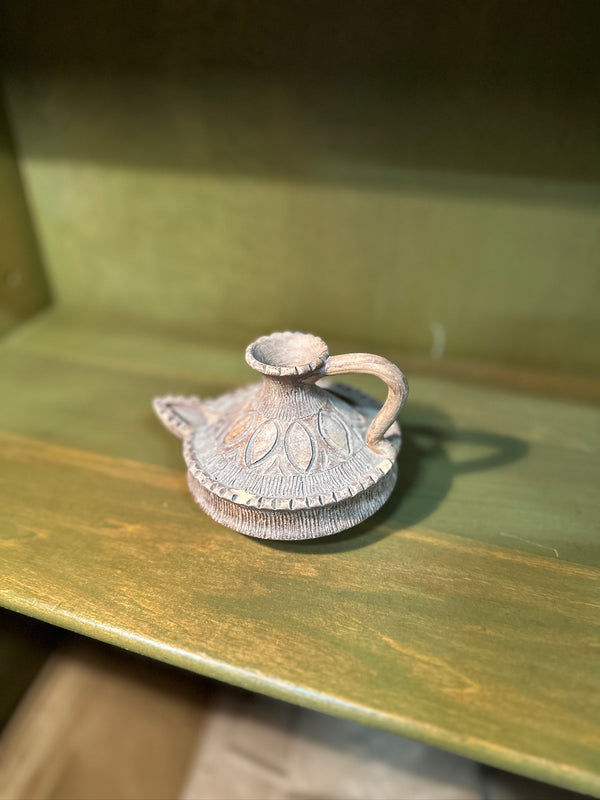
A small waisted pewter vessel, cast in one piece, standing on a felted base. The lower body is a cylinder carrying a relief frieze in panels, each panel divided from the next by a narrow pilaster of acanthus scrollwork. Above it the wall draws in through a deep waist and opens again into a wide flared socket. The proportions are compact and top-heavy in a deliberate way, with the mass at the foot and the eye pulled up the curve to the rim.
The frieze carries two scenes. In the first, a woman rides sidesaddle in a Hardanger bridal crown, her horse led by a man playing a fiddle as he walks, with a stave church spire rising behind them and figures in bunad standing along the road. In the second, a rowing boat crosses open water crowded with wedding guests, oars out, one figure standing with arms raised at the centre of the boat. The two panels are the two halves of the same journey, over land and over water.
The finish is the traditional one for Norwegian relief pewter: the recesses darkened almost to black and the raised surfaces left bright, so that at this scale the figures read clearly instead of dissolving into grey. The neck and rim are turned smooth and have taken a soft polish. Inside the socket the metal is torn and there is an open void beside the central boss, and the maker's mark is stamped on that boss.
History & Provenance
The scene is Brudeferden i Hardanger, the Bridal Procession on the Hardangerfjord, and it is the most recognisable image in Norwegian art. Hans Gude and Adolph Tidemand painted it together in 1848. The two had met in Hardanger in 1843, both trained at the Kunstakademie in Düsseldorf, and they worked the picture up over the winter of 1847 and 1848: Gude, then twenty-three, painted the fjord and the mountains, and Tidemand, a decade older, painted the wedding party. The original hangs in the National Gallery in Oslo, which acquired it in 1895, and the two men went on to make at least five versions of the subject around 1850.
What the painting did was fix an image of Norway for Norwegians. It arrived at the height of romantic nationalism, when a country still in union with Sweden was assembling a picture of itself out of its own landscape, its own dress and its own music, and it has been reproduced ever since on everything from banknotes and stamps to the sides of small pewter objects like this one. A maker putting the bride and the fiddler on a candle holder in the twentieth century was not inventing a decoration; he was quoting the national picture, and every Norwegian buyer knew it on sight.
The mark stamped inside the socket reads NORSK TINN, Norwegian for Norwegian pewter, around a small shield device. The device does not resolve clearly enough to attribute the workshop and no maker is claimed here.
The dating rests on the object rather than the image, since the image has been in use since 1848. The cast one-piece body, the blackened relief against burnished high points, the turned neck and the felted base all match Norwegian relief pewter documented to the 1950s and 1960s, of which the best known are the Mastad Pewter candle holders of closely comparable size and construction. The mark is in Norwegian rather than an English export legend, and there is no barcode, printed label or moulded country line anywhere on the piece, all of which carry a ceiling only. On that evidence it is offered as c. 1950–1975.
Product Details
| Era | Vintage, offered as c. 1950–1975 on construction evidence |
| Origin | Norway |
| Material | Pewter |
| Marks | NORSK TINN around a shield device, stamped inside the socket. The shield does not resolve and no maker is claimed |
| Decoration | Cast relief frieze of the Hardanger bridal procession, after the 1848 painting by Hans Gude and Adolph Tidemand; acanthus scroll pilasters between panels; blackened recesses against burnished relief |
| Form | Waisted candle holder with a flared socket; felted underside |
| Dimensions | Approx. 3 3/4 in. high; approx. 2 in. across the base |
| Condition | Sound and stable on its base, with the frieze crisp and fully legible. Inside the socket the metal is torn and an open void sits beside the central boss. Surface scratching and handling marks to the neck and rim, and light spotting to the pewter. Offered as a decorative object; it is not represented as fit to burn a candle. |
| Quantity | One, as shown |
Why It Belongs in Your Home
Small objects have to earn their place by rewarding a close look, and this one does. From across a room it is a compact grey shape with a good curve. From a foot away it is a fiddler, a bride in a crown, a stave church and a boat full of people, all of it legible at under four inches. That gap between what it looks like and what it contains is the whole pleasure of it.
Pewter sits well with almost everything, because it is a warm grey rather than a cold one and it does not compete the way silver does. Put it on a bookshelf, a desk, a bathroom ledge or in a cabinet with other small metal, and it will hold a taper, a few stems of something dried, or nothing at all with equal conviction.
Every piece is packed with professional-grade materials: multiple foam layers, double-boxing, directional and fragile handling labels. For large furniture we use custom timber crating. We photograph packing before dispatch and can provide images on request.
White-glove delivery is complimentary within 100 miles of Reno, NV. National shipping quotes provided at checkout. All shipments are photographed and documented. Damage claims must be filed with the carrier; we provide all documentation needed to support your claim.
Local pickup is available at Viridian HQ (Reno, NV) with 2–4 days notice. Contact us to arrange. Private viewings also available.
All antique and vintage items are sold as described and all sales are final. Each listing includes detailed condition notes and photographs so you can make a fully informed decision. We encourage buyers to ask questions — about condition, dimensions, finish, provenance — before purchasing.
Antiques are irreplaceable and one-of-a-kind. Carrier handling is outside our control once a piece has left our facility, and major carriers including FedEx do not insure antiques. We do everything within our power to ensure safe transit, but cannot accept liability for carrier damage. If damage occurs in transit, we will provide full documentation to support your carrier claim.
Have a question? — we're happy to provide additional photos, condition detail, or discuss the piece directly.